WeeklyWatch – Market twists and turns – the ups and downs

22nd July 2025
Stock Take
Are rising markets here to stay?
The FTSE 100 broke the 9,000 barrier last week, meaning that it reached a new record high. And across the pond, US markets also enjoyed positive results despite the lows they endured in early April; investor confidence in US assets has returned.
2025 has been quite the rollercoaster ride for markets. As it stands, current trajectories are on the up, but can investors confidently put their faith in continuing highs, or is there another twist in the tracks to come?
Onwards and upwards for the UK?
To date this year, the FTSE 100 has made significant gains of more than 10%. After hitting its record high of 9,016 last Tuesday, it’s fallen back slightly to 8,986 at the time of writing.
One of the main reasons for this success is down to the companies that make up the index – including big banking names, like HSBC and Lloyds Banking Group, and the defence sector, which includes BAE Systems. Strong earnings growth across these two sectors has subsequently been a driving force in the FTSE 100’s success.
Additionally, the rally has also been boosted by mining and commodity stocks and the rallying of the price of copper. Overall, this indicates that the market is battling through the noise that’s been created by the US tariffs and has adopted a more positive approach.
One of the lesser-known factors that has also contributed to the index’s success is the companies that have launched share buyback programmes in the last few months in order to increase their values or improve their balance sheet. Since December 2024, the UK has been outpacing the US in share buybacks, as a percentage of market cap. Moreover, mergers and acquisitions are also on the rise. These combined factors are helping underpin a strong UK stock market.
Is the budget a bump in the track?
Despite the positivity, there’s a need for caution. The UK’s budget gap is becoming more of a problem – one that’s been compounded by government U-turns on welfare spending.
Recent reports revealed that the government was considering selling cryptocurrency confiscated from scam investment schemes to try and raise £5 billion for the coffers.
Regardless of whether this happens, tax rises in the Autumn Budget look pretty certain. So, are we anticipating a gloomier outlook than hoped? Tax rises will undoubtedly have some kind of impact on consumer confidence, which could even extend to investor sentiment, yet there are still strong reasons to remain positive about the UK.
One significant reason is that the UK market has been underperforming for a while, meaning that it’s less expensive compared to the US market and has better opportunities for value and growth. As mentioned above, earnings growth has shown great strength across large cap companies. Numerous experts also think the same is the case for smaller and mid-cap companies.
Investment Specialist at St. James’s Place Nina Stanojevic believes that UK equities are “increasingly catching the attention of investors”. This is down to a combination of excellent valuations, strong earnings potential and proven market resilience. She says:
“Valuations remain among the most depressed globally – both in absolute terms and relative to historical levels. This means they offer one of the most attractive valuation tailwinds in developed markets.”
Most companies within the FTSE 100 also have great exposure to international markets as 70%–75% of revenues is generated overseas. Additionally, this shows that the index is far less reliant on the domestic economy when it comes to performance and is resilient to possible downturns.
Stanojevic adds:
“The UK’s high international revenue exposure, coupled with robust dividend yields, supports not only strong global earnings growth potential but also income resilience.
“And from a portfolio perspective, UK equities also offer investors valuable diversification benefits.”
Dips and rises for the US
It would be an understatement to say that US markets have had a rollercoaster of a year. At the beginning of 2025, the S&P 500 started at around 6,000 and plunged to 19% below its peak at the start of April on the back of Trump’s Liberation Day of tariff declarations.
Since then, there has been a steady rise, with only small falls affecting the upwards trajectory. At the time of writing, the index stood at 6,296.
To showcase the extent of how up and down the US markets can be: investors withdrew more than $51 billion in assets from the US in April – the largest monthly foreign outflow from the US in five years.
Last Thursday, the US Treasury released data that revealed the direction of travel had reversed. In May, a whopping $319 billion of foreign investment went into the US – a new record by a margin of $60 billion. $146 billion of inflows was received by US treasuries and US equities benefitted by $114 billion.
Is shaky confidence in the US warranted?
Investor confidence may have rallied, but clouds still loom on the horizon– in particular, the latest global tariffs announced by Trump that are coming into place on 1st August. Many nations are scrambling to agree on deals before the deadline, but time is quickly running out.
The Equity Strategist at St. James’s Place, Carlota Estragues Lopez, says:
“While the markets may be expecting Trump to back down on tariffs in some way, there is no guarantee of this. The impact of tariffs is still very uncertain and that introduces fragility into US earnings.”
She highlights the fact that US companies citing tariffs in their Q2 earnings calls is at an all-time high. She adds:
“We need more visibility on the impact of tariffs on US company earnings to assess whether the S&P 500 rally is backed by strong fundamentals.”
Company profits could be negatively impacted by higher tariffs, which could additionally increase inflation as businesses will look to push costs on to customers.
An awkward curve in the rails
Over the course of the decade, US equities have significantly outperformed international equities – boosted by the very high relative valuations of US companies. More specifically, returns have been fuelled by the Magnificent 7 technology companies.
But the outcome has resulted in a big concentration risk. Around two-thirds of global equities now sit in the US – a huge increase over the last decade. The top 10 stocks in the US make up over a third of the US stock market, which is the highest concentration in six decades.
Lopez states that the high valuations of US companies, concentration issue and the uncertain macroeconomic backdrop makes for a risky picture for investors as they try to plan ahead:
“Given elevated starting valuations, US equities appear to offer more downside risk than upside over the medium term. We cannot foresee when the US exceptionalism narrative will peak, but it is unlikely that it will grow from its current 70% weighting to closer to 100%, or a larger dominance of global equity indices.
“In contrast, given cheap valuations in the UK, there is a lot more room for upside surprises because there are lower expectations attached.”
The Federal Open Market Committee suggest that the US will likely see economic growth of 1.4% for 2025 (compared to GDP growth of 2.8% recorded in 2024). However, US job data published earlier in the month showed better than expected numbers – 147,000 jobs were added in June.
It’s widely expected that the Federal Reserve will cut interest rates sooner than expected, which could help the S&P 500 strengthen even more before the end of the year.
While there’s no crystal ball that can tell us exactly what the future entails, such as what will happen in the ongoing Middle East conflict and subsequent geopolitical instability. Only one thing is certain, and that’s more volatility.
Wealth Check
Be the boss of your business growth
Finances and funding are essential if you want to successfully grow your business. The CEO of business growth advisory at Elephants Child, Martin Brown, addresses some of the important questions that business owners have put forward regarding this topic. (Where the opinions of third parties are offered, these may not necessarily reflect those of St. James’s Place.)
The UK economy relies on small and medium-sized enterprises (SMEs) – they represent over 99% of all businesses.1 So how do we ensure that we continue to fuel the growth of these smaller but essential businesses?
If a business wants to scale up, careful strategic investment and funding are required. Whichever funding source you choose, lenders will need to see a robust business plan in place. By having one, you’ll maximise the chance of securing the funds you need.
- How much will you need?
The amount you require will depend on your sector, goals and growth stage. A typical UK SME tends to require between £50,000 and £250,000 to fund expansion operations, invest in tech, increase staff numbers or break into new markets. High-growth start-ups in sectors like fintech or health tech will usually require more – upwards of £1 million for product development and market impact.
- Where can you find the capital?
You can seek out the more traditional options, including bank loans and government-backed schemes like the British Business Bank’s Start Up Loans or the Recovery Loan Scheme. If you’re looking to get more flexible funding, you can consider venture capital, angel investors or equity crowdfunding platforms. Additionally, asset-based lending and invoice financing can be helpful with short-term cash flow.
Personal loans, credit cards and support from family and friends are a common way for business owners to get started. If you’re a newer, fast-growing business, you may look to explore grant funding, particularly in innovation-heavy sectors. Organisations like Innovate UK offer non-dilutive grants for R&D activities. This is a kind of funding that doesn’t require the business to give up any equity or share of ownership. And accelerators and growth hubs provide region-specific support and advice.
A solid business plan, realistic financial projections and a clear growth strategy will be the best way to ensure that you secure funding. Whether you’re increasing team numbers or launching new products, having the correct funding can vastly increase your chance of success. This means aligning funding to the need and having a clear understanding of the numbers.
- Should I take out a loan, seek investors or self-fund?
How you fund your SME’s growth is a pivotal decision and is dependent on your business goals, risk tolerance and financial situation.
- Loans – These provide quick access to capital without giving up ownership. If you have a steady cash flow and want to maintain control, this is a good choice. But you must bear in mind that you’ll need to manage repayments and interest – your growth plan must therefore support future revenue.
What are they best for? Stable businesses that need capital to scale operations or assets.
- Seeking investors – Equity funding from high-net-worth individuals, angel investors, venture capitalists or crowdfunding platforms can inject significant growth capital and strategic guidance. Repaying the funds won’t be required, but you’ll give up a share of ownership and decision-making authority. High-growth, scalable businesses looking to move quickly are well-suited for this option.
What are they best for? Start-ups or SMEs in high-growth sectors like tech or biotech.
- Self-funding – This is also known as ‘bootstrapping’ and uses personal savings or reinvested profits, allowing for full control and avoiding debt or dilution. But this option limits growth speed and can pressurise your finances.
What are they best for? Early-stage businesses with modest capital needs and founders willing to take a financial risk.
No size fits all when it comes to business funding. It’s important that you consider your growth timeline, risk tolerance and control preferences. Hybrid approaches (combining self-funding with loans or investment) usually offer the best balance. Securing that first “lead’ investor is a critical moment.
An unlikely first option for raising finance is seeking funding from angel investors, venture capitalists or crowdfunding, as conditions are attached by the fund managers for any agreement that’s reached. By their nature, these will be more onerous than those imposed by a mainstream lender.
Source
1Gov.uk October 2024
In the Picture
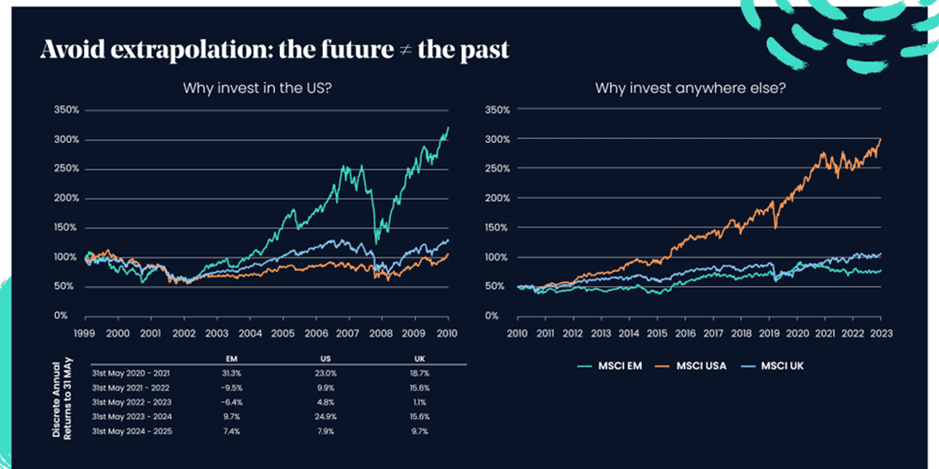
As US equities continue to recover and even reach new record highs in recent weeks, it’s easy to assume that the usual US market dominance will return.
But you don’t have to cast your mind too far back to see that past performance isn’t the determiner of future results.
The chart below shows that in the first 10 years of the 21st Century, emerging markets were the main characters in the growth story. US equities were pretty flat over this same time period. But between 2010 and 2023, US equities really soared and significantly outperformed emerging markets.
We can’t know for certain what will happen over the next few years, especially given the current volatile geopolitical environment and economic pressure the US is facing.
Past performance is not a reliable indicator of future performance.
Please note it is not possible to invest directly into s financial index and the figures shown do not take into account any charges applicable to the appropriate investment wrapper or any relevant tax charges.
The value of an investment with St. James’s Place will be directly linked to the performance of the funds you select and the value can therefore go down as well as up. You may get back less than you invested.
The information contained is correct as at the date of the article. The information contained does not constitute investment advice and is not intended to state, indicate or imply that current or past results are indicative of future results or expectations. Where the opinions of third parties are offered, these may not necessarily reflect those of St. James’s Place.
Source: London Stock Exchange Group plc and its group undertakings (collectively, the “LSE Group”). ©LSE Group 2025. FTSE Russell is a trading name of certain of the LSE Group companies.
“FTSE Russell®” is a trademark of the relevant LSE Group companies and is used by any other LSE Group company under license. All rights in the FTSE Russell indexes or data vest in the relevant LSE Group company which owns the index or the data. Neither LSE Group nor its licensors accept any liability for any errors or omissions in the indexes or data and no party may rely on any indexes or data contained in this communication. No further distribution of data from the LSE Group is permitted without the relevant LSE Group company’s express written consent. The LSE Group does not promote, sponsor or endorse the content of this communication.
© S&P Dow Jones LLC 2025; all rights reserved.
Source: MSCI. MSCI makes no express or implied warranties or representations and shall have no liability whatsoever with respect to any MSCI data contained herein. The MSCI data may not be further redistributed or used as a basis for other indices or any securities or financial products. This report is not approved, endorsed, reviewed or produced by MSCI. None of the MSCI data is intended to constitute investment advice or a recommendation to make (or refrain from making) any kind of investment decision and may not be relied on as such.
SJP Approved 21/07/2025