WeeklyWatch – Trade deals reached – more nations sign up!

29th July 2025
Stock Take
Indices vs tariffs
A new week – and more new record highs have been reached around the globe for multiple indices, as national leaders have worked hard to shelter themselves from the looming threat of the US tariffs.
Japan beats the deadline
The deadline continues to count down to 1st August when the tariffs are due to be introduced, and negotiations surrounding them have been making the headlines once again. Japan signed a trade deal on Wednesday, which includes a 15% tariff on imports from Japan – a significant improvement from the original 25% tariff that imports from Asian nations were facing. As well as a reduction in the tariff, the deal also included a $550 billion investment package from Japan into the US.
This helped boost the Nikkei, with many Japanese shares seeing a rise following the announcement. Car manufacturers Toyota and Honda were some of the biggest beneficiaries of the news, as their shares rose by around 10%.
The index was up by 4.1% by the end of the week, but it was too little too late when it came to Japan’s 20th July Upper House election. The event resulted in Prime Minister Shigeru Ishiba and his ruling coalition losing control of the Upper House and populist opposition parties making important gains. Despite the setback, Ishiba has remained resolute that he’ll remain in power as he looks ahead to overseeing the agreed Japan–US trade deal play out.
The EU also strikes a deal
As the weekend unfolded, the EU also reached a trade agreement with the US, securing a 15% tariff – half the threatened 30% if a deal wasn’t reached. Additionally, the deal will reportedly involve Europe spending hundreds of billions on US energy and arms, plus an investment of $600 billion into the US.
Even though European stocks closed before the trade deal was announced, they still managed to finish the week with a slight increase, although some automakers slumped.
Global sign-ups
Indonesia and the Philippines have also secured trade deals with the US – and at a lower rate after the deal comes into force. Overall, international markets were encouraged by the progress being made on a wider scale.
Small caps on the rise
Following the recovery from Liberation Day, news has been centred mostly on large companies, many of which are now trading at historic highs. This was illustrated by Nvidia’s recent success as it became the first company in history to achieve a market cap of $4 trillion.
However, some of the biggest winners of the year to date have been small cap companies (smaller companies) outside of the US. As a group, these companies have managed to outperform even the US large caps in the year to date.
The Equity Strategist at St. James’s Place, Carlota Estragues Lopez, said:
“International small caps have benefited from positive macroeconomic sentiment from interest rate cuts in several developed market economies, the prospect of fiscal stimulus in Germany and business reforms in Japan. Smaller companies tend to be more sensitive to interest rates and domestic economic conditions.”
An exception to this is within the US itself, where smaller companies experienced overflows when the initial tariff announcements were made and the fear of recession scared the markets. Moreover, the Federal Reserve’s hesitancy to cut interest rates in comparison to Europe has also had an impact.
With the US small caps not in favour at the moment and the large caps mostly recovered, there’s an extremely wide valuation gap between the two groups in comparison to past results. However, this could present an intriguing investment opportunity…
How is the UK faring?
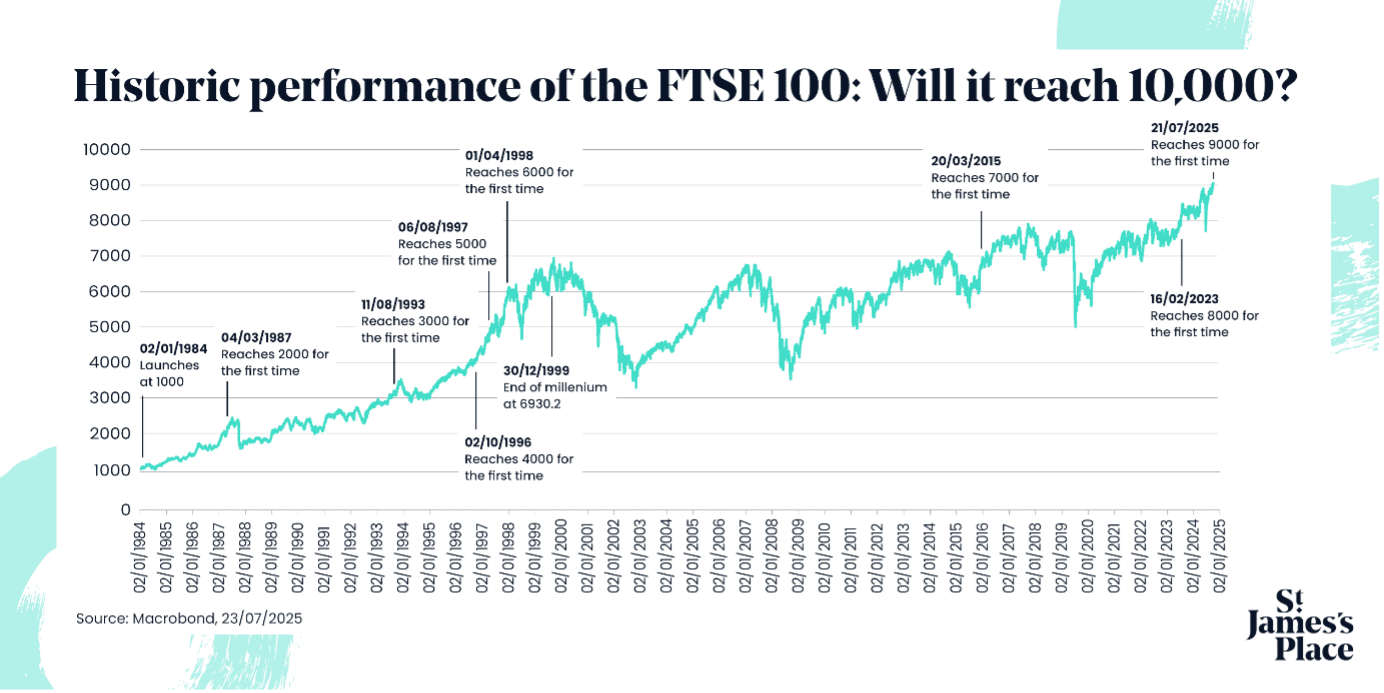
It’s still good news for the FTSE 100! The index remained above the 9,000 mark as companies continued to benefit from their strong results.
The Office for National Statistics revealed on Friday that the June heatwave boosted UK retail figures by 0.9% in June – encouraging news following the 2.8% drop in May. And with a tax rise announcement in the Autumn Budget looking increasingly likely, Chancellor Rachel Reeves will breathe a small sigh of relief to see more promising activity in the UK consumer base. But it’s worth remembering that June’s 2025 figures are still down compared to pre-pandemic levels.
Are the good times here to stay?
Uncertainty still remains around Trump’s international trade policies but despite this, equities have made great progress and broken into record territory in recent weeks.
Nations that have signed deals with the US are still facing pretty hefty tariffs, giving rise to the question: why did markets drop significantly after the Liberation Day announcement, but are now seemingly able to take tariffs somewhat in their stride?
Estragues Lopez suggests:
“The back and forth has impacted policy credibility as anticipated tariffs were scaled back. The initial panic has been replaced by renewed investor optimism on hopes of trade deals being made. In addition, earnings have remained robust and even beating expectations in some sectors such as Communication Services, Technology and Financials.”
Wealth Check
Beating the 60% tax trap
The average UK salary currently stands at £37,500.1 So earning £100,000 should feel more comfortable, but it’s often not the case. Even though wages have been rising gradually, personal tax thresholds have been frozen since April 2021. Consequently, more people are reaching the higher tax band and falling into the 60% tax trap.
But wait, you might be thinking, a 60% tax band doesn’t exist. While it isn’t an official band, if your income lies between £100,000 and £125,140, the complexities of the UK tax system come into play…
What is the 60% tax trap?
Income tax is charged at 0%, 20%, 40% or 45%, depending on your income amount. Scotland rates differ slightly.
You’re entitled to a £12,750 personal allowance as a basic rate taxpayer – this is the amount of income you can receive each year without paying Income Tax. When your income is £100,000 or more, the personal allowance is reduced or tapers off.
The allowance tapers down at a rate of £1 for every £2 of income above £100,000 currently. For example, for every £100 of income between £100,000 and £125,140, the Income Tax deduction is £40 and another £20 is lost by the tapering of the personal allowance. Additionally, employee National Insurance (NI) is paid at 2% on the income – in total, this comes to a 60% tax rate, plus NI – a real double jeopardy…
When your income stands at £125,140 or more, you become an additional rate taxpayer and the allowance is lost – 45% tax is paid as a result.
Beat the tax, use your pension
Bringing your taxable income below the threshold can be achieved through putting more money into your pension before the tax year-end. Simple, quick and a win-win – you’ll reduce your tax bill and also increase your retirement fund.
For example, if you receive a £1,000 pay rise or bonus that takes your taxable income to £101,000, if you put that £1,000 straight into your pension, you’ll avoid the 60% tax zone, plus you’ll receive the benefit of a 40% top-up on your contribution as a result of pension tax relief for higher rate taxpayers.
The annual pension allowance does put a limit on these tax benefits. £60,000 is the current standard annual allowance but can be lower for higher earners. However, it’s possible to ‘carry forward’ any unused allowance from the three previous tax years. Tax relief on personal contributions is limited to a maximum of 100% of earnings in the tax year that you make the contributions.
If you find yourself just over one of the tax bands, contributing more to your pension can reduce your tax in several ways. As whatever you add to your pension reduces your taxable income and receives tax relief, we highly recommend putting in as much money as you can afford.
Are you facing a 60% tax bill, or want to find out more? Get in touch with our financial advisors today.
The value of an investment with St. James’s Place will be directly linked to the performance of the funds selected and may fall as well as rise. You may get back less than the amount invested.
The levels and bases of taxation, and reliefs from taxation, can change at any time and are generally dependent on individual circumstances.
Any tax relief over the basic rate is claimed via your annual tax return.
Source
1Statistica, average annual earnings for full time employees 2024.
In the Picture
Breaking 9,000 – the latest big accomplishment of the FTSE 100. The dot.com bubble, 2008 financial crisis and 2020 pandemic – shares have certainly taken a battering over the years. But the time gap between 8,000 and 9,000 was under 30 months… So, what’s next in store for the FTSE 100?
Past performance is not indicative of future performance.
The information contained is correct as at the date of the article. The information contained does not constitute investment advice and is not intended to state, indicate or imply that current or past results are indicative of future results or expectations. Where the opinions of third parties are offered, these may not necessarily reflect those of St. James’s Place.
Source: London Stock Exchange Group plc and its group undertakings (collectively, the “LSE Group”). ©LSE Group 2025. FTSE Russell is a trading name of certain of the LSE Group companies.
“FTSE Russell®” is a trademark of the relevant LSE Group companies and is used by any other LSE Group company under license. All rights in the FTSE Russell indexes or data vest in the relevant LSE Group company which owns the index or the data. Neither LSE Group nor its licensors accept any liability for any errors or omissions in the indexes or data and no party may rely on any indexes or data contained in this communication. No further distribution of data from the LSE Group is permitted without the relevant LSE Group company’s express written consent. The LSE Group does not promote, sponsor or endorse the content of this communication.
© S&P Dow Jones LLC 2025; all rights reserved.
Source: MSCI. MSCI makes no express or implied warranties or representations and shall have no liability whatsoever with respect to any MSCI data contained herein. The MSCI data may not be further redistributed or used as a basis for other indices or any securities or financial products. This report is not approved, endorsed, reviewed or produced by MSCI. None of the MSCI data is intended to constitute investment advice or a recommendation to make (or refrain from making) any kind of investment decision and may not be relied on as such.
SJP Approved 28/07/2025