WeeklyWatch – Tariffs are a go!

5th August 2025
Stock Take
It’s tariff time
Markets were pushed lower last week as the 1st August tariff deadline arrived. Several nations managed to beat the deadline and secure a deal with the US. The UK signed one much earlier, with a 10% tariff being imposed on most British exports.
A deal has also been signed between the EU and the US, where they’ll face a 15% tariff; yet this has been met with controversy across the continent and still requires signing off by several EU member states. Japan and South Korea’s agreed deals also mean that they will face a 15% tariff.
But now that the deadline has passed, there are still numerous nations that are facing more punitive measures…
- Canadian goods that aren’t covered by the US-Mexico-Canada Trade Agreement will get a 35% tariff when exporting to the US.
- Swiss imports will face a 39% tariff.
- Even though Mexico received a 90-day extension on their deadline, if no deal is agreed upon, their tariffs could reach 30%.
- Brazil originally faced a 10% tariff, but last Thursday, an extra 40% was added to many industries, including beef and coffee exports.
- China’s negotiations with the US continue – their current deadline comes up later this month.
The Chief Economist at St. James’s Place, Hetal Mehta, says that from an economic perspective, the tariffs are a “lose-lose” situation. She states:
“Ultimately US consumers will face higher prices because of them. On the exporter side, what they sell will be more expensive and therefore less competitive.”
While markets processed the situation, there was a drop in global share prices – not quite as severe as April levels, but significant all the same. The S&P 500 concluded the week at a drop of 2.36%.
Cranking up the inflationary pressure
Even before Trump was sworn in as President, many economists expressed concern towards the implementation of tariffs and the increased inflationary pressure it would put on the US and the knock-on effect that this would have on consumers.
They were shielded from much of the initial impact as a result of companies stockpiling goods before the tariffs came into effect. But these stockpiles could only last for a limited time, and in more recent months, inflationary pressures have started to weigh on the data.
The US Commerce Department’s Bureau of Economic Analysis have said that the personal consumption expenditures (PCE) price index was 2.6% for June – this is the highest number since February. Additionally, it marked a third consecutive month where the number had increased.
The PCE price index is used by the Federal Reserve (the Fed) to help inform decision-making regarding interest rates. And with continued increases in inflation, it was hardly surprising when no changes were made last Thursday.
However, there were some noteworthy moments that came from the meeting. One of these was the two dissents to the vote – they voted in favour of a 0.25% cut. This is a first since 1993 and served as an example of how challenging a position the Fed is in right now.
Comments made by Fed chair Jerome Powell following the release caught the attention of the markets. He stated:
“We have made no decisions about September. We don’t…do that in advance.”
While the Fed remains uncertain about their future stance, markets have begun to price out and plan for an interest rate drop in September when the next decision will take place.
An economic slowdown for the US?
News of the Fed’s decision not to change interest rates stayed in the spotlight for approximately a day before other economic news entered the picture.
On Friday, the most recently released payroll data suggested that the US job market was starting to soften. Only 73,000 nonfarm jobs were recorded and added to July by the Bureau of Labor Statistics. The figures for the number of jobs added in May and June are also significantly reduced, dropping in May from 125,000 to 19,000 and in June from 147,000 to 14,000.
Uneven GDP growth across the year has also contributed to the Fed’s complications in its decision-making.
On an initial look, the figures that were released in the previous week appear positive: a growth of 3% was registered over the second quarter (annualised). But, on closer inspection, there’s a different tale to tell. The growth followed a 0.5% decrease in Q1. Moreover, over the first half of 2025, US economic activity expanded only by 1.2% annualised – the first half of 2024’s increase was 2.3%.
Much of the growth in the last quarter was as a result of a drop in imports into the US. GDP growth is calculated by removing imports from the total to avoid double counting. And in Q1, the large increase of imports as a result of stockpiling consequently brought down the overall rate of GDP growth. When Q2 came round, companies were sitting on a surplus of goods – with tariffs starting to nip at the heels – and import levels decreased significantly, which boosted GDP growth into positive territory.
In her comments regarding the figures, Mehta says:
“If you strip out the trade side of it, what you see is that consumer spending has taken a step down from where it was. This also ties in with the cooling jobs market as well and interest rates staying elevated.”
Considering both the job data and the consumer spending, it suggests that the US economy is slowing down.
Wealth Check
How comfortably do you want to live in retirement?
Whether you’re planning to retire in 5 years or 20, it’s essential to have an idea of how much money you’ll require to live comfortably once your regular earning comes to an end.
The Pensions and Lifetime Savings Association (PLSA) have crunched the numbers and released new figures on how much money individuals and couples require in order to live a comfortable, moderate or minimum standard of living during their retirement.
The most important thing to bear in mind is that figures have increased over the last 12 months and will continue to do so as the cost of living continues to go up. The latest numbers were released in February this year.
- Minimum – A single person requires £13,400 a year in order to achieve the minimum living standard, which will cover most people’s basic needs. You could take a holiday in the UK, eat out around once a month and spend £450 on clothes and footwear per year. However, you can’t expect to run a car. Even with the 2025/2026 full State Pension – £11,973 per year – there’s still a shortfall.
- Moderate – This lifestyle requires £31,700 and is a more financially secure and enjoyable option. With this lifestyle, you could afford a two-week European holiday, eat out a couple of times a month and own and run a small car.
- Comfortable – £43,900 is required for this level of retirement lifestyle. You can enjoy further luxuries and higher ticket items, including regular beauty treatments, theatre trips and at least two weeks of holiday in Europe plus a couple of weekend mini breaks each year.
For couples, the price tag of these three lifestyles is £21,600, £43,900 and £60,000 per annum.1
Pension realities
There will be many who’ll be shocked to find out that their savings will provide little income and will worry that they left it too late to start saving.
If you qualify for the full annual State Pension, the PLSA says you’ll need to amass a pension pot of between £540,000 and £800,000 (for a single person) in order to achieve a comfortable retirement.2 If you want to turn your pension into an annuity, this will pay you a guaranteed annual income for life during your retirement.
By combining the full State Pension and a workplace pension, many will be able to look forward to the PLSA’s minimum level of retirement. But even with a modest contribution, it’s unlikely to cross over the line of minimum and moderate levels of living in retirement. Beginning to plan proactively at an early stage to set yourself up for your later years can literally pay dividends.
The value of an investment with St. James’s Place will be directly linked to the performance of the funds selected and may fall as well as rise. You may get back less than the amount invested.
Source:
1, 2 Retirement Living Standards, Pensions and Lifetime Savings Association, 2025. All figures quoted were developed by the Centre for Research in Social Policy at Loughborough University on behalf of the PLSA.
In the Picture
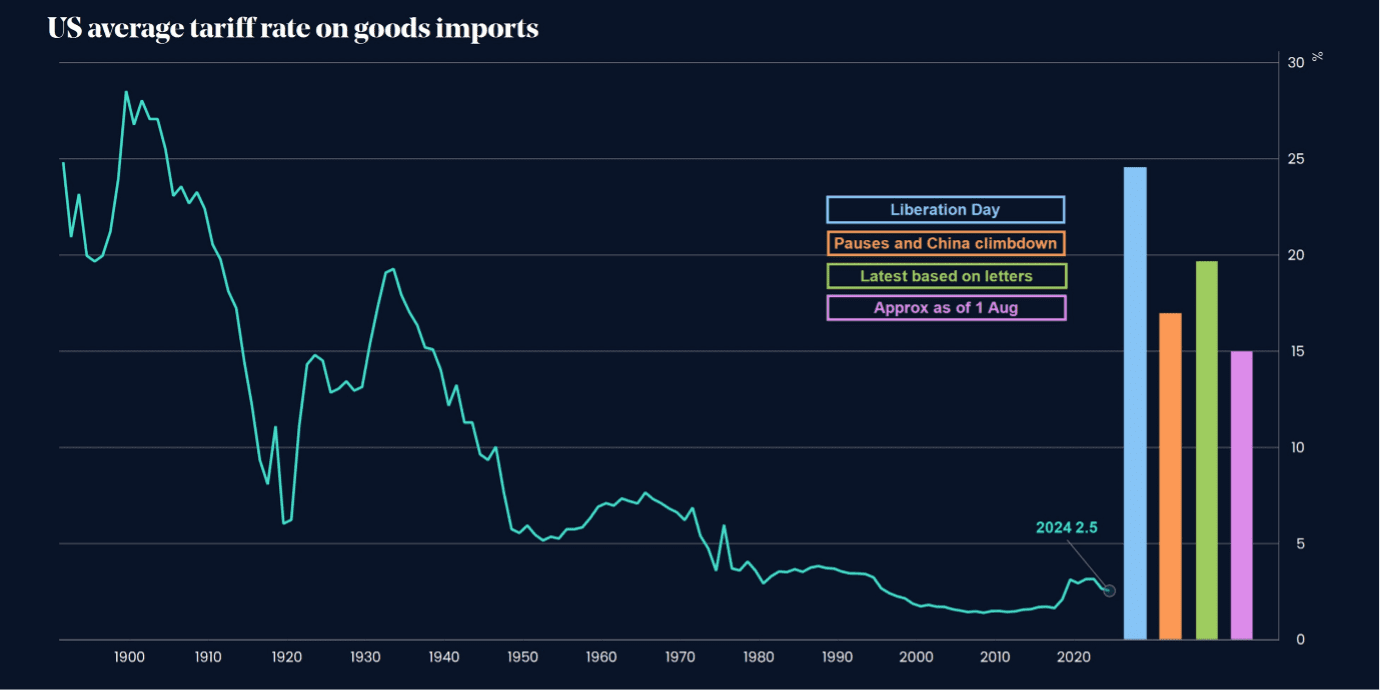
The tariffs may be lower than previously threatened in the earlier part of 2025, but following the August announcements, they’re still significantly above levels seen over the last few decades.
The information contained is correct as at the date of the article. The information contained does not constitute investment advice and is not intended to state, indicate or imply that current or past results are indicative of future results or expectations. Where the opinions of third parties are offered, these may not necessarily reflect those of St. James’s Place.
Source: London Stock Exchange Group plc and its group undertakings (collectively, the “LSE Group”). ©LSE Group 2025. FTSE Russell is a trading name of certain of the LSE Group companies.
“FTSE Russell®” is a trademark of the relevant LSE Group companies and is used by any other LSE Group company under license. All rights in the FTSE Russell indexes or data vest in the relevant LSE Group company which owns the index or the data. Neither LSE Group nor its licensors accept any liability for any errors or omissions in the indexes or data and no party may rely on any indexes or data contained in this communication. No further distribution of data from the LSE Group is permitted without the relevant LSE Group company’s express written consent. The LSE Group does not promote, sponsor or endorse the content of this communication.
© S&P Dow Jones LLC 2025; all rights reserved.
Source: MSCI. MSCI makes no express or implied warranties or representations and shall have no liability whatsoever with respect to any MSCI data contained herein. The MSCI data may not be further redistributed or used as a basis for other indices or any securities or financial products. This report is not approved, endorsed, reviewed or produced by MSCI. None of the MSCI data is intended to constitute investment advice or a recommendation to make (or refrain from making) any kind of investment decision and may not be relied on as such.
SJP Approved 04/08/2025