WeeklyWatch – Peak season for US earnings

12th August 2025
Stock Take
US markets reach summit heights
Over the last few weeks, US second-quarter earnings have been in the spotlight, as the greatest number of companies reported in the two weeks leading up to mid-August. But with trade wars escalating, causing further volatility and uncertainty, and indications of deteriorating economic data – what are the main takeaways?
Earnings season is a key barometer of how US-listed companies – large and small – are performing, with details of their operational and financial environment, and assessment of their performance on ‘Main Street’ and in overseas markets. It’s also when companies provide guidance on prospects.
So far, approximately 80% of companies in the S&P 500 index have reported increased sales and earnings in Q2 when compared to the same period in 2024 (this is according to Factset’s financial data).
These positive earnings surprises were dominated by the strong performance of the ‘Magnificent 7’ companies, including in the communication, information technology and consumer discretionary sectors. Together, the Magnificent 7 account for over a third of the S&P 500’s total value – this is a near three-fold increase over the course of the last decade. Even though tech results were the dominant force, the financial sector has performed well and delivered strong earnings which have been boosted by the higher-for-longer interest rate environment in addition to the market volatility spurring on trading income.
A strong tech season
Sharp divergence remains in Q2 returns between the Magnificent 7 mega-cap technology companies and the remainder of the index – showcased in this week’s ‘In the Picture’. Tech-associated companies account for more than half of the US stock market’s value. The defensive sector has fallen to less than 20%.
Tech companies have outperformed due to the high demand for investing in cloud computing and AI infrastructure, as well as a resurgence in digital advertising. During the latest earnings season, these companies have been putting forward positive, upbeat outlooks. Several have opted to raise their full-year 2025 sales forecasts, which has alleviated concerns that demand for AI services is slowing down – despite the possibility that economic growth will falter. Additionally, for some, they’re projecting improvements in profit margins and indicating continuous productivity gains.
Broader market struggles to keep pace
Unlike the strong-performing tech stocks, the broader market (‘the S&P 493’) faced more of a struggle throughout Q2…
- They faced much slower consumer demand, especially for non-essential items like holidays, dining out, cars, furniture and appliances.
- With lower demand, there were higher levels of unsold goods. This could lead to discounting and more cuts in production.
- The US dollar has been weaker than other currencies since the start of 2025, leading to the increased price of raw materials.
- The volatility caused by tariffs has caused the business environment to deteriorate.
Weakened oil prices and energy sector
The weakest earnings generated during Q2 was by the energy sector. A 21% decline in oil prices in the 12 months leading up to June 2025 was the main cause of this. The materials sector, engaged in extracting and processing raw materials like iron and copper ore, was also a poor performer. As a result, more analysts are predicting that global economic growth will slow down in 2026.
Scaling the ‘wall of worry’
According to the London Stock Exchange, Q2 earnings for S&P 500 companies have grown by nearly 8% every year. Since volatility caused by the April announcement of the ‘Liberation Day’ tariffs, the index has since recovered all lost ground and is now close to its all-time high.
The Head of Discretionary Fund Management Research at St. James’s Place, Peter McLoughlin, says that investors are showing willingness to climb ‘the wall of worry’ as more positive momentum keeps building for the AI revolution and is looking to maintain a strong course. He says:
“Earnings have once again exceeded expectations – this is the third consecutive quarter of double-digit EPS growth, and current guidance suggests a high degree of resilience despite tariff concerns.”
However, he urged some caution. US government debt continues to grow at a rapid rate and currently stands at $37 trillion. McLoughlin also alludes to a deteriorating macro picture including rising unemployment and the weaker dollar value. Additionally, inflation pressures continue to mount and the trade war continues to disrupt businesses and create further margin pressures – due to the fact that not all of the extra tariff costs are currently being passed on. This was underlined further by analysts with key issues outlined by company managements being tariffs, uncertainty, inflation and recession.
Markets over the week
There was a stark recovery by the US markets from the previous week’s sell-off, as all key US indices concluded the week higher. Nasdaq led the way by closing at a record high which was boosted by Apple’s double returns. Most investors weren’t as bothered by the latest tariff announcements that took place, partly because the US administration is being more flexible on exceptions for key domestic sectors.
For Europe, major markets also ended the weak with a boost. Positive sentiment towards talks to end the war in Ukraine played a big part in this. However, despite the optimism, the FTSE 100 didn’t make much progress, even with the 0.25% interest rate cut. It’s response was likely a result of the weaker jobs market, even with the Bank of England predicting that inflation will likely rise to 4% in September: a two-year high.
Wealth Check
Investing – it’s all about doing (almost) nothing
Most investors are encouraged to go by the wise action of ‘blocking out the noise’. Situations come and go and may cause volatility as they’re seen through. Over the long-term, ignoring short-term impact and keeping your eye on your ultimate financial goals is the key to achieving what you set out to do.
However, 2025 has proven to be a challenging year (to say the least!), which has made it difficult to hold steady.
Live and unfolding
Once, international trade negotiations were found predominantly in financial outlets. Currently, it’s tariff discussions that are flooding the front pages of the newspapers and social media feeds.
As a result of the spike in inflation and rise of interest rates post-Covid, central banks have become part of the national conversation in a way that’s never been seen before. For example, when was the last time you saw a disagreement between a US president and the head of the Federal Reserve regarding interest rate changes go viral?
Another addition to the pressure is the news cycle that’s on 24 hours a day. With tech advancements, you can watch a news story break, develop and also see immediate investment reaction. Therefore, it requires a lot of effort to resist what can often feel like a bombardment of information, good or bad.
Filtering through assorted information
One of the challenging aspects to this is understanding what’s a useful insight and what’s background noise.
A key consideration for investors is to look at their investment time horizon. If it’s a long-term horizon, i.e. 10 years or more, then the majority of events won’t significantly impact your plans longer term. It’s important to remember that over the long run, companies can grow their earnings ahead of inflation, and reinvest those earnings to grow their businesses and pay dividends to their shareholders. As time goes on, the compound impact of that is what dominates returns.
The Investment Research Director at St. James’s Place, Joe Wiggins, said:
“If we look back through history, there’s been a multitude of huge events that have affected markets in the short-term. At the time, they would have seemed extremely consequential for financial markets. But as you zoom out to a longer time frame, these events usually end up looking like a blip on the horizon. So, providing you have a long-term time horizon, most things are not that consequential for meeting your objectives. The real problem is reacting to these events and making poor short-term decisions that then have a negative, long-term impact.”
The value of an investment with St. James’s Place will be directly linked to the performance of the funds selected and may fall as well as rise. You may get back less than the amount invested.
In the Picture
The chart below shows how the earnings gap between the ‘Magnificent 7’ tech companies and the broader market has grown as Q2 earnings season has unfolded.
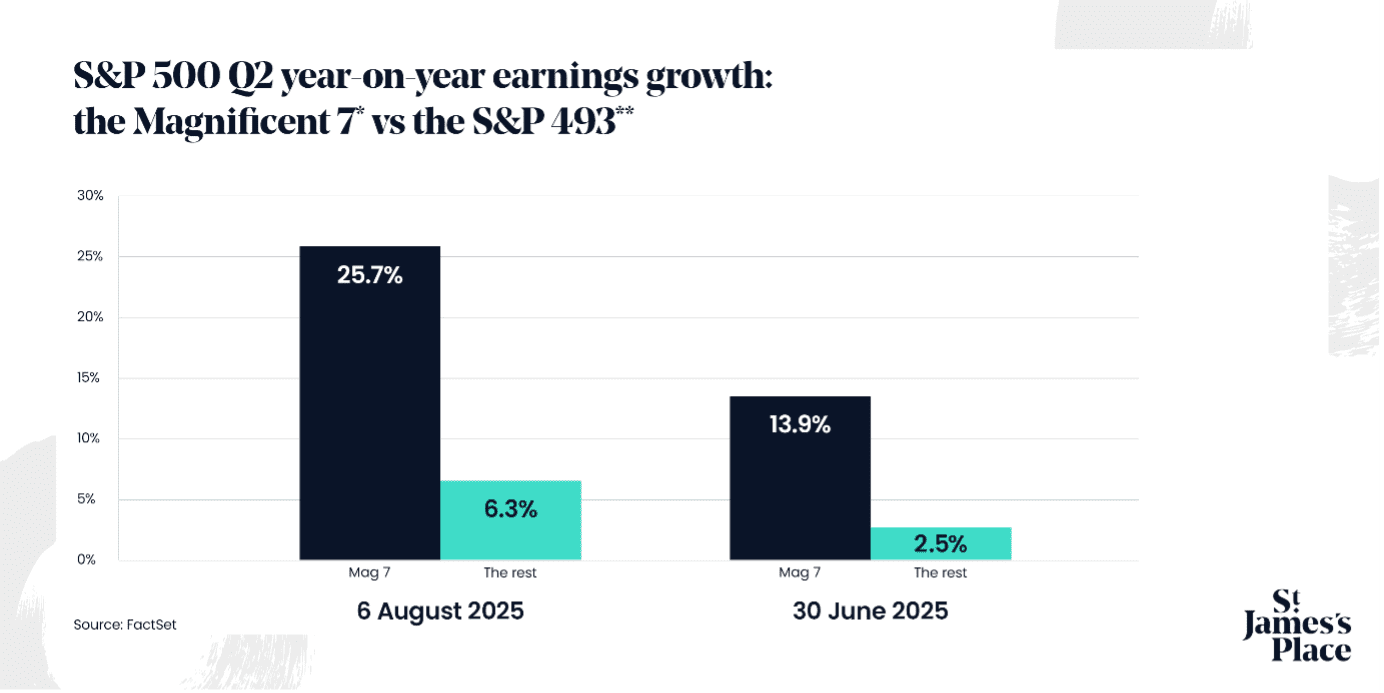
*The Magnificent Seven is the name given to a group of seven mega-cap technology companies. These are: Apple, Amazon, Alphabet, Meta Platforms, Microsoft, Nvidia and Tesla.
** The S&P 493 refers to the S&P 500 without the Magnificent 7.
Past performance is not indicative of future performance.
The information contained is correct as at the date of the article. The information contained does not constitute investment advice and is not intended to state, indicate or imply that current or past results are indicative of future results or expectations. Where the opinions of third parties are offered, these may not necessarily reflect those of St. James’s Place.
Source: London Stock Exchange Group plc and its group undertakings (collectively, the “LSE Group”). ©LSE Group 2025. FTSE Russell is a trading name of certain of the LSE Group companies.
“FTSE Russell®” is a trademark of the relevant LSE Group companies and is used by any other LSE Group company under license. All rights in the FTSE Russell indexes or data vest in the relevant LSE Group company which owns the index or the data. Neither LSE Group nor its licensors accept any liability for any errors or omissions in the indexes or data and no party may rely on any indexes or data contained in this communication. No further distribution of data from the LSE Group is permitted without the relevant LSE Group company’s express written consent. The LSE Group does not promote, sponsor or endorse the content of this communication.
© S&P Dow Jones LLC 2025; all rights reserved.
Source: MSCI. MSCI makes no express or implied warranties or representations and shall have no liability whatsoever with respect to any MSCI data contained herein. The MSCI data may not be further redistributed or used as a basis for other indices or any securities or financial products. This report is not approved, endorsed, reviewed or produced by MSCI. None of the MSCI data is intended to constitute investment advice or a recommendation to make (or refrain from making) any kind of investment decision and may not be relied on as such.
SJP Approved 11/08/2025