WeeklyWatch – How will markets react to Ukraine peace talks?

19th August 2025
Stock Take
Is peace in Ukraine on the horizon?
Yesterday, talks continued in Washington – between President Trump and President Zelenskyy this time as they looked to try and end the war in Ukraine. They came off the back of the weekend talks between President Trump and President Putin, focused on agreeing a ceasefire.
While the outcome remains uncertain, the markets have responded in a mixed fashion. After Friday’s Alaska meeting, there was a slight decrease in oil prices. It was a quiet start to the week for European equities, whereas Asian markets concluded the week higher.
Since the start of the conflict in 2022, the markets have faced significant impact. And looking ahead, the picture could alter again. So what can investors expect?
Market highs and lows
One of the most immediate effects of the invasion was the soaring cost of energy, which had a huge impact on businesses and consumers. This also caused a rise in inflation, which was already high due to countries applying fiscal stimulus measures as a response to the Covid pandemic. To begin with, markets sold off – particularly in Europe, where fears of a prolonged recession were heightened. This was reflective of the geographical proximity to Russia and the long-standing trade links existing between them. There was a fall of almost 4% for the Stoxx 600 and the tech-heavy Nasdaq fell by 3.2%. There was a sharp drop in US Treasury yields (which move in the opposite direction to prices) due to investors seeking safety in US government debt.
The Russo–Ukraine conflict is the largest seen in Europe since WWII and has also been the most costly – in terms of lives and expenditure – and has had a huge influence on the markets. The defence sector growth has increased, and there have been record profits for the big five oil companies (BP, Shell, Chevron, ExxonMobile and TotalEnergies). Campaigning and investigation organisation Global Witness published a report in February this year, which stated that the world’s largest oil companies had made profits of $380 billion since the start of the war in 2022.
Fast forward 41 months, and the world seems to have settled into a ‘new normal’ wherein global volatility has come to be widely expected.
Equities
Following the invasion, global equities were sold off, which was particularly prevalent across Europe. This was due to the fact that Europe was very dependent on cheap Russian gas to power households and businesses. For Germany, the ‘industrial powerhouse’ of Europe, there was an initial fall of 5% for the DAX 40 index. The index already faced struggles such as an ageing population and issues with infrastructure; the Ukraine conflict only piled more pressure on an economy that was stagnating.
Recovery was noticeable towards the end of 2022, and since then, global equity markets have, for the most part, been on an upwards trajectory, as noted by Will Hargreaves, Multi-Asset Analyst at St. James’s Place. He states:
“The real shock for markets came at the start of the conflict, with energy prices spiking violently in the early months of the invasion due to supply fears. However, they then trended downwards as global demand for Russian supplies was re-routed.
“Following the invasion, global equities sank to the lowest point in October 2022. However, they’ve been on an upwards trajectory since. Long-term growth is good and equities have delivered – albeit there are variations in performance.”
He adds:
“Developed markets have continued to outpace emerging markets quite substantially. In terms of geographical regions, Japanese equities outperformed all other areas in local currency terms. The US followed, while the UK just outperformed Europe over this time.”
Record highs have been reached by both the S&P 500 and the FTSE100 this year. In July, for the first time in its 41-year history, the FTSE100 passed the 9,000 mark.
Yesterday, Japanese and Taiwanese shares concluded at record highs. There’s been a boost to Japanese shares on the back of a bullish corporate outlook, a calmer assessment of the tariff backdrop and the continuing weakness of the yen. For domestic automakers, exports have been helped by this. Additionally, investors in Taiwan have been encouraged by this outlook as it relates to the tech sector and a more positive tariff assessment.
Energy
The global energy sector was impacted significantly by the invasion. There was a quick and steep spike in the price of oil, natural gas and coal – a near 300% price rise for natural gas and approximately 30% price increase in the cost of Brent crude oil which reached $139 per barrel.
As a result, market volatility became widespread with energy prices reaching their peak in August 2022; these gradually fell back as more nations looked to diversify their energy supply in order to be less reliant on Russian gas. But this wasn’t the case for many European nations and across the UK, where energy prices remain significantly higher than they were prior to the start of the conflict.
The Equity Strategist at St James’s Place, Carlota Estragues Lopez, says:
“The most important sectoral impact of the invasion was on energy prices. But, on the positive side, there have been some structural changes as a result of that invasion.
“Europe has realised the risks of being over-reliant on external energy suppliers so are looking to become more self-sufficient, investing in their own energy infrastructure.”
There’s been a refreshed focus on the significance of renewable energy, as nations also look to diversify their energy usage and move away from fossil fuel reliance. The International Energy Agency (IEA) note that this is an emerging global pattern as national awareness grows and countries look to ensure that they have secure energy supplies and systems in place. In one of their website papers, the IEA state:
“The war continues to reshape the global energy system in profound ways. Trade patterns for oil and natural gas have shifted dramatically since Russia’s invasion as governments look to strengthen their energy security. At the same time, cleaner alternatives to fossil fuels are growing faster than ever.”
Defence
This sector has had some of the most notable growth since the start of the Ukraine conflict and the changing geopolitical climate.
The UK has also made a commitment to increasing defence spending to 2.5% of GDP by 2027 and then up again to 3% of GDP by 2030.
Germany made a pledge in June this year to increase their defence budget to 3.5% of GDP by 2029. The nation plans to spend $781 billion on defence in the next five years. By providing a huge boost to its defence sector, leaders also hope that these actions will significantly spur economic growth and breathe life back into its economy.
Estragues Lopez notes:
“Industrial earnings in Europe – especially in the defence sector – have been buoyed by a surge in defence spending following the invasion. Companies such as Rheinmetall and BAE Systems are experiencing record demand. Meanwhile, NATO has committed to raising defence budgets significantly by 2035.”
Technology
Over the last 41 months, growth in developed markets has largely been driven by the AI boom. This has been most noticeable in the US where the Magnificent 7 tech companies make up around a third of the S&P 500 by market capitalisation – these include Alphabet, Amazon, Apple, Meta, Microsoft, Nvidia and Tesla.
The S&P 500 is up 10% for the year to date, and much of this growth is down to the Magnificent 7. According to Pantheon Macroeconomics, increased spending on AI and other related infrastructure is estimated to have added 0.5% to US economic growth in the first half of 2025.
With US tech companies being so dominant, it’s meant that growth stocks outperformed value stocks and large caps outperformed small caps over the period.
However, questions linger over whether the tech and AI success can continue… Valuations of US companies, particularly technology, are regarded as very high. Having said this, only if demand remains strong can this be justified – so far, this is proving to be the case.
Hargreaves emphasises the need for investors to consider the fundamentals amid the noise. He states:
“AI is not a fleeting theme, it’s here to stay. If you look at the Magnificent 7, especially a company like NVIDIA, it’s a really strong business. The fundamentals are solid even though their valuations are high.”
Gold
Regarded as a ‘safe haven’ during times of turmoil, investors once again reverted to gold as their safety measure as prices spiked at the start of the invasion. In just the first few hours of the attack, gold prices rose to their highest levels in more than a year – $1,973 per ounce. But the main cause of the gold drive was a result of the central banks rushing to buy up stocks in the short-term aftermath of the invasion – a practice that has continued to the present day.
The World Gold Council identifies that central banks have purchased more than 1,000 tonnes of gold per year in the three years that the Ukraine conflict has been going on for. Gold prices have more than doubled in price during this time and at the time of writing, gold prices stand at $3,346 per ounce.
Where do markets go from here?
At the Alaskan summit, Trump and Putin failed to make a deal. The outcome of talks between Zelenskyy and Trump is yet to be determined – although, Trump said that he had called Putin to arrange bilateral talks between the Russian leader and Zelenskyy. Russia are demanding that Ukraine concede land so that the war may come to an end, so the situation continues to look volatile.
But no matter what the outcome may be, most experts anticipate that markets will be muted in their reaction.
Estragues Lopez says:
“The invasion sparked a sharp inflationary shock, largely driven by energy prices, and equity markets plunged sharply in the weeks that followed. The S&P 500 fell approximately 20%. Since then, markets have largely stabilised and shown reduced sensitivity to the ongoing war. This parallels earlier episodes like trade-tariff shocks, where initial panic gave way to a return to ‘business as usual’.
“Markets tend to respond more to fundamentals with enduring impact rather than headline noise. Central banks still have major influence. When the Fed signals a rate cut, markets typically react. Today, investors remain especially focused on monetary policy guidance, labour market dynamics and economic indicators.”
Investors have faced much volatility in different forms this year, and will likely continue to filter out the noise and focus on the fundamentals no matter what the outcome is in regard to the Ukraine conflict.
In the Picture
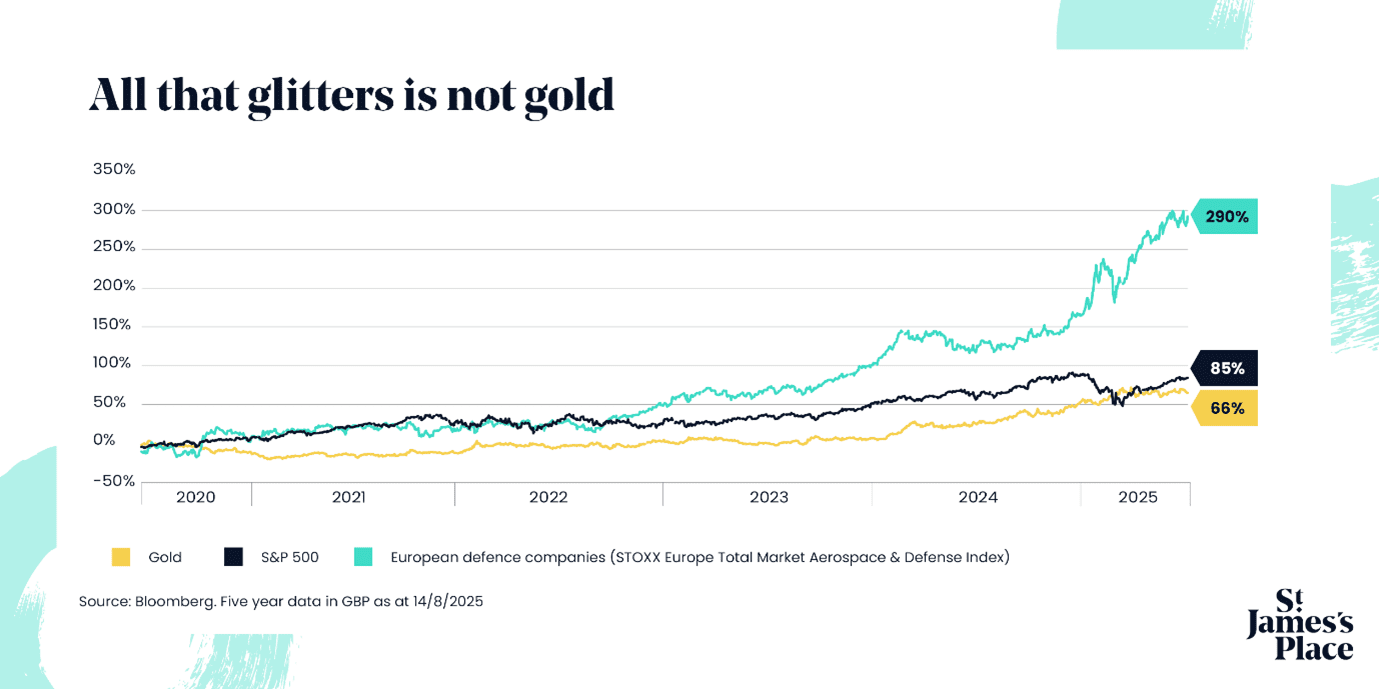
When volatility rolls around, gold remains a safe haven for investors. Currently, the precious metal is less than 5% off its all-time high. This highlights the issues of ongoing inflation, geopolitics and central bank buying. The clear winner on a relative basis is Europe’s defence sector in the aftermath of Russia’s invasion of Ukraine – its growth is noticeable on the chart below. Gold has lagged in comparison and is struggling against the US S&P 500.
The information contained is correct as at the date of the article. The information contained does not constitute investment advice and is not intended to state, indicate or imply that current or past results are indicative of future results or expectations. Where the opinions of third parties are offered, these may not necessarily reflect those of St. James’s Place.
Source: London Stock Exchange Group plc and its group undertakings (collectively, the “LSE Group”). ©LSE Group 2025. FTSE Russell is a trading name of certain of the LSE Group companies.
“FTSE Russell®” is a trademark of the relevant LSE Group companies and is used by any other LSE Group company under license. All rights in the FTSE Russell indexes or data vest in the relevant LSE Group company which owns the index or the data. Neither LSE Group nor its licensors accept any liability for any errors or omissions in the indexes or data and no party may rely on any indexes or data contained in this communication. No further distribution of data from the LSE Group is permitted without the relevant LSE Group company’s express written consent. The LSE Group does not promote, sponsor or endorse the content of this communication.
© S&P Dow Jones LLC 2025; all rights reserved.
Source: MSCI. MSCI makes no express or implied warranties or representations and shall have no liability whatsoever with respect to any MSCI data contained herein. The MSCI data may not be further redistributed or used as a basis for other indices or any securities or financial products. This report is not approved, endorsed, reviewed or produced by MSCI. None of the MSCI data is intended to constitute investment advice or a recommendation to make (or refrain from making) any kind of investment decision and may not be relied on as such.
SJP Approved 18/08/2025