WeeklyWatch – First Fed rate chop of 2025

23rd September 2025
Stock Take
Rate cuts and risk management in the US
Last week, the Federal Reserve cut interest rates for the first time this year. In a widely expected move, the US central bank opted to lower its key lending rate by 0.25% – a move often referred to as dovish.
The US equity market index, the S&P 500, as well as the tech-focused Nasdaq Composite index both hit record highs at the end of the week – boosted in part by expectations of two further rate cuts before the year ends.
The Fed operates under a dual mandate: to maintain price stability (i.e. target an inflation rate of 2%), while also, unusually, safeguarding maximum employment. This differs from many other central banks, such as the Bank of England, which typically focus solely on price stability.
Juggling employment and inflation is challenging given the Fed only has one tool (interest rates) to control both responsibilities, meaning it’s often forced to prioritise. At present, the Fed faces slowing job growth, while inflation remains above its 2% target and higher than a year ago.
The Fed called its rate decision a ‘risk-management cut’. Investors have taken this to mean that supporting the job market is now the priority, even if inflation stays high. Fed chair Jerome Powell pointed to tariffs and tighter immigration policies as key pressures on employment. The recent downward revision to annual job creation figures, alongside weaker-than-expected employment data, featured in the central bank’s calculations to cut interest rates.
Greg Venizelos, Fixed Income Strategist at St. James’s Place, emphasised this risk-management stance:
“Post-Covid, the Fed was late to raise interest rates. Remember when they described inflation as being ‘transitory’ during the pandemic? What we are seeing now is the US central bank being more proactive regarding possible problems in its jobs market. Even so, they are cutting rates as economic growth forecasts for the global (and US) economies are being raised. US equity valuations have also been increasing.”
The underlying concern is that a weakening jobs market could undermine consumer confidence and consumption, threatening the broader economy. The Fed now faces a conundrum: while cutting rates may support employment, it may cause reputational damage if inflation remains high and the job market fails to rebound.
The UK holds steady
In contrast to the Fed, the Bank of England (BoE) chose to hold interest rates last week. At 3.8%, UK inflation remains persistently above the UK central bank’s 2% target, driven in large part by the food and housing rental market sectors, as well as wage growth. Even so, it maintained its guidance that future rate cuts will be ‘gradual and careful’. Notably – unlike the US – the BoE has already lowered rates four times since last November.
Despite domestic inflation remaining above target, weakness in the domestic job market is a growing concern. Similarly to the US, there are risks that job market conditions could deteriorate further.
The BoE also announced a slowdown in its programme of bond (also known as gilt) sales, reducing the annual target from £100 billion to £70 billion. This process, known as quantitative tightening (QT), is the reverse of quantitative easing. Easing the pace of QT is expected to deliver several benefits, including greater support for gilt prices. Since bond prices and yields move in opposite directions, many analysts expect this adjustment to help reduce some of the upward pressure on bond yields and the cost of servicing the government’s debt.
Global markets react to Fed cut
The US smaller companies Russell 2000 index and Dow Jones joined the S&P 500 and Nasdaq 100 in hitting record highs during the week following the Fed’s rate cut. A range of other assets also rose – including gold, silver and the US dollar. US 10-year bond yields edged higher (with prices falling), while oil prices also fell. Meanwhile, upbeat news around AI continued to make headlines, helping US mega-cap technology shares outperform the broader S&P 500.
In Europe, performance was more varied. The MSCI Europe ex UK benchmark posted modest gains, while the UK’s FTSE 100 and several other European indices retreated. The pound also slipped against the US dollar.
Asian emerging markets mostly rallied, but mainland Chinese equities fell after disappointing data on retail sales and industrial output. Japanese markets also ended the week in the red.
Wealth Check
UK house prices have surged over the last 20 years, but will the boom last? Many still expect values to keep climbing. Watch Alex Loydon of St. James’s Place and Karen Ward of JP Morgan Asset Management discuss whether those expectations are realistic here.
In the Picture
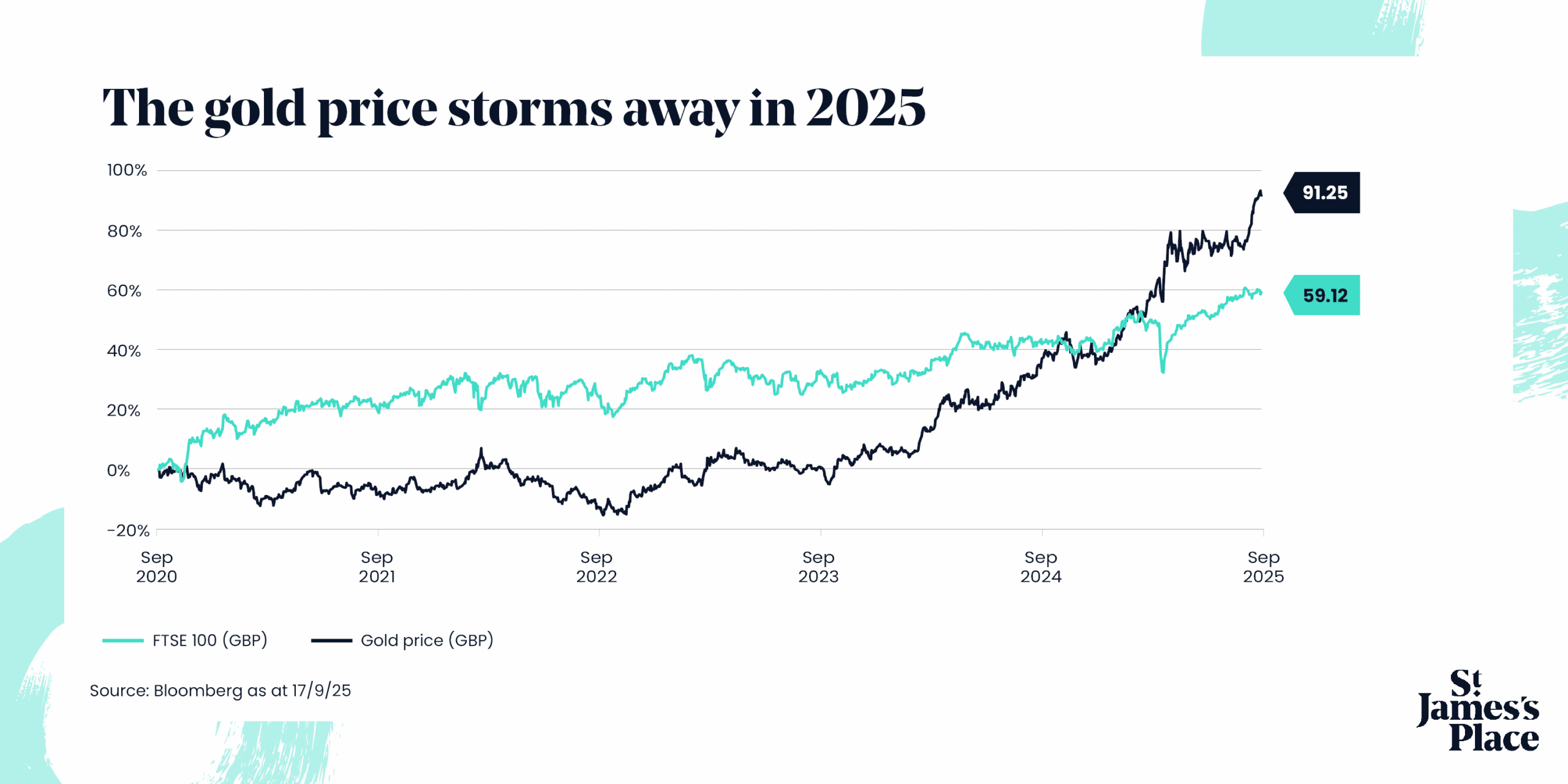
Gold is shining bright against the current market backdrop. Because it doesn’t pay interest, it often becomes more attractive when interest rates drop – reducing the opportunity cost of holding it versus other assets. At the same time, the weaker US dollar since the start of the year has made gold more affordable for international buyers. Global trade tensions are also playing a role in this ‘flight to safety’ as investors seek safe-haven assets.
The value of an investment with St. James’s Place will be directly linked to the performance of the funds selected and may fall as well as rise. You may get back less than the amount invested.
Past performance is not indicative of future performance.
The information contained is correct as at the date of the article. The information contained does not constitute investment advice and is not intended to state, indicate or imply that current or past results are indicative of future results or expectations. Where the opinions of third parties are offered, these may not necessarily reflect those of St. James’s Place.
Source: London Stock Exchange Group plc and its group undertakings (collectively, the “LSE Group”). ©LSE Group 2025. FTSE Russell is a trading name of certain of the LSE Group companies.
“FTSE Russell®” is a trademark of the relevant LSE Group companies and is used by any other LSE Group company under license. All rights in the FTSE Russell indexes or data vest in the relevant LSE Group company which owns the index or the data. Neither LSE Group nor its licensors accept any liability for any errors or omissions in the indexes or data and no party may rely on any indexes or data contained in this communication. No further distribution of data from the LSE Group is permitted without the relevant LSE Group company’s express written consent. The LSE Group does not promote, sponsor or endorse the content of this communication.
© S&P Dow Jones LLC 2025; all rights reserved
Source: MSCI. Certain information contained herein, including without limitation text, data, graphs, charts (collectively, the “Information”) is the copyrighted, trade secret, trademarked and/or proprietary property of MSCI Inc. or its subsidiaries (collectively, “MSCI”), or MSCI’s licensors, direct or indirect suppliers or any third party involved in making or compiling any Information (collectively, with MSCI, the “Information Providers”), is provided for informational purposes only, and may not be modified, reverse-engineered, reproduced, resold or redisseminated in whole or in part, without prior written consent.
Source: Bloomberg. BLOOMBERG®” and the Bloomberg indices listed herein (the “Indices”) are service marks of Bloomberg Finance L.P. and its affiliates, including Bloomberg Index Services Limited (“BISL”), the administrator of the Indices (collectively, “Bloomberg”) and have been licensed for use for certain purposes by the distributor hereof (the “Licensee”). Bloomberg is not affiliated with Licensee, and Bloomberg does not approve, endorse, review, or recommend the financial products named herein (the “Products”). Bloomberg does not guarantee the timeliness, accuracy, or completeness of any data or information relating to the Products.
SJP Approved 22/09/2025