WeeklyWatch – Earth’s core financial focus

14th October 2025
Stock Take
China’s mineral move shakes markets
9th October was a bad day for Nasdaq and the broader-based S&P 500, after they experienced their worst day’s performance in six months. The catalyst? China’s announcement on 8th October regarding their latest restrictions on exporting rare-earth minerals. It took less than a day for the US government to bite back, opting to impose an additional 100% tariff on all Chinese imports into the US, due to begin on 1st November.
Exporters in both China and the US are already impacted by some of the most far-reaching tariffs that have been seen in modern trade history. Back in August, the average US tariff on Chinese goods was 50%, with Chinese tariffs on US imports being 33%. If these latest tariffs come into force, Chinese imports will become prohibitively expensive.
However, by the time the weekend rolled around, President Trump had softened his stance, which left investors feeling hopeful for a rebound in US equities for the week coming. The Chief Economist at St. James’s Place, Hetal Mehta, says that even though there’s ongoing uncertainty as a result of the government shutdown and newly proposed tariffs, the prospect of a US recession has decreased. She links this to the recent actions of the US Federal Reserve to cut interest rates and ongoing government spending, adding:
“Still, we think it makes sense to remain more cautious and keep our recession probability assumption unchanged at 35% for the time being.”
Central to the debate
Rare-earth minerals – the name is somewhat misleading, as they’re not actually uncommon. They can be found worldwide; however, some reports indicate that China accounts for nearly 90% of global output. This is due to their extensive refining capabilities, which have been built up over decades, leading to many regarding the nation as having a strategic monopoly in this area.
These minerals are used in both civilian and defence industries and are particularly essential for chip manufacturing. They’re used in multiple ways for defence systems and everyday life, including smartphones, renewable energy systems and electric vehicles.
As part of their crackdown, China have also implemented the need for foreign companies to get government authorisation for some products. For international companies, this could make things rather difficult and may threaten the advancement of US artificial intelligence (AI) companies. Some experts speculate that it could potentially take the US and other Western governments years – maybe even decades – to create alternative supply chains.
AI facing an arms race
Supply issues aren’t the only challenge facing AI and chip companies… They tend not to look to the open market, rather focusing on securing multi-year deals that take equity and building partnerships to make sure that there’s continuity in their supply chains.
Leading industry player OpenAI recently secured deals worth $1 trillion with a wide range of chip makers in order to get long-term access to supplies of the latest high-powered semiconductors. In order to ‘train’ their computer models, these semiconductors are essential.
Despite the obvious benefits, these deals also have quite a big downside. AI tech is evolving quickly and long-term commitments to purchase specific chips could be more expensive for companies if better tech is invented. Additionally, chip companies that have a concentrated supply chain also face possible issues if components suddenly become inaccessible.
Japan on a positive climb
Turning away from minerals and AI, a look at the global markets saw a successful week for the Nikkei 225, closing 5% higher, which came as a welcome relief for global investors. After Sanae Takaichi was elected as the new leader of the Liberal Democratic Party – Japan’s ruling party – investors reacted positively. However, as the week continued, the hope that she would become the nation’s first female prime minister had diminished.
In the year to date, the Nikkei 225 has risen 21% in local currency terms. Japan’s negative real interest rates (i.e. inflation exceeding interest rates) have boosted the relative attractiveness of equities. Interest rates are expected to remain low due to Japan’s weakened economy and rising debt servicing costs on the nation’s debt.
Markets in summary
US treasury yields concluded the week lower (as bond prices moved higher). The demand for traditional ‘safe haven’ assets like US treasuries usually increases during periods of high uncertainty. The CBOE Volatility Index – Wall Street’s ‘fear index’ – saw a rise of 30%. Shares in Europe saw a drop on Friday as trade tensions increased between the US and China.
There was an easing in oil prices to a level that hasn’t been seen since ‘Liberation Day’ back in April, as China is the world’s second-largest consumer. Increased global production has also been a headwind. Gold ended the week edging close to an all-time high of $4,000/troy oz.
Wealth Check
UK party conferences – what’s been happening?
The last of the annual party conferences concluded last week, with the Conservatives finishing theirs in Manchester. Conferences are a key opportunity for the major parties to lay out and communicate their agenda to party members, the public and media ahead of the next Budget from Labour, due on 26th November. Below is a summary of some of the key announcements made by each party.
Labour
Keir Starmer declared that growth would be the ‘defining mission’ of his government. Despite this, he couldn’t rule out tax increases due to the changed global economic outlook over the last 12 months. This has fuelled further speculation that tax increases will be a big part of the upcoming Budget.
Liberal Democrats
Europe forms a key part of the Lib Dems’ economic agenda. The party have put forward the idea of a new customs union and even the possibility of the UK rejoining the EU. The party also would look to launch a ‘family farm test’ to oppose the upcoming changes to Inheritance Tax (IHT) liability for agricultural businesses. Additionally, they introduced the idea of a new tax to be levied on windfall profits made by banks.
Conservatives
Stamp duty put the Conservatives and leader Kemi Badenoch firmly in the spotlight when they announced that they would scrap it and VAT on private school fees, as well as banning doctors’ strikes. In a similar approach to the Lib Dems, the Tories also said they’d reverse proposed IHT on family farms.
The levels and bases of taxation, and reliefs from taxation, can change at any time. The value of any tax relief depends on individual circumstances.
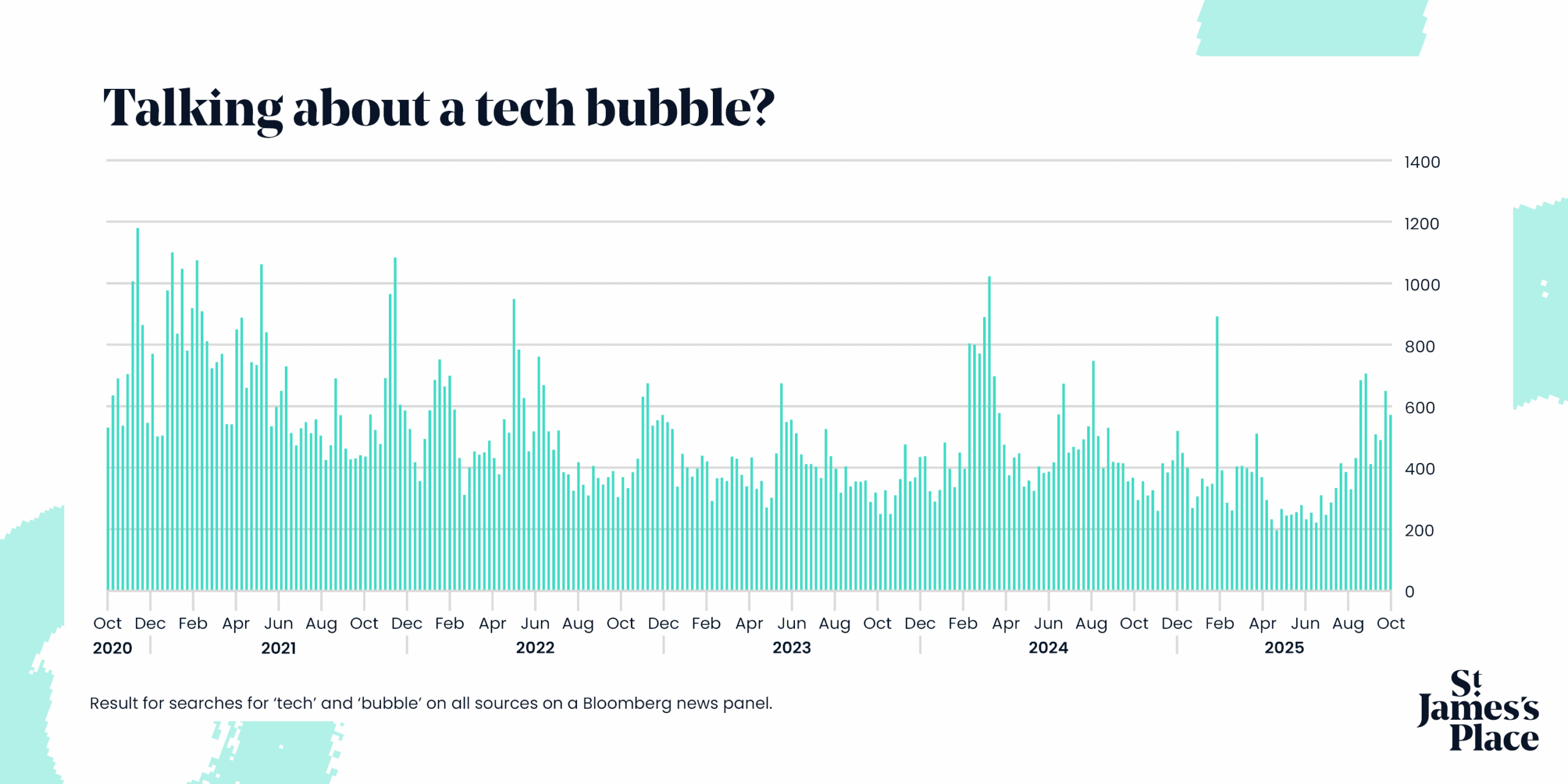
In the Picture
The phrase ‘tech bubble’ is being more commonly used by investors since the summer regarding their trading terminals. But it still remains below some of the recent highs.
The information contained is correct as at the date of the article. The information contained does not constitute investment advice and is not intended to state, indicate or imply that current or past results are indicative of future results or expectations. Where the opinions of third parties are offered, these may not necessarily reflect those of St. James’s Place.
Source: London Stock Exchange Group plc and its group undertakings (collectively, the “LSE Group”). ©LSE Group 2025. FTSE Russell is a trading name of certain of the LSE Group companies.
“FTSE Russell®” is a trademark of the relevant LSE Group companies and is used by any other LSE Group company under license. All rights in the FTSE Russell indexes or data vest in the relevant LSE Group company which owns the index or the data. Neither LSE Group nor its licensors accept any liability for any errors or omissions in the indexes or data and no party may rely on any indexes or data contained in this communication. No further distribution of data from the LSE Group is permitted without the relevant LSE Group company’s express written consent. The LSE Group does not promote, sponsor or endorse the content of this communication.
© S&P Dow Jones LLC 2025; all rights reserved.
Source: MSCI. MSCI makes no express or implied warranties or representations and shall have no liability whatsoever with respect to any MSCI data contained herein. The MSCI data may not be further redistributed or used as a basis for other indices or any securities or financial products. This report is not approved, endorsed, reviewed or produced by MSCI. None of the MSCI data is intended to constitute investment advice or a recommendation to make (or refrain from making) any kind of investment decision and may not be relied on as such.
SJP Approved 13/10/2025