WeeklyWatch – UK inflation not set to fall soon

21st October 2025
Stock Take
Is the UK economic picture improving?
The International Monetary Fund (IMF) has published a rare positive headline regarding the latest global outlook, forecasting the UK to be one of the fastest-growing economies in the G7. The IMF upgraded the UK growth outlook (GDP) for 2025, while the outlook for 2026 remains positive, but possibly not as high as previously hoped for. But has the wait been worthwhile?
On closer inspection, it’s still slim gains for the UK. Expected domestic annual real GDP growth (i.e. accounting for inflation) of 1.3% in 2025 and 2026 is only just ahead of the eurozone. It also falls behind the US GDP outlook.
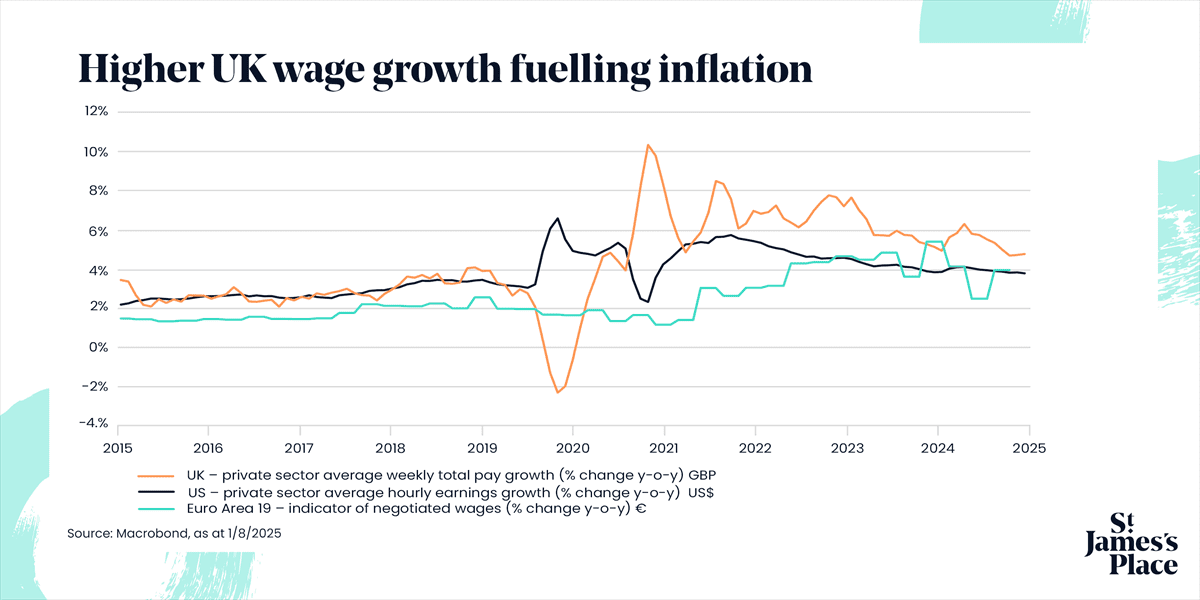
In another troubling turn, the UK unfortunately takes the top spot on the G7 table for inflation figures…and regular WeeklyWatch readers will know there are many reasons as to why this is the case. There was a sharp acceleration in UK wage growth after Brexit was ratified and following the pandemic. Currently, there are labour shortages across multiple sectors, including the NHS, social care and construction. One-off adjustments to some regulated household utility bills have taken place. Plus, last year’s budget saw an increase in employers’ National Insurance contributions, which has only put more upward pressure on UK inflation.
This week will see the Office for National Statistics publish their latest data. It’ll likely reveal that UK inflation reached a near two-year peak of 4% in September.
Compared to its peers, the UK is more vulnerable to higher wage growth, which in part is due to the persistent problem of low productivity. Domestic companies then face the challenge of being unable to offset higher wage demands or input prices by making more, meaning they’re unable to build up a buffer before higher costs can be passed on to consumers. US firms, on the other hand, were able to absorb some of the additional costs after the new tariffs were introduced earlier this year. This helped contain inflationary pressures.
The latest IMF update echoes what many commentators have been saying about the UK economy. If high wage pressure remains strong and productivity growth remains weak, the Bank of England won’t be keen to cut interest rates. However, the Chief Economist at St. James’s Place, Hetal Mehta, believes that despite the Bank of England’s focus on increased inflation in the short-term:
“Continual labour market weakness might create the opportunity for a pivot later on, allowing it to cut interest rates.”
Cockroach watch in the US
The US earnings season began last week, and it started rather well. Leading the way were investment banks, who produced impressive earnings and were supported by an easing interest environment and buoyant markets.
Bank returns are widely considered to be a useful measure of how the economy is performing overall, but it’s investment banks that have a closer link to financial markets. Trading desks, which buy and sell shares, bonds and other assets, performed very well. Additional successes were found in wealth management and mergers and acquisitions (M&A). Reports confirmed that US consumers and businesses were in a good place.
However, by the middle of the week, the mood had shifted. There was a fall in share prices of a few US regional banks (those more concerned with ‘Main St.’ rather than ‘Wall St.’) following reports of problem loans, some of which were allegedly fraudulent. Some of these issues were known to investors as a result of the recent bankruptcies of two companies: First Brands and Tricolor Holdings.
The resulting news fed the fear of more systemic issues in private credit markets. The ‘contagion’ and the resultant investor concern regarding pockets of weakness and fraud in US regional banks saw global markets fall. This led to a sell-off in the banking sector on Thursday, particularly for smaller banks. There was a partial recovery in sentiment, but analysts will continue to scrutinise the sector earnings releases as the week unfolds.
Discussing the apparent fraud in this area, the CEO of JP Morgan, Jamie Dimon, said:
“When you see one cockroach, there are probably more.”
As it stands, the problems are specific to individual banks and aren’t necessarily reflective of a sector-wide issue. Having said this, Dimon’s words imply an expectation of further issues coming to light.
Wealth Check
Beware the Budget rumours: why we shouldn’t try to predict the future
Following months of whispers and theories, Chancellor Rachel Reeves has confirmed what the vast majority were predicting: tax rises and spending cuts will be big features in the Autumn Budget.
A £30 billion fiscal black hole needs to be filled, and Reeves has been quoted as saying that wealthy people should shoulder more of the burden. But how this will be accomplished remains to be seen.
We’ve compiled some of the key themes below. As always, we advise that you wait to see what’s revealed on 26th November before you make any big financial decisions. Making moves based on hearsay or rumours can lead to unintended consequences.
Reform for pensions
There could be a potential reduction in the amount that can be withdrawn from pensions as tax-free cash. Additionally, there may be cuts to the tax relief on pension contributions or the implementation of a flat level of relief. Currently, basic rate taxpayers benefit from tax relief of 20% on pension contributions; it’s 40% for higher rate taxpayers and 45% for additional rate taxpayers.
Overhaul of property taxes
Property tax could replace stamp duty. It was reported in August that a national tax paid by owner-occupiers on properties worth more than £500,000 when they sell their home was being considered.
Council tax may be scrapped. Conversely, speculation has arisen that a new, higher council tax band will be put in place instead. Additionally, Capital Gains Tax could be applied to the sale of main homes above a particular value. Rental income may also have National Insurance applied to it as a way of targeting landlords.
Cash ISAs
Following the backlash, notions to cut the cash ISA allowance were shelved in July. But last week, renewed rumours carried the possibility that there may be a reduction as the government tries to encourage more people to invest in equities.
Inheritance Tax (IHT)
Currently, the period donors must live after making a substantial gift before it falls outside their estate for Inheritance Tax purposes is seven years – this could be increased to 10 years. Furthermore, there may be a potential lifetime cap on the value of gifts people can make that are free from IHT.
Focus on the here and now
It’s hard to predict the future, but it’s highly likely that some of the current Budget rumours in circulation won’t come to pass. A good question to ask yourself is: How would I feel if I took an action based on speculation of change which then didn’t come to pass and I found myself in a less beneficial position? Staying calm until the Budget is revealed and avoiding knee-jerk reactions is key.
The value of an investment with St. James’s Place will be directly linked to the performance of the funds selected and may fall as well as rise. You may get back less than the amount invested.
The levels and bases of taxation and reliefs from taxation can change at any time and are dependent on individual circumstances.
In the Picture
Longstanding weak UK productivity and the long-lasting effects of Brexit on the supply of labour have resulted in high domestic wage growth. It’s a significant reason for the expectations that the UK will have the highest inflation levels in the G7 for both 2025 and 2026.
The value of an investment with St. James’s Place will be directly linked to the performance of the funds selected and the value may fall as well as rise. You may get back less than the amount invested.
The levels and bases of taxation, and reliefs from taxation, can change at any time and are generally dependent on individual circumstances.
Past performance is not indicative of future performance.
The information contained is correct as at the date of the article. The information contained does not constitute investment advice and is not intended to state, indicate or imply that current or past results are indicative of future results or expectations. Where the opinions of third parties are offered, these may not necessarily reflect those of St. James’s Place.
Source: London Stock Exchange Group plc and its group undertakings (collectively, the “LSE Group”). ©LSE Group 2025. FTSE Russell is a trading name of certain of the LSE Group companies.
“FTSE Russell®” is a trademark of the relevant LSE Group companies and is used by any other LSE Group company under license. All rights in the FTSE Russell indexes or data vest in the relevant LSE Group company which owns the index or the data. Neither LSE Group nor its licensors accept any liability for any errors or omissions in the indexes or data and no party may rely on any indexes or data contained in this communication. No further distribution of data from the LSE Group is permitted without the relevant LSE Group company’s express written consent. The LSE Group does not promote, sponsor or endorse the content of this communication.
© S&P Dow Jones LLC 2025; all rights reserved.
Source: MSCI. MSCI makes no express or implied warranties or representations and shall have no liability whatsoever with respect to any MSCI data contained herein. The MSCI data may not be further redistributed or used as a basis for other indices or any securities or financial products. This report is not approved, endorsed, reviewed or produced by MSCI. None of the MSCI data is intended to constitute investment advice or a recommendation to make (or refrain from making) any kind of investment decision and may not be relied on as such.
SJP Approved 20/10/2025