WeeklyWatch – A golden week for inflation?

28th October 2025
Stock Take
Surprise inflation data
Investors and central bankers around the globe breathed a sigh of relief when last week’s inflation figures came in below expectations on both sides of the Atlantic.
The UK’s consumer price inflation (CPI) had been expected to rise slightly to 4% in September compared with the same month in 2024. Instead, it surprised many and stayed flat at 3.8% for a third consecutive month. There was even a slowdown in core inflation (which doesn’t include volatile price effects of food, alcohol and tobacco) compared to August, with a drop from 3.6% to 3.5%.
Even though the data has been well received by the markets, the figure still remains significantly higher than the 2% target set by the Bank of England (BoE).
The Fixed Income Strategist at St. James’s Place, Greg Venizelos, said:
“The figure we got was better than a disappointment, but the Bank of England cannot latch on to these figures and start rapidly cutting rates again because we are not quite there yet in terms of target.”
The BoE Monetary Policy Committee (who decide the level of UK interest rates) are due to meet next week and are expected to maintain the current level of 4%. However, the encouraging inflation data had an instant effect on UK government borrowings – known as gilts. 10-year gilt yields reached their lowest levels this year (while their prices, which move in the opposite direction, rose). As Chancellor Rachel Reeves continues to weigh up her options for the upcoming Autumn Budget, lower borrowing costs will come as a relief.
The UK market received further good news this week, as the London Stock Exchange (LSE) saw two new companies (Princes Group and Shawbrook Bank) list for over £1 billion. The news came not long after infrastructure company Fermi chose to dual list in both the UK and US.
Going back just a few years, companies listing in the UK wouldn’t have been regarded as particularly significant. But the recent lack of IPO activity in the UK has given cause for concern over the LSE’s long-term position as a global financial centre. Consequently, the recent activity will be lauded.
Carlota Estragues Lopez, Equity Strategist at St. James’s Place, agrees that the listings add to the momentum that’s been building in the UK market with improving conditions. She says:
“A lot of companies were listing in the New York Stock Exchange straight away. However, given the rerating and improving UK valuations that we’ve seen year to date, it feels like UK companies are starting to improve on that, especially in more traditional sectors outside of technology.”
BoE Governor issues warning
Despite the positive news, there remains a need for caution. Last Tuesday, BoE Governor Andrew Bailey spoke of ‘alarm bells’ ringing that were reminiscent of the 2008 global financial crisis, following recent US company failures.
Particular examples included car parts maker First Brands and sub-prime auto lender Tricolor, who both collapsed over the last few days. Bailey identified:
“We certainly are beginning to see, for instance, what used to be called slicing and dicing and tranching of loan structures going on, and if you were involved before the financial crisis then alarm bells start going off at that point.”
Bailey’s warning may come across as unsettling, but Estragues Lopez highlights that we still don’t know whether these companies will prove the thin end of a wedge or remain as isolated issues. Additionally, she states that there are key differences between today and 2008 as banks are better capitalised and have better regulations in place, and regulators are more vigilant.
Investors showed little concern about a possible correction, with the FTSE 100 finishing the week up over 2.5%.
A slowdown in US inflation
Across the pond, good news for inflation continued. Similar to the UK, US inflation figures came in slightly lower than expected.
In the year to September, annual inflation was recorded at 3% – a slight increase from the 2.9% in August, but below the 3.1% predicted by analysts.
This has been good news for the US President, who’s been wanting to reduce interest rates. Next week, the Federal Reserve will meet and are expected to cut interest rates by 0.25%. On the back of the inflation news, markets responded quickly to price in four interest rate cuts for 2026.
Although, it must be remembered that even though September inflation was lower than expected, it still remains at its highest point for the year.
US markets finished the week on a high. Aside from the encouraging inflation readings, investor sentiment is being boosted by the latest quarterly updates. Non-AI and tech companies are delivering strong results.
There was also a rise in European shares as eurozone business sentiment reported at a multi-month high. Additionally, Chinese and Japanese shares finished higher, the latter being boosted by the election of Sanae Takaichi as Prime Minister.
Oil prices rallied in response to the US’s sanctions on the Russia’s energy sector. On the other side, gold suffered its worst-performing week since the end of last year.
Wealth Check
Avoiding the CGT penalty
In the past two years, penalties related to the failure of people to disclose capital gains liabilities to HMRC have doubled – this was revealed by a freedom of information request.
Capital Gains Tax (CGT) represents the amount payable based on profits made upon selling an asset. This could be personal possessions, a second home, any shares (excluding ISAs) or business assets.
The rise in penalty notices comes on the back of sharp cuts to the CGT allowance over the last few years. During the 2023/24 tax year, the annual exemption (the tax-free allowance) fell from £12,300 to £6,000 and then in 2024/25 it was reduced again to £3,000.
Financial experts are encouraging people to submit any gains above the threshold in order to avoid fines from HMRC. To ensure this is done accurately and punctually, making a record of any asset sales and disposals and keeping track of the deadlines to submit them is key.
Those who have questions regarding the scope of CGT, including whether you need to pay, should always consult a financial expert. Depending on your individual circumstances, a financial adviser can provide valuable guidance on what’s affected by CGT and recommend the best steps going forward to ensure nothing gets missed out.
Are LLPs in the line of fire?
In other personal finance news, recent reports suggest that Limited Liability Partnerships (LLPS) could possibly be in the firing line in the upcoming Autumn Budget as the Chancellor is looking to close this tax loophole.
Those who are currently in LLPs (usually lawyers, accountants and GPs) don’t have to pay employer’s National Insurance (levied at 15%) as they’re registered as self-employed.
More than 190,000 people in the UK work in an LLP.1 And according to thinktank CenTax, if the Chancellor levels the field for all partnerships, it has the potential to raise up to £2 billion. However, critics have cautioned that a move like this could mean higher costs, which may be passed onto customers, clients and patients.
The levels and bases of taxation and reliefs from taxation can change at any time. Tax relief is dependent on individual circumstances.
Source: 1Almeida, L. (2025). ‘How might Rachel Reeves target lawyers, accountants and doctors in her budget?’, The Guardian, 23 October. Available at: www.theguardian.com/uk-news/2025/oct/23/how-might-rachel-reeves-target-lawyers-accountants-and-doctors-in-her-budget
In the Picture
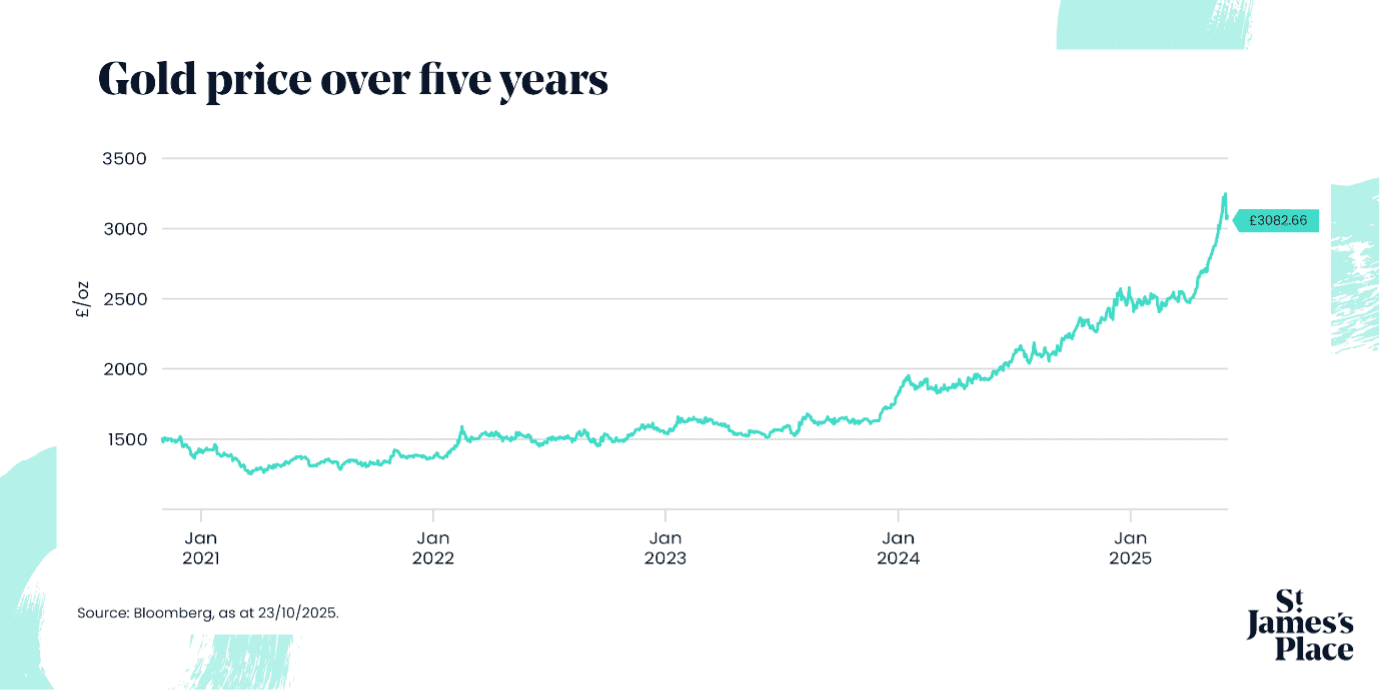
In October, gold rose above $4,000 an ounce. This came as a result of geopolitical concerns and weakness in the dollar. This six-month move compares with the nearly five years it took for gold to increase from $2,000 an ounce to $3,000. Last week saw the largest percentage drop for gold in a decade.
The information contained is correct as at the date of the article. The information contained does not constitute investment advice and is not intended to state, indicate or imply that current or past results are indicative of future results or expectations. Where the opinions of third parties are offered, these may not necessarily reflect those of St. James’s Place.
Source: London Stock Exchange Group plc and its group undertakings (collectively, the “LSE Group”). ©LSE Group 2025. FTSE Russell is a trading name of certain of the LSE Group companies.
“FTSE Russell®” is a trademark of the relevant LSE Group companies and is used by any other LSE Group company under license. All rights in the FTSE Russell indexes or data vest in the relevant LSE Group company which owns the index or the data. Neither LSE Group nor its licensors accept any liability for any errors or omissions in the indexes or data and no party may rely on any indexes or data contained in this communication. No further distribution of data from the LSE Group is permitted without the relevant LSE Group company’s express written consent. The LSE Group does not promote, sponsor or endorse the content of this communication.
© S&P Dow Jones LLC 2025; all rights reserved.
Source: MSCI. MSCI makes no express or implied warranties or representations and shall have no liability whatsoever with respect to any MSCI data contained herein. The MSCI data may not be further redistributed or used as a basis for other indices or any securities or financial products. This report is not approved, endorsed, reviewed or produced by MSCI. None of the MSCI data is intended to constitute investment advice or a recommendation to make (or refrain from making) any kind of investment decision and may not be relied on as such.
SJP Approved 27/10/2025