WeeklyWatch – The cat’s out the bag – Autumn Budget unpacked

2nd December 2025
Stock Take
Positive initial Budget reactions
Last week saw Chancellor Rachel Reeves deliver her Autumn Budget. She has four key groups to please – party, electorate, business and the market – of which only the market response can be precisely measured. So far, test passed! As November drew to a close, important domestic financial indicators like government bonds (gilts), the pound and shares all ended higher.
Early reveal causes chaos
Budget day started off rather messily. The accidental early release of the Office for Budget Responsibility’s (OBR) fiscal forecast broke a cardinal rule in finance markets: no surprises.
As a result, gilt yields yo-yoed (yields and prices move in opposite directions). But by 28th November, the yields on UK government bonds fell to their lowest level for the week. Despite it being a fairly modest drop, investors seemed to be giving the government’s fiscal plans the benefit of the doubt. Additionally, lower gilt yields meant that the UK was also paying lower interest rate on borrowings.
OBR to the rescue?
The Fixed Income Strategist at St. James’s Place, Greg Venizelos, identifies that the easing in gilt yields was:
“Likely a reflection of the fact the OBR’s upward revision in the fiscal headroom to £22 billion reduces the near-term risks associated with possible macro-economic shocks.”
Sterling strengthened slightly after the Budget was revealed, which could be an indication that investors were willing to adopt a ‘glass half-full’ approach.
Venizelos highlights that the chances of the Bank of England cutting interest rates in December have increased by over 90% and believes it’s almost a done deal. The OBR forecast of domestic inflation looking to slow to 2.5% in 2026 would boost this move. He adds:
“It’s worth noting this probability jumped from below 40% to over 70% on 6th November, when the Chancellor made a speech hinting at income tax hike.”
Fiscal hole to fiscal surplus?
The Director of Public Policy at St. James’s Place, James Heal, says:
“The Chancellor managed to walk a difficult tightrope on the day, but some of the relief on the day may have already evaporated. There is now a strong media and political focus on the strong pre-Budget signalling of a fiscal black hole (thereby justifying some of the difficult decisions taken) which turned out to be a small surplus.”
Relief rally by UK shares
It was a good week for UK shares. The FTSE 250 (the domestically focused index) rose by over 3% over the course of the week. Plus, the FTSE 100 concluded the week in the green.
Rate-sensitive beneficiaries whose earnings are helped by lower borrowing costs – for example, banks as well as utility companies, electricity and gas providers with high levels of borrowing – were helped by the expectations that interest rates are set to ease. Also benefiting were property companies and (more significantly) housebuilders, with hints of a potential increase in mortgage demand. Some consumer-facing sectors like retail and hospitality rose, showing that apparent relief wasn’t targeted more harshly. On the opposite side, the gaming sector weakened after higher taxes were announced in the Budget.
Downgraded UK growth
Market reaction to the Budget wasn’t unconditional. The commentary – and critics – have been particularly looking at the impact on economic growth and whether the Budget goes far enough. Worries that there could be more tax implications in the long run were expressed.
It also wasn’t a bright macro picture. The downgrading of its productivity forecast by the OBR will result in a lower economic outlook from next year. Venizelos says:
“While the Budget managed to smooth market anxieties, at least in the short and medium term, we remain cautious due to the longer-term fiscal concerns.”
AI and interest rate cut hopes support US shares
Shares rose strongly in the US, even though the trading week was shortened because of the Thanksgiving holiday. Talk of a US interest rate cut later in December seemed to boost investor sentiment. There was also a rally in AI-related shares, helping the S&P 500 recover from a bad start in November and finish the month with a 0.1% gain. On the flip side, the tech-focused Nasdaq index revealed a negative monthly return for the first time since March.
There was also a rise in continental European shares. Notes from the European Central Bank’s October meeting revealed that the eurozone was in a good place, as inflation stayed near the 2% target – below the level this time last year.
Wealth Check
The Budget rumours are finally over, even if the early release from the OBR didn’t help the speculation…
Measures announced in Rachel Reeves’ Autumn Budget weren’t as drastic or dramatic as many had expected. But the upcoming changes are likely to be felt across UK households over the next few years.
It will take a few weeks for the dust to settle, and then there’ll be a clearer picture of who wins and who loses out. Until then, here are some of the main reforms that were announced.
A freeze in Income Tax thresholds
Income Tax and National Insurance contribution (NIC) thresholds have been frozen for three more years (until 2031, beyond the next general election) and are expected to raise £23 billion for the government. This so-called fiscal drag will result in more people edging into higher tax rate bands.
Savings and property Income Tax increased
There will be a rise of two percentage points for savings and property Income Tax for each band of taxpayers from April 2027. The rate will rise to 22% for basic rate taxpayers, 42% for higher rate taxpayers and 47% for additional rate taxpayers. A similar increase in tax on dividend income will take place from April 2026, but this will only apply to basic and higher-rate taxpayers.
The cash ISA allowance is reduced
To little surprise, the annual cash ISA allowance will be capped at £12,000 from April 2027 – but this only applies to savers under 65 years of age. The rest of the £20,000 annual allowance will be reserved for investments.
NICs on pension salary sacrifice contributions
People paying into their pension through salary sacrifice will begin to pay National Insurance on contributions that exceed £2,000 a year from April 2029. Employers will also pay National Insurance contributions (NICs) on such contributions.
Mansion tax
Those who own a home valued at £2 million or over will receive a council tax surcharge from April 2028. The ‘mansion tax’ will bring in annual charges between £2,500 and £7,500 levied, but this will be dependent on the value of the property.
The levels and bases of taxation, and reliefs from taxation, can change at any time. The value of any tax relief is generally dependent on individual circumstances.
In the Picture
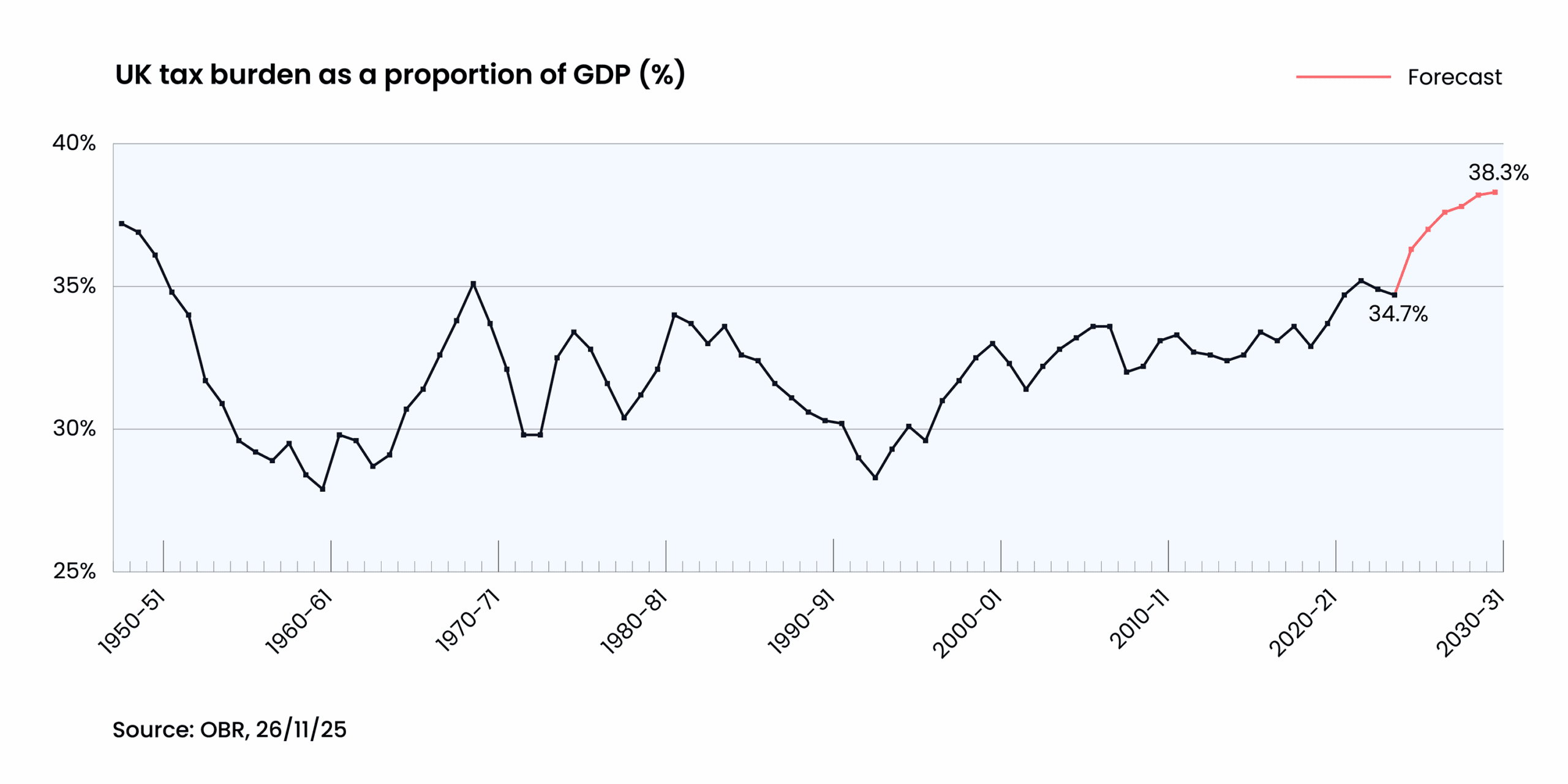
Not a friend, this trend… The UK tax take as a proportion of national wealth is set to rise to historic highs. Increased levels of tax take are being relied on heavily by the government to tackle debt and fund expenditure. Returning to a tax and spend could impact the UK’s competitive positioning for both investment and growth.
The information contained is correct as at the date of the article. The information contained does not constitute investment advice and is not intended to state, indicate or imply that current or past results are indicative of future results or expectations. Where the opinions of third parties are offered, these may not necessarily reflect those of St. James’s Place.
Source: London Stock Exchange Group plc and its group undertakings (collectively, the “LSE Group”). ©LSE Group 2025. FTSE Russell is a trading name of certain of the LSE Group companies.
“FTSE Russell®” is a trademark of the relevant LSE Group companies and is used by any other LSE Group company under license. All rights in the FTSE Russell indexes or data vest in the relevant LSE Group company which owns the index or the data. Neither LSE Group nor its licensors accept any liability for any errors or omissions in the indexes or data and no party may rely on any indexes or data contained in this communication. No further distribution of data from the LSE Group is permitted without the relevant LSE Group company’s express written consent. The LSE Group does not promote, sponsor or endorse the content of this communication.
© S&P Dow Jones LLC 2025; all rights reserved.
Source: MSCI. MSCI makes no express or implied warranties or representations and shall have no liability whatsoever with respect to any MSCI data contained herein. The MSCI data may not be further redistributed or used as a basis for other indices or any securities or financial products. This report is not approved, endorsed, reviewed or produced by MSCI. None of the MSCI data is intended to constitute investment advice or a recommendation to make (or refrain from making) any kind of investment decision and may not be relied on as such.
SJP Approved 01/12/2025