WeeklyWatch – Investors tentatively stepping into 2026

13th January 2026
Stock Take
What’s in store for 2026?
Not even two weeks into the new year, and investors are already navigating numerous potential market-moving events. The US’s intervention in Venezuela has initiated multiple financial market responses. And if that shock wasn’t enough, news over the weekend broke that Fed Chair Jerome Powell is under criminal investigation.
These events are certainly a reminder that unexpected events and market volatility will be almost inevitable in 2026. Let’s take a close look at some of the areas that investors will be keeping an eye on as the months unfold…
Hawk or dove approach for a new Fed chair?
At the end of May this year, Powell’s term as chair of the US central bank (the Fed) comes to an end. As a result, investors will be watching closely to see whether the newly appointed chair will adopt a ‘hawkish’ approach (favouring keeping interest rates higher for longer) or a ‘dovish’ one (lower interest rates). Whoever is appointed, they will be a key component in market sentiment in the upcoming months.
The ‘dual mandate’ set by the Fed aims to create the best conditions for maximum domestic employment that’s compatible with their 2% inflation target. Trying to keep this in balance has been dubbed one of the most difficult jobs in finance. The shortlist of candidates to replace Powell was completed before Christmas, and President Trump will make the final decision. When it comes to Fed policy, Trump hasn’t held back in his criticism, believing that decisions to cut interest rates should be made faster.
The choice to select someone potentially vulnerable to undue pressure could get a bad reception from investors and be perceived as an erosion of the Fed’s independence. And the news that Powell is now under criminal investigation, in relation to the US$2.5 billion renovations to the Federal Reserve Building, may contribute to growing concerns. A possible consequence could include investors demanding higher yields on US government bonds in order to compensate for the higher perceived risks.
Peace in Ukraine but without the dividend?
When Russia invaded Ukraine back in 2022, it brought an end to Europe’s decades-long ‘peace dividend’. For several years, numerous European members of the North Atlantic Treaty Organisation (NATO) failed to meet their 2% of economic output (GDP) for annual defence commitment. But against the backdrop of bigger regional tensions, member states have agreed to up their defence expenditure to 5% of GDP by 2035.
Even though this is a massive commitment, it could underpin the European defence sector and further areas if put in place. Moving to high-volume, low-expense systems – valuable against mass drone attacks – and increasingly digitised battlefields could bring more support to the order books.
However, with many governments already struggling with high levels of debt that are proving challenging to ease, a move like this will likely increase fiscal and political pressures across the continent.
The Venezuela intervention and tumbling oil prices
Oil markets saw a brief spike after the US strike in Venezuela, but then the price slumped to levels not seen since the height of the pandemic in January 2021. The current figure lies below US$60/bbl, while Trump has expressed a preference for a US$50/bbl level. For investors, they’re presented with a ‘glass half empty, glass half full’ situation. The pessimistic outlook sees the current relative oil price weakness as an indication of slowing consumer demand, weaker economic growth (GDP) expectations and global oil oversupply. On the other hand, the optimistic outlook will argue that the price is just right – not too high that it’ll push inflation higher and not too low to suggest a downward spiral in the outlook for the global economy.
When it comes to oil, there are conflicting forces. The OPEC+ group of oil producers, as well as the US, are producing high amounts, but demand is lacklustre. The growth that’s been recorded in China, Japan and the eurozone is expected to slow down in 2026 – China in particular. It’s the world’s second-largest oil consumer and has been the main booster of global oil demand for years. However, weak domestic consumer confidence has influenced demand. Additionally, there are upcoming structural changes, including the rise of electric vehicles (EVs), which make up half of new car sales across the nation.
For optimistic thinkers, they look to the broad positive benefits of lower oil prices, including its ability to reduce inflation and aid central banks in lowering their interest rates. The benefits go beyond cheaper utility and motoring bills for consumers and businesses, as businesses also benefit from improved profit margins without having to increase prices.
Lots of emerging market (EM) economies are big importers of oil and are more specific beneficiaries of lower oil prices. Government finances are boosted as less government revenue is spent importing oil. Furthermore, it relieves the cost of energy subsidies, undertaken by lots of EMs in Asia, Latin America and the Middle East (which includes top oil producers such as Saudi Arabia and Iran) to provide cheap energy.
China – what’s going on?
Last year, China’s stock markets saw a big rise, and even outperformed the US. However, its annual economic growth (GDP) potentially undershot its annual target of ‘around’ 5%. China’s 2026–2031 Five-Year Plan also comes into play this year and will lay out the next stage of the nation’s economic and social development – technology and innovation are expected to be the main focus.
Trade tensions between China and the US didn’t stop the former’s annual trade surplus (the balance between exports and imports) from rising to over US$1 trillion for the first time in 2025, while non-US exports filled the space from lower US demand. On the domestic side, there’s still not much sign of recovery in residential property prices (a major store of household wealth, affecting key areas like consumer spending). This continued to weaken in 2025 – the fourth year in a row. When combined with unsold housing inventory plus a weak jobs market, this heavily impacts consumer confidence and expenditure.
Investor sentiment could be Investor sentiment could be supportive on signs that China’s investment in AI will be influential in real-world applications for services and the industrial sector – even if Chinese economic growth remains below 5% over the year.
The next stage of AI
Global AI spending to date has been estimated at US$1.6 trillion – most of which has been spent on infrastructure. In 2025, a further US$375 billion is expected to have been spent. 2026 could be the year when investors start to ask AI companies and operators to “show me the money”. Even though OpenAI have said that profits aren’t expected to be seen until 2029, the company plans to invest over US$1 trillion over the next few years.
Long-term, this mismatch doesn’t seem sustainable and could result in lower valuations for the whole sector. Only a handful of tech companies account for between 35% and 40% of the US S&P 500, meaning that any weaknesses across AI-heavy companies could spark a broader market correction.
For investors in 2026, they may become more selective. The AI companies that can charge meaningful subscriptions and show a credible path to profitability are more likely to be rewarded. But AI companies that are reliant on never-ending funding rounds and have unrealistic projections will fade out.
Gridlock ahead of US midterms?
November 2026 could be a significant month for the US financial markets when the midterm elections take place. These elections grant the electorate the chance to vote on who controls Congress – think of it as the people’s response to the politician’s question: “How are we doing?”
It’s also gained a reputation for being known as the ‘midterm curse’, as the president’s party nearly always loses seats during these elections; this has been the case in 20 out of 22 midterms dating back to 1938. It’s likely the Republicans will be put on the defensive – assuming they lose control of either the House or the Senate. It would make things more challenging for Trump – his poll ratings are at a historic low as he endeavours to go ahead with his legislative programme, which includes tax cuts and deregulation across the environmental, crypto and technology sectors.
It may sound strange, but a stalemate like this can sometimes provide a positive backdrop for markets. Legislative logjams mean that the markets have one less thing to be concerned with, so they can devote more time to corporate activity. The benchmark S&P 500 has delivered double-digit returns in the 12 months following the midterm elections since 1950.
Missed the boat on gold buying?
During 2025, gold prices rose by a whopping 65%; it’s therefore not surprising that the price would increase again following the news of the US’s intervention in Venezuela. However, gold’s haven status during high geopolitical tensions is just one reason that underpins support for the precious metal. High levels of government borrowings in several developed economies, led by the US, add a bigger boost. The results: the possibility of increased inflationary pressures and weaker currencies.
Gold is a finite resource and has been shown to be an effective foil against currency debasement, yet it remains free of any default risk. The US dollar’s weakness against other key currencies throughout 2025 has probably had a helpful impact by reducing the cost of gold for non-US buyers. Additional high levels of gold purchases by central banks have further supported this, having significantly increased gold purchases since 2022.
Even though gold has enjoyed a great run, this may not be the case in 2026. If the US dollar strengthens and there’s an easing in geopolitical tensions, there could be some very different outcomes.
Wealth Check
A happy new year for pubs
Chancellor Rachel Reeves is set to back down on increases to businesses rates, following widespread worry that further increases will put many of them at risk of bankruptcy.
During her 2025 Autumn Budget, Reeves announced that business rate relief that was brought in during the pandemic would fall from 40% to 0% in April 2026, following a large-scale revaluation of pub premises, which saw large increases in rateable values.
But pushback from pub landlords and industry groups has forced the government to make another U-turn. They’re now believed to be considering many measures, which includes changing the methodology that calculates business rates or increasing the discount for pubs.
For businesses struggling in the hospitality sector, this eases the financial pressure somewhat. But it serves as another example where a decision that was announced in last year’s Budget has been reversed.
Another significant example of this was when a £1 million allowance on qualifying assets for agricultural property and business property was announced in the 2024 Budget. Following subsequent pressure from the farming community, the threshold was raised to £2.5 million in December. Further government U-turns include reinstating winter fuel payments and increasing National Insurance.
This latest announcement could cause further governmental headaches as other businesses within the hospitality sector (hotels, entertainment venues, etc.) are calling for similar changes to their billing situations.
In the Picture
Could the FTSE 100 be an investment sweet spot? In comparison to other indexes, it offers lower-priced exposure to a variety of in-demand sectors outside of AI.
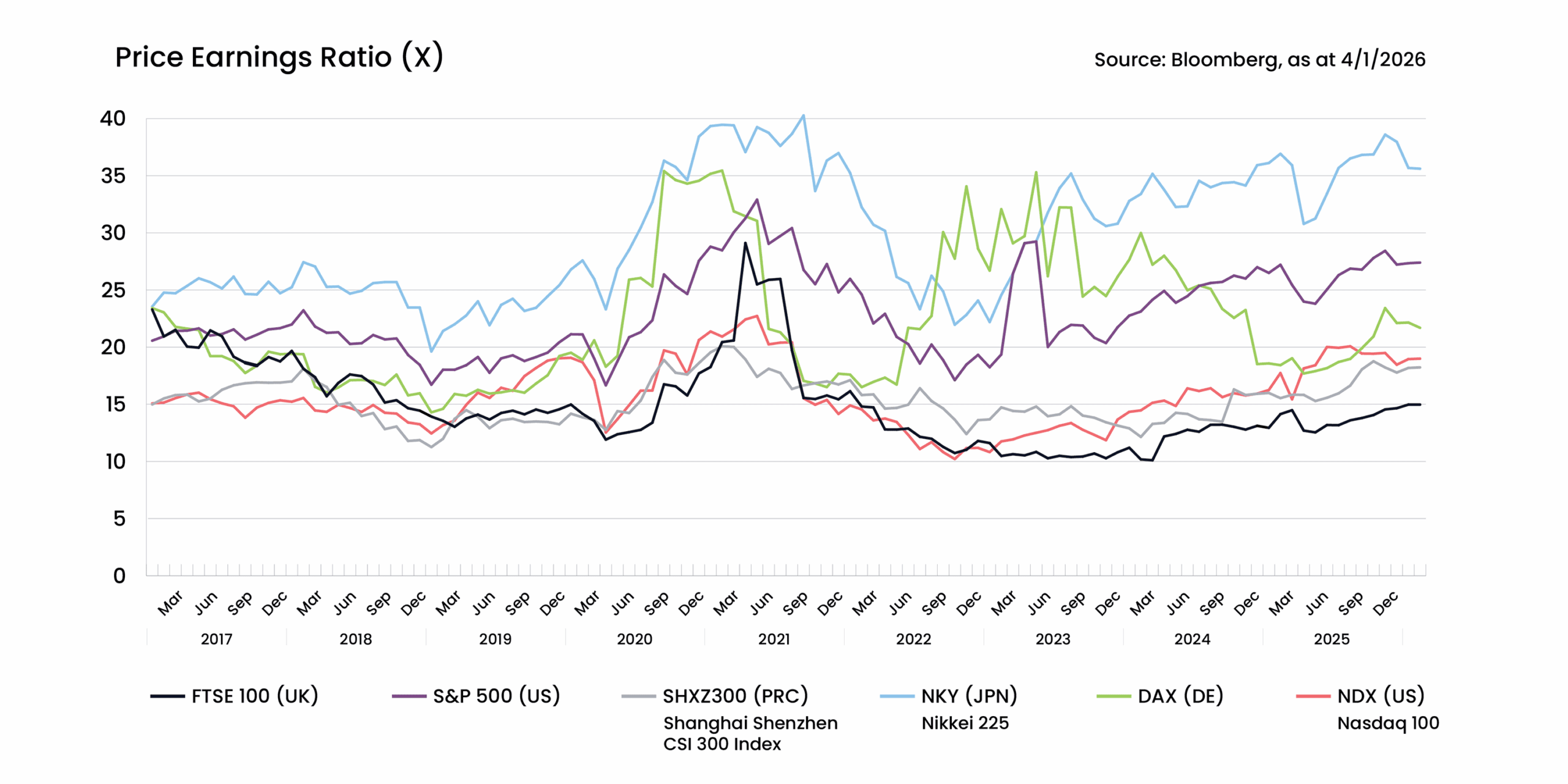
The value of an investment with St. James’s Place will be directly linked to the performance of the funds selected and may fall as well as rise. You may get back less than the amount invested.
Past performance is not indicative of future performance.
Please note it is not possible to invest directly into a financial Index and the figures shown do not take into account any charges applicable to the appropriate investment wrapper or any relevant tax charges.
The information contained is correct as at the date of the article. The information contained does not constitute investment advice and is not intended to state, indicate or imply that current or past results are indicative of future results or expectations. Where the opinions of third parties are offered, these may not necessarily reflect those of St. James’s Place.
Source: London Stock Exchange Group plc and its group undertakings (collectively, the “LSE Group”). ©LSE Group 2026. FTSE Russell is a trading name of certain of the LSE Group companies.
“FTSE Russell®” is a trade mark of the relevant LSE Group companies and is used by any other LSE Group company under license. All rights in the FTSE Russell indexes or data vest in the relevant LSE Group company which owns the index or the data. Neither LSE Group nor its licensors accept any liability for any errors or omissions in the indexes or data and no party may rely on any indexes or data contained in this communication. No further distribution of data from the LSE Group is permitted without the relevant LSE Group company’s express written consent. The LSE Group does not promote, sponsor or endorse the content of this communication.
© S&P Dow Jones LLC 2026; all rights reserved
Source: MSCI. Certain information contained herein, including without limitation text, data, graphs, charts (collectively, the “Information”) is the copyrighted, trade secret, trademarked and/or proprietary property of MSCI Inc. or its subsidiaries (collectively, “MSCI”), or MSCI’s licensors, direct or indirect suppliers or any third party involved in making or compiling any Information (collectively, with MSCI, the “Information Providers”), is provided for informational purposes only, and may not be modified, reverse-engineered, reproduced, resold or redisseminated in whole or in part, without prior written consent.
Source: Bloomberg. BLOOMBERG®” and the Bloomberg indices listed herein (the “Indices”) are service marks of Bloomberg Finance L.P. and its affiliates, including Bloomberg Index Services Limited (“BISL”), the administrator of the Indices (collectively, “Bloomberg”) and have been licensed for use for certain purposes by the distributor hereof (the “Licensee”). Bloomberg is not affiliated with Licensee, and Bloomberg does not approve, endorse, review, or recommend the financial products named herein (the “Products”). Bloomberg does not guarantee the timeliness, accuracy, or completeness of any data or information relating to the Products.
SJP Approved 12/01/2026