WeeklyWatch – AI’s disruptive domino effect

17th February 2026
Stock Take
AI disruption rages on
The AI domino effect is giving way to a new line of thinking: which industries will AI disrupt and make irreparably less profitable? This follows the wave of sell-offs happening across a variety of sectors in just the last few weeks.
Last week, affected areas included insurance brokers and wealth management firms, with publishing companies and the software sector being the victims two weeks ago.
How it’s panned out so far: a new AI tool is released that is able to replicate or improve the function or value added associated with a specific industry or sector. An immediate sell-off follows, with many companies seeing double-digit percentage corrections.
What this does is show up some of the issues associated with short-term investing. As it stands, no one knows what new AI tools will be released in the next month – and certainly not for the rest of the year. Even beyond that, it’s impossible to predict what the impact of the tools will be. The consequence: large swings in share prices.
The volatility across specific sectors has also reinforced the importance of diversification. The Investment Research Director at St. James’s Place, Joe Wiggins, says:
“The rapid progress of AI technology is creating significant uncertainty as markets attempt to understand who the winners and losers will be. At this stage, we are seeing focused bouts of short-term speculation, rather than anything more fundamentally driven. Given the pace of change, this uncertainty is likely to persist, making prudent diversification more important than ever for the long-term investor.”
Struggles for technology and 100-year bonds
In the second half of last week, there was a noticeable fall in technology stocks, with big names like Apple, Amazon and Alphabet suffering declines of 5% or more.
The technology sector faces pressure from two sides:
1. Investor concerns regarding the high levels of investment involved with the AI arms race.
2. Concerns that entire sectors could be at risk of being superseded by AI completely.
Volatility caused by AI has meant that US equities have struggled. By the end of Friday, the S&P 500 was at the level it began the year and the Nasdaq was down.
However, this didn’t prevent Alphabet from launching a multi-billion-dollar 100-year bond as part of their funding for AI development. They’re not the first company to create such a long-term bond, but it’s rare. In the 1990s, JCPenney issued century bonds, but 23 years later, they went bankrupt. Ford and Motorola also launched ‘century bonds’, and there’s at least one case, from the 1800s, where the Canadian Pacific Corporation offered a 1,000-year bond!¹
For perspective, Google is only 27 years old.
The Senior Fixed Income Analyst at St. James’s Place, Ian Entwisle, commented on the Google bond issuance:
“Demand for this bond appears to have been solid rather than exceptional, as it is not currently trading at a notable premium. It is nevertheless the kind of bond that is attractive to insurance/pension/asset and liability management (ALM) type of investors who are looking for attractive cashflows over a very long-time horizon.”
Progress across Asia
Since Prime Minister Sanae Takaichi’s recent victory in the general election, Japanese stocks have continued to climb. Her emphasis on greater economic stimulus was well-received by investors.
The South Korean index, the Kospi, has also been enjoying strong performance, having doubled over the past year. Last week, the index finished around 4% up. Previously low valuations have aided the Korean market, as have the strength of its semiconductor businesses and the wider boost in sentiment across emerging markets.
Strong performance in the Asian markets, plus ongoing volatility in the US, has resulted in Asian markets having their best start compared to US equities since at least 2000.
For the rest of the world, a mixed bag
Strong US payroll data was released for January on Wednesday. Employment rose by 130,000 jobs month-on-month, which is the strongest reading since December 2024 – and roughly double what was expected. However, the devil’s in the detail… Job gains weren’t evenly spread, with healthcare jobs being the main reason for the positive figures. In other sectors, the challenges may remain.
On home soil, the Office for National Statistics said that the UK economy saw a 0.1% growth in the final quarter of 2025. Even though this was a little below estimates, economists weren’t alarmed. The reality is that the British economy, which is home to an ageing population and low productivity growth, is unlikely to return to high growth anytime soon.
Over the week, the FTSE 100 hit a new record high; after retreating slightly, it still ended the week higher. The possibility of an interest rate cut next month is being priced in by investors, and corporate takeover and defence spending also provided support.
¹Investopedia (2024). Why Do Companies Issue 100-Year Bonds? Available at: www.investopedia.com/ask/answers/06/100yearbond.asp (Accessed 13/02/2026).
Wealth Check
Making Tax Digital (MTD) – the implementation
There is only a matter of weeks left for hundreds of thousands of landlords and sole traders to get ready for huge changes to the tax system coming into place on 6th April.
Described as the biggest shake-up in tax returns since self-assessment was launched more than 30 years ago, the introduction of Making Tax Digital (MTD) is about to make big waves.
Landlords and sole traders who earn more than £50,000 from property income and self-employment will need to keep digital records and submit tax records to HMRC five times a year. They’ll need to use new HMRC-compatible accounting software to manage their taxes, and submission dates for taxes and paying due tax won’t change.
HMRC are encouraging landlords and sole traders to get prepared now, ahead of the introduction of MTD. Failure to follow the MTD rules will incur penalties, with every submission deadline missed getting one penalty point. If four penalty points are incurred, a £200 fine will be issued. There will also be financial costs for late tax payments; these can range from 3% of the amount owed up to 10%.
The MTD roll-out will be a staged process. Traders and landlords with an income of more than £30,000 must comply with MTD from 6th April 2027. For those earning above £20,000, it will come into force in April 2028.
Sole traders, landlords and agents can find guidance on the new way of reporting via this link.
The levels and bases of taxation and reliefs from taxation can change at any time. Tax relief is dependent on individual circumstances.
In the Picture
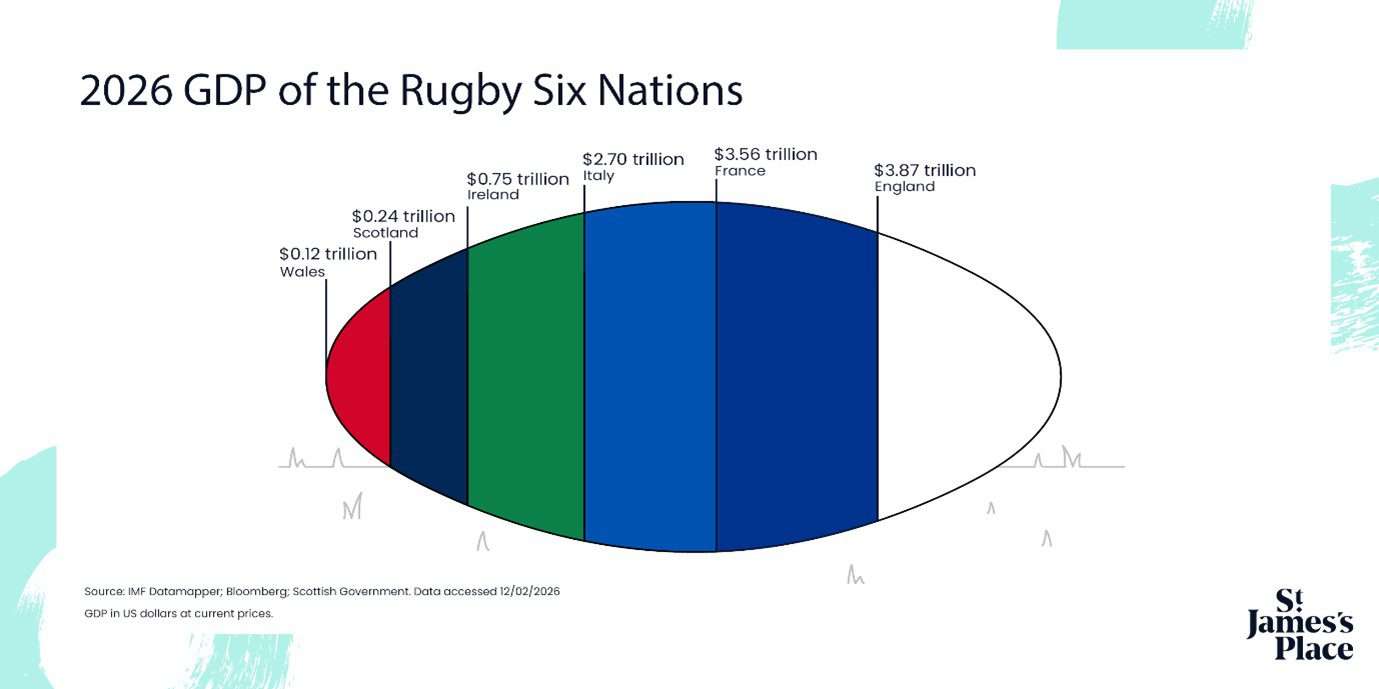
The Six Nations rugby tournament is well underway and there’s an intense battle on the pitch to claim sporting glory. Even though France are currently topping the table, and England being dominated by Scotland at the weekend, England leads when it comes to GDP. The chart shows the competing nations of the tournament have a combined economy of over $11 trillion. Here are their respective sizes:
The value of an investment with St. James’s Place will be directly linked to the performance of the funds selected and may fall as well as rise. You may get back less than the amount invested.
Past performance is not indicative of future performance.
The information contained is correct as at the date of the article. The information contained does not constitute investment advice and is not intended to state, indicate or imply that current or past results are indicative of future results or expectations. Where the opinions of third parties are offered, these may not necessarily reflect those of St. James’s Place.
Source: London Stock Exchange Group plc and its group undertakings (collectively, the “LSE Group”). ©LSE Group 2026. FTSE Russell is a trading name of certain of the LSE Group companies.
“FTSE Russell®” is a trademark of the relevant LSE Group companies and is used by any other LSE Group company under license. All rights in the FTSE Russell indexes or data vest in the relevant LSE Group company which owns the index or the data. Neither LSE Group nor its licensors accept any liability for any errors or omissions in the indexes or data and no party may rely on any indexes or data contained in this communication. No further distribution of data from the LSE Group is permitted without the relevant LSE Group company’s express written consent. The LSE Group does not promote, sponsor or endorse the content of this communication.
© S&P Dow Jones LLC 2026; all rights reserved
Source: MSCI. Certain information contained herein, including without limitation text, data, graphs, charts (collectively, the “Information”) is the copyrighted, trade secret, trademarked and/or proprietary property of MSCI Inc. or its subsidiaries (collectively, “MSCI”), or MSCI’s licensors, direct or indirect suppliers or any third party involved in making or compiling any Information (collectively, with MSCI, the “Information Providers”), is provided for informational purposes only, and may not be modified, reverse-engineered, reproduced, resold or redisseminated in whole or in part, without prior written consent.
Source: Bloomberg. BLOOMBERG®” and the Bloomberg indices listed herein (the “Indices”) are service marks of Bloomberg Finance L.P. and its affiliates, including Bloomberg Index Services Limited (“BISL”), the administrator of the Indices (collectively, “Bloomberg”) and have been licensed for use for certain purposes by the distributor hereof (the “Licensee”). Bloomberg is not affiliated with Licensee, and Bloomberg does not approve, endorse, review, or recommend the financial products named herein (the “Products”). Bloomberg does not guarantee the timeliness, accuracy, or completeness of any data or information relating to the Products.
SJP Approved 16/02/2026