WeeklyWatch – Oil impacts market momentum

17th March 2026
Stock Take
The caution and optimism sentiment scale
Even though global volatility continues to shake up markets, the FTSE 100 still managed to finish last week in positive territory – boosted by the energy sector. Its success came about in spite of January’s disappointing economic data and fading hope in the Bank of England (BoE) making an interest rate cut this week.
The widespread prediction was that the UK would register a modest economic expansion of 0.2% in January compared to the previous month, but this didn’t come to pass. Rather, there was no sign of any growth. The strain was felt across the more dominant services sector, manufacturing and construction. If this pattern continues, it’ll be unlikely that the economy will grow by 0.3% in the first quarter, which is what the BoE had forecasted.
However, optimistic observers highlight that investors should avoid reading too much into only one month’s worth of data. In the last few years, the first quarter performance of the UK economy has been good in comparison to the rest of the year.
Yet the US–Iran war is entering its third week and continues to complicate an already uneasy economic outlook, both domestically and overseas. Earlier in March – but too late to take into consideration the beginning of the hostilities – the Office for Budget Responsibility (OBR) revised and downgraded the UK economic growth forecast for 2026 from 1.4% to 1.1%.
Hopes of UK interest rate cut fade
Over the last month, the Brent crude oil price has risen more than 50% – at the end of last week, the price was more than $100 per barrel. Consequently, the BoE are more likely to decide against an interest rate cut when they meet later this week. Even if the war in the Middle East concludes soon, the resulting disruption to supply is expected to keep energy prices high. This feeds into inflation, which will result in increased costs for businesses and consumers. While a cut in UK interest rates would be supportive for consumers and businesses by reducing borrowing costs, the BoE are expected to prioritise inflationary pressure points.
It’s still a case of ‘wait and see’ when it comes to global events. A worst-case scenario could be that the economy slips into stagflation – when low economic growth combines with high inflation and unemployment numbers. In the UK, the last significant period of stagflation followed the 1973 Arab–Israeli war, when oil prices nearly quadrupled.
Global shockwaves felt strongly in Asia
The UK is far from alone – energy and geopolitical shocks are weighing on economies worldwide, at a time when global growth expectations for 2026 were already modest.
Asian economies in particular are vulnerable to the events in Iran. Much of the oil that passes through the Strait of Hormuz is destined for Asian markets, with China, India, Japan and South Korea accounting for the majority of these purchases.
Even though China is the world’s largest oil importer, they’re expected to be fairly shielded from the near-term volatility in energy prices – this is down to the country’s strategic reserves, which could support their economy for three to four months. And even though Japan imports almost all their oil, they also have a strategic reserve that can cover the next couple of months of consumption.
Imported energy is also relied on by India and South Korea, and some analysts are concerned that disruptions to the South Korean economy could result in a negative knock-on effect when it comes to domestic chip production. This highlights the high energy requirements needed to manufacture chips (South Korea is a global leader in this area) and the resulting high dependency on energy imports.
Market turmoil, but that’s not a new story
The increased volatility across the financial markets in the last few weeks serves as a reminder that geopolitics and economic shocks regularly happen and are a huge part of investing. Recent examples of such events include Trump’s “Liberation Day” tariffs in 2025, Russia invading Ukraine in 2022 and the start of the Covid pandemic in early 2020. Being disciplined and diversifying across regions and asset classes is one of the best ways to combat short-term negative sentiment.
The Director of Portfolio Management at St. James’s Place, Robin Ellis, highlights the significance of diversification, discipline and having a long-term mindset when it comes to investing. He says it’s more down to preparing well, which includes diversifying portfolios before periods of market volatility come into force, instead of being reactive during a crisis. He adds:
“Market events like this are highly uncertain, evolve quickly and cause significant market fluctuations. While tempting, trying to predict how these will unfold so often destroys value over the long term. Looking through the noise, remaining invested and allowing returns to compound over the long term is usually the best strategy in building long-term wealth.”
Wealth Check
Lords pursue higher limit for pension salary sacrifice
An amendment to the current bill on pension salary sacrifice has been passed by the House of Lords (HoL), seeking to double the government’s proposed cap. The government are wanting to limit the tax relief on pension salary sacrifice arrangements – to £2,000 per year from April 2029 – with the bill currently making its way through parliament. However, the HoL amendment is looking to increase the annual cap on employee contributions eligible for full National Insurance relief on salary sacrifice from £2,000 to £5,000.
St. James’s Place and other wealth management and pension companies have actively called for the proposed £2,000 limit on pension salary sacrifice to be scrapped.
As well as the revised cap, the HoL have also put forward further amendments to the bill, which include a motion for basic rate taxpayers to be exempt from the cap completely. Additionally, they want any contributions above the cap to be excluded as income in order to work out student loan repayments.
Since Chancellor Rachel Reeves laid out plans to limit pension salary sacrifice in her 2024 Budget, the proposal has been met with controversy and strong opposition by industry leaders.
There’s concern from ministers that limiting National Insurance contributions tax relief on pension contributions in this manner will have negative long-term effects on pension savings.
If it remains unaltered, the £2,000 cap could affect many more people than initially thought and not just people in higher tax rate bands, according to the OBR. The OBR estimate the measure could generate £4.7 billion in revenue for the government in the 2029/30 tax year.1
On Monday 23rd March, the bill will return to the House of Commons, and the amendments will be considered by parliament.
The levels and bases of taxation, and reliefs from taxation, can change at any time. The value of any tax relief depends on individual circumstances.
Source
1Office for Budget Responsibility – February 2026.
In the Picture
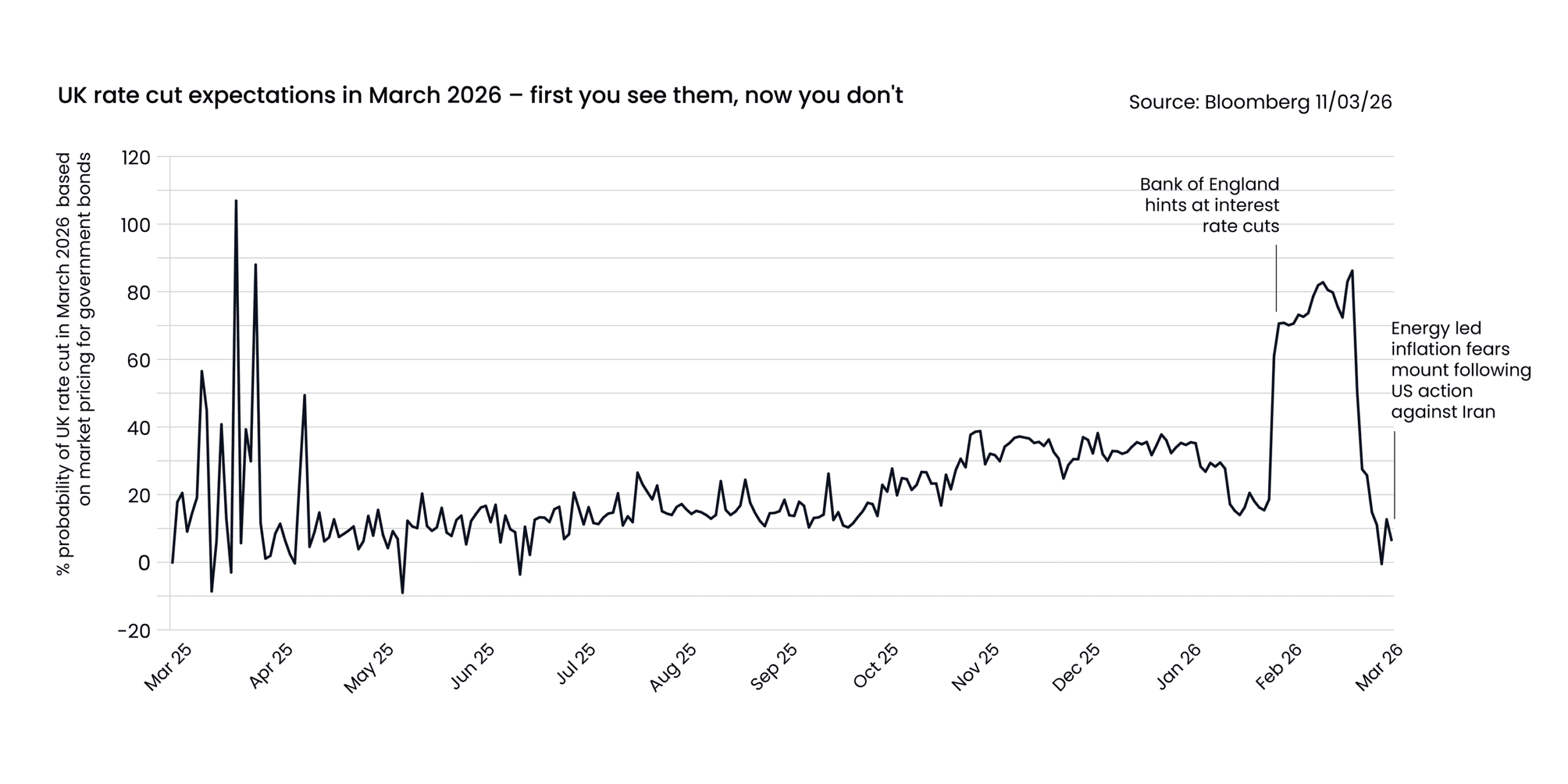
In the chart below, we can see the chances of an interest rate cut in the UK later this week has dropped to almost nothing. Analysts initially thought that lacklustre growth, a deteriorating jobs market and inflation heading towards the target figure would urge the BoE’s rate-setting committee to make a 0.25% cut. But global events have altered the course.
The information contained is correct as at the date of the article. The information contained does not constitute investment advice and is not intended to state, indicate or imply that current or past results are indicative of future results or expectations. Where the opinions of third parties are offered, these may not necessarily reflect those of St. James’s Place.
Source: London Stock Exchange Group plc and its group undertakings (collectively, the “LSE Group”). ©LSE Group 2026. FTSE Russell is a trading name of certain of the LSE Group companies.
“FTSE Russell®” is a trademark of the relevant LSE Group companies and is used by any other LSE Group company under license. All rights in the FTSE Russell indexes or data vest in the relevant LSE Group company which owns the index or the data. Neither LSE Group nor its licensors accept any liability for any errors or omissions in the indexes or data and no party may rely on any indexes or data contained in this communication. No further distribution of data from the LSE Group is permitted without the relevant LSE Group company’s express written consent. The LSE Group does not promote, sponsor or endorse the content of this communication.
© S&P Dow Jones LLC 2026; all rights reserved
Source: MSCI. Certain information contained herein, including without limitation text, data, graphs, charts (collectively, the “Information”) is the copyrighted, trade secret, trademarked and/or proprietary property of MSCI Inc. or its subsidiaries (collectively, “MSCI”), or MSCI’s licensors, direct or indirect suppliers or any third party involved in making or compiling any Information (collectively, with MSCI, the “Information Providers”), is provided for informational purposes only, and may not be modified, reverse-engineered, reproduced, resold or redisseminated in whole or in part, without prior written consent.
Source: Bloomberg. BLOOMBERG®” and the Bloomberg indices listed herein (the “Indices”) are service marks of Bloomberg Finance L.P. and its affiliates, including Bloomberg Index Services Limited (“BISL”), the administrator of the Indices (collectively, “Bloomberg”) and have been licensed for use for certain purposes by the distributor hereof (the “Licensee”). Bloomberg is not affiliated with Licensee, and Bloomberg does not approve, endorse, review, or recommend the financial products named herein (the “Products”). Bloomberg does not guarantee the timeliness, accuracy, or completeness of any data or information relating to the Products.
SJP Approved 16/03/2026