WeeklyWatch – Keeping an eye on Iran developments

24th March 2026
Stock Take
Hawkish turn for central banks towards Iran conflict
It’s been nearly a month since the Iran conflict began, and the rapidly changing developments in the region are making it difficult for global markets to keep up.
Yesterday (23rd March), there was a significant rise in equity markets following President Trump’s announcement that there will be a five-day pause to strikes, following successful talks. Immediately, equities soared, while oil prices and gilt yields shifted in the opposite direction.
Prior to this, the opposite had been going on, with the two sides locked in a war of words and statements that served to escalate tensions further. At the weekend, Trump issued a 48-hour ultimatum to Iran: fully reopen the Strait of Hormuz or face attacks on their energy infrastructure. Iran’s response was to threaten a like-for-like retaliation on US-linked assets within the region.
When markets have to move quickly due to fast-paced developments, prices can undergo rapid change, exemplified in the way that soon after Trump made his announcement, Iran denied that talks had taken place. When it comes to the bigger picture of investing, it’s important not to resort to making snap, short-term, emotional investment decisions or make any guesses as to ‘timing the market’. No one can know the direction of travel over the days to come, let alone the weeks to follow.
The fog of war
The medium- to long-term effects of the Iran conflict remain shrouded in uncertainty.
One example of this can be seen in last week’s numerous strikes on gas and oil facilities across the Middle East; we know that the impact of this will linger for some time, even if a peace agreement were to be reached tomorrow. Prices will remain high, and over the upcoming months, inflation will also rise – but the scale and length of this are unclear.
The long-term fallout on global markets also remains unknown. After Russia’s invasion of Ukraine in 2022, the equity markets fell but then rebounded. And before the US/Israeli attack, the markets were trading at or close to record highs around the globe. Will their recovery be just as quick?
In 2022, governments around the world offered their assistance in supporting consumers with energy prices in order to limit inflationary effects. If oil and gas prices continue to increase, questions will arise as to how the government will be able to intervene this time.
The world is in a very different position than it was four years ago. The start of the Ukraine war followed swiftly on from the Covid pandemic, from which consumers emerged with excess savings that they could spend, which aided recovery. At the time, inflation was rising quickly and interest rates were very low. Now, consumer savings are lower and interest rates have increased, and both these and inflation were, for the most part, on a downward path. In summary, equity markets might not adhere to a similar pattern as four years ago.
Reactions from the central bank
As the conflict across the Middle East ensues and develops, it leaves the central banks in an increasingly awkward position. With increased energy prices and uncertainty, it came as little surprise that the Bank of England (BoE) decided to keep interest rates the same in their meeting last Thursday.
They highlighted that it’s expected that CPI inflation will be close to 3.5% in March – almost 0.5 percentage points higher than was estimated in February, which is a result of the increased energy prices. The BoE said they stood “ready to act as necessary” to make sure that CPI inflation stays on track in order to meet the 2% inflation target.
Prior to the conflict, markets had priced in two interest rate cuts over the course of the year, and now they’re expected to increase interest rates two or even three times over the year, which is a significant swing.
While investors predict more rises, there’s been an increase in gilt yields: they hit their highest levels since 2008 on Friday, and the benchmark 10-year rate crossed 5%. After Trump’s ceasefire announcement, yields fell below 4.9%. Higher borrowing costs will affect the government’s future fiscal headroom.
This was the most dramatic swing; however, the BoE wasn’t the only central bank to decide on their current interest rates. Over the last seven days, the US Federal Reserve, European Central Bank and Bank of Japan also voted to keep their interest rates at the same level.
The Chief Economist at St. James’s Place, Hetal Mehta, said:
“This week saw an unusually heavy central bank calendar, with the Fed, BoE, ECB and BoJ all in the same week for the first time since December 2021. Back then, in a pre-Russia–Ukraine conflict era, the global economy was still emerging from the pandemic. Growth was solid, inflation was picking up rapidly and interest rates were still very low. Then came the Russia–Ukraine conflict, which saw energy prices soar, triggering the first major supply shock since the 1970s. Central banks tore up the textbook prescription to look through supply shocks and hiked rates aggressively in the hope of containing inflation expectations.
“Fast forward to the current juncture, and the same central banks are once again grappling with another energy shock, this time stemming from the disruption in the Middle East. All four of the central banks voted to keep interest rates unchanged amid a fast-moving and very uncertain backdrop, highlighting the intention to wait and see.”
Wealth Check
Iran conflict impacts UK households
The inflationary impact is starting to be felt by consumers as the conflict in the Middle East deepens, approaching the one-month mark since the US’s first attacks.
The disruption to the Strait of Hormuz (the narrow shipping route on Iran’s southern coast) has resulted in a significant decrease in shipments of oil and gas. Consequently, the cost of energy has increased, and UK drivers are seeing the price of their fuel fill-ups increasing.
UK households are being warned to prepare for increased domestic energy bills over the next few months. Additionally, the cost of food and consumer goods (clothing, electronics, etc.) is likely to be higher as a result of the cost of transport and rising bills within the supply chain.
Moreover, with inflation also on the rise, banks are taking a more cautious approach when it comes to lending. Lenders across the market have been increasing the cost of fixed-rate mortgage deals over the last few weeks. The result will be higher borrowing costs for first-time buyers and remortgage customers.
As the Iran conflict develops, it’s likely to create a longer period of raised consumer costs. Holidays could become more expensive with airlines facing higher fuel bills. Additionally, some insurance types, e.g. motor and home, could also see increases, with insurers facing increased costs when settling claims. These costs will be passed on through higher premiums.
We’ve compiled four top tips for UK consumers to help minimise the effects of these increased costs:
- Switch cash savings to more competitive accounts that have higher interest rates.
- Review the fixed-rate energy tariffs that are available and consider changing.
- Look into creating long-term financial resilience, which can be done by investing in ISAs and pensions.
- Talk to a financial adviser to voice your concerns and help ensure your financial plans stay on track.
10-year backstop on FOS complaints imposed by government
It’s been confirmed by HM Treasury that a 10-year absolute limit for complaints submitted to the Financial Ombudsman Service (FOS) will be imposed.
No time limit currently exists where consumers have only recently become aware of an issue or detriment.
As part of the proposed reform, the 10-year limit will remain absolute, but the Financial Conduct Authority can still grant limited exceptions where appropriate.
The value of an investment with St. James’s Place will be directly linked to the performance of the funds you select and the value can therefore go down as well as up. You may get back less than you invested.
The favourable tax treatment of ISAs may be subject to changes in legislation in the future.
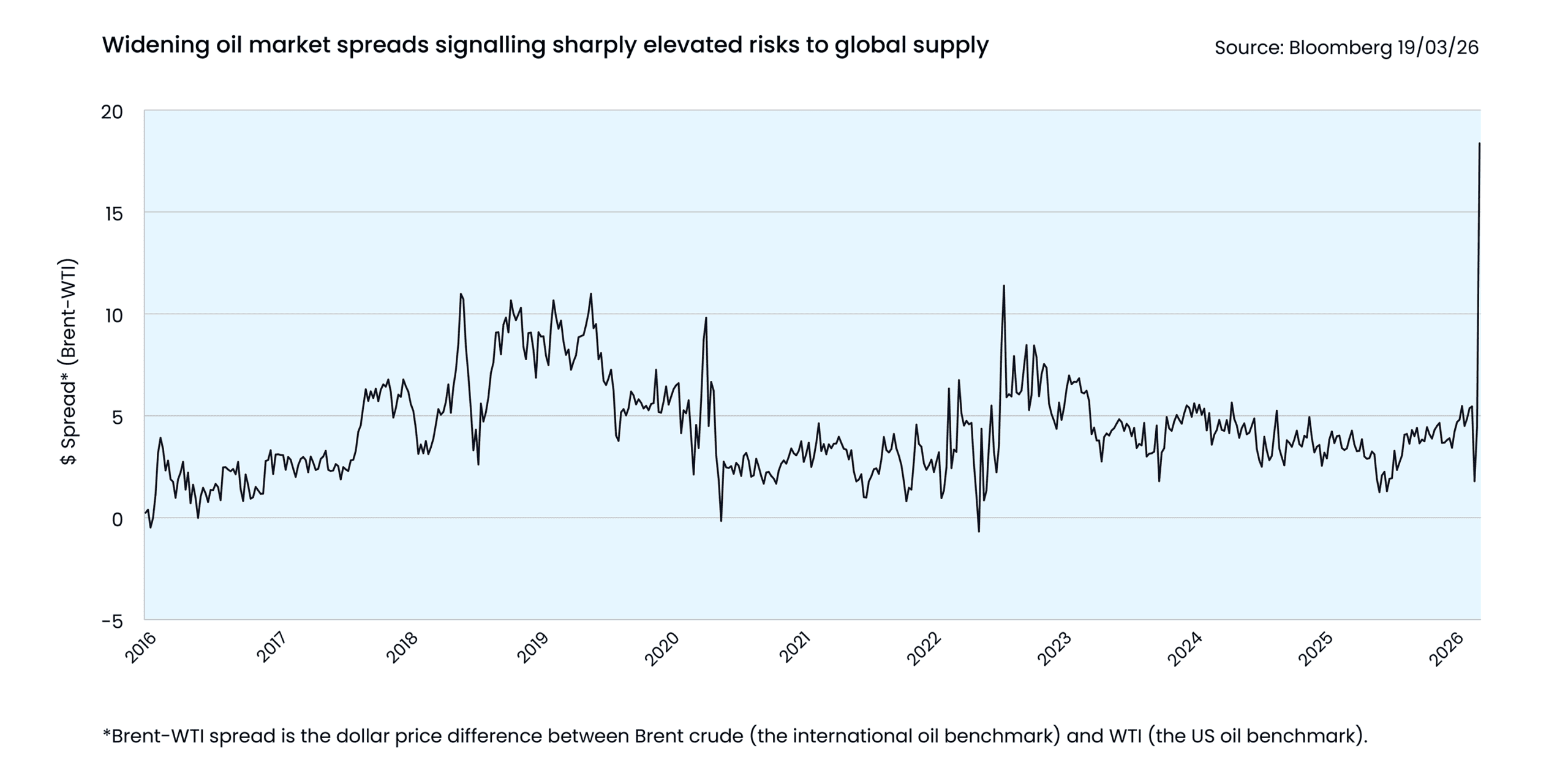
In the Picture
The continued conflict in Iran has had a huge effect on the price difference between international Brent and US WTI oil prices. This reflects the geopolitical energy disruption vulnerability in Europe and Asia compared to the US.
The information contained is correct as at the date of the article. The information contained does not constitute investment advice and is not intended to state, indicate or imply that current or past results are indicative of future results or expectations. Where the opinions of third parties are offered, these may not necessarily reflect those of St. James’s Place.
Source: London Stock Exchange Group plc and its group undertakings (collectively, the “LSE Group”). ©LSE Group 2026. FTSE Russell is a trading name of certain of the LSE Group companies.
“FTSE Russell®” is a trademark of the relevant LSE Group companies and is used by any other LSE Group company under license. All rights in the FTSE Russell indexes or data vest in the relevant LSE Group company which owns the index or the data. Neither LSE Group nor its licensors accept any liability for any errors or omissions in the indexes or data and no party may rely on any indexes or data contained in this communication. No further distribution of data from the LSE Group is permitted without the relevant LSE Group company’s express written consent. The LSE Group does not promote, sponsor or endorse the content of this communication.
© S&P Dow Jones LLC 2026; all rights reserved
Source: MSCI. Certain information contained herein, including without limitation text, data, graphs, charts (collectively, the “Information”) is the copyrighted, trade secret, trademarked and/or proprietary property of MSCI Inc. or its subsidiaries (collectively, “MSCI”), or MSCI’s licensors, direct or indirect suppliers or any third party involved in making or compiling any Information (collectively, with MSCI, the “Information Providers”), is provided for informational purposes only, and may not be modified, reverse-engineered, reproduced, resold or redisseminated in whole or in part, without prior written consent.
Source: Bloomberg. BLOOMBERG®” and the Bloomberg indices listed herein (the “Indices”) are service marks of Bloomberg Finance L.P. and its affiliates, including Bloomberg Index Services Limited (“BISL”), the administrator of the Indices (collectively, “Bloomberg”) and have been licensed for use for certain purposes by the distributor hereof (the “Licensee”). Bloomberg is not affiliated with Licensee, and Bloomberg does not approve, endorse, review, or recommend the financial products named herein (the “Products”). Bloomberg does not guarantee the timeliness, accuracy, or completeness of any data or information relating to the Products.
SJP Approved 23/03/2026