WeeklyWatch – Finding a way out of the conflict

8th April 2026
Key Takeaways
- The majority of key assets finished the period in negative territory.
- Shares were outperformed by fixed income as investor concerns shifted from inflation to recession.
- In GBP, US shares were at the front when it came to returns on a relative basis. Markets in Europe were outperformed by the UK. Emerging markets and Japan suffered double digit declines.
Stock Take
Searching for the exit
The past week marked the first positive period for shares in the US and Europe since the beginning of the Iran war. There was a rise of at least 3% in major indices in the US. It was also a particularly successful week for the tech-heavy Nasdaq Composite, which delivered its best weekly returns since November 2025. On the other side of the coin, bond yields and the price of gold fell, while stocks in Japan and China weakened.
Last Thursday, President Trump addressed the US nation, saying that the Iran war would conclude in a couple of weeks, but failed to offer more specific details. Yesterday (7th April), the Strait of Hormuz remained closed off for nearly all traffic and Trump’s threats of further conflict escalation once again resulted in a spike in oil prices. However, there have been major developments overnight, with Trump announcing he had agreed to a ‘double-sided’ ceasefire for two weeks, to allow negotiations to take place to try and come to a permanent settlement. It’s contingent on Iran also suspending hostilities and fully opening the Strait of Hormuz to commercial shipping traffic, which the regime says it will do.
While the news has had a positive effect on markets and oil costs, there’s a long way to go. Last week, the West Texas Intermediate (WTI) – the US domestic oil benchmark – rose by nearly 12% to its highest price in almost four years. Motorists across the US have received quite the financial spike: the price of petrol has risen by just over $1 from the beginning of the war to $4 per gallon. This will likely be a contributing factor in the headline inflation rise in March (including energy and food prices), the details of which are expected to be revealed later this week by the US Bureau of Labor Statistics.
As his personal poll ratings weaken, both Trump and the wider global markets are hoping for a conclusion to the conflict within weeks rather than months. This positivity is providing support for the bull case for markets, holding them up through the uncertain long-term effects of the conflict on the global economy.
European governments stepping in to help consumers?
The big increase in oil prices following the start of the war created fears of a rebound in inflation in the UK, Europe and even the US.
To begin with, some analysts suggested that interest rates would need to increase. Impact from the conflict on the economic outlook has resulted in a pivot: markets are more concerned about the issues related to weaker economic growth. If central banks choose to increase interest rates, this will hamper the low growth expectations across Western economies.
Increased interest rates will also add pressure on already high government debt. As an example, the Bank of Italy has cut predicted annual domestic economic growth in 2026 and 2027 to just 0.5% as a result of the war in Iran. Simultaneously, the Italian government are facing the challenge to ease some of the additional costs – mainly higher energy prices – by tax cuts. The country has one of the highest government debt to economic growth (GDP) ratios in the eurozone.
Other nations in Europe have similar demands. The UK faces pressure to extend the freeze on fuel duty and to deliver additional support. Governments in Europe will be aware of the need for action to respond to the energy shock, but they also risk provoking the fixed-income markets. Unfunded tax cuts will be punished by higher bond yields.
March marks a good month for US job creation
The best month for US job creation in over a year was March 2026, which saw 178,000 new jobs created, reducing the national unemployment rate to 4.3%. The start of the Iran war didn’t have much effect on what is backward-looking data. It has added to the expectation that the US central bank, the Federal Reserve, will leave interest rates as they are for the rest of the year.
No let-up for the tech sector
In the last few weeks, some analysts have been praising the merits of the US technology sector and have suggested that they’ve been more protected from the global market turmoil. However, since the outbreak of the war, the tech sector has followed the same pattern as the broader indices in the US. The sector’s strong multi-year returns make it a clear option for investors looking to crystallise profits. Despite the sell-off for technology, the sector still accounts for about one-third of the value of the S&P 500.
The first quarter’s weakness has been more evident. The Magnificent 7 – the group of leading tech companies – have significantly underperformed the S&P 500. A further problem could be linked to AI; many mega-tech companies have committed to incredibly high levels of capital expenditure on data centres. It’s been an ongoing concern for investors that the high investment levels will make it extremely challenging to get an attractive investment return.
Wealth Check
Government rejects call to double IHT deadline for pensions
Calls to double the amount of time bereaved families will have to pay inheritance tax (IHT) on pension assets and estates with qualifying agricultural and business property have been rejected by the government.
The House of Lords recently proposed that the current six-month deadline for IHT payments on estates should be extended to one year for those specific assets. It was put forward to give families more time to deal with the complexities that are involved in sorting out IHT that’s due on pensions and business assets.
St. James’s Place has supported the House of Lords’ proposal to increase the payment deadline and provided evidence to show the negative impact of the current six-month timeframe.
Unused pension assets will become liable to IHT from April 2027.
There’s now concern among industry experts that six months won’t be enough time for people to locate the deceased’s pensions, calculate the IHT due on the estate and complete the payment to HMRC.
The current timeframe also poses a challenge for asset-rich, cash-poor farms and businesses that may have to resort to selling their business in order to meet their IHT liability. Valuations may need to take into account assets such as shops and rental businesses, creating further challenges that may require more time to fully resolve.
Late payments of IHT, made after the six-month deadline, incur a charge of four percentage points above the Bank of England’s base rate, which is currently 3.75%.
The levels and bases of taxation and reliefs from taxation can change at any time. Tax relief is dependent on individual circumstances.
In the Picture
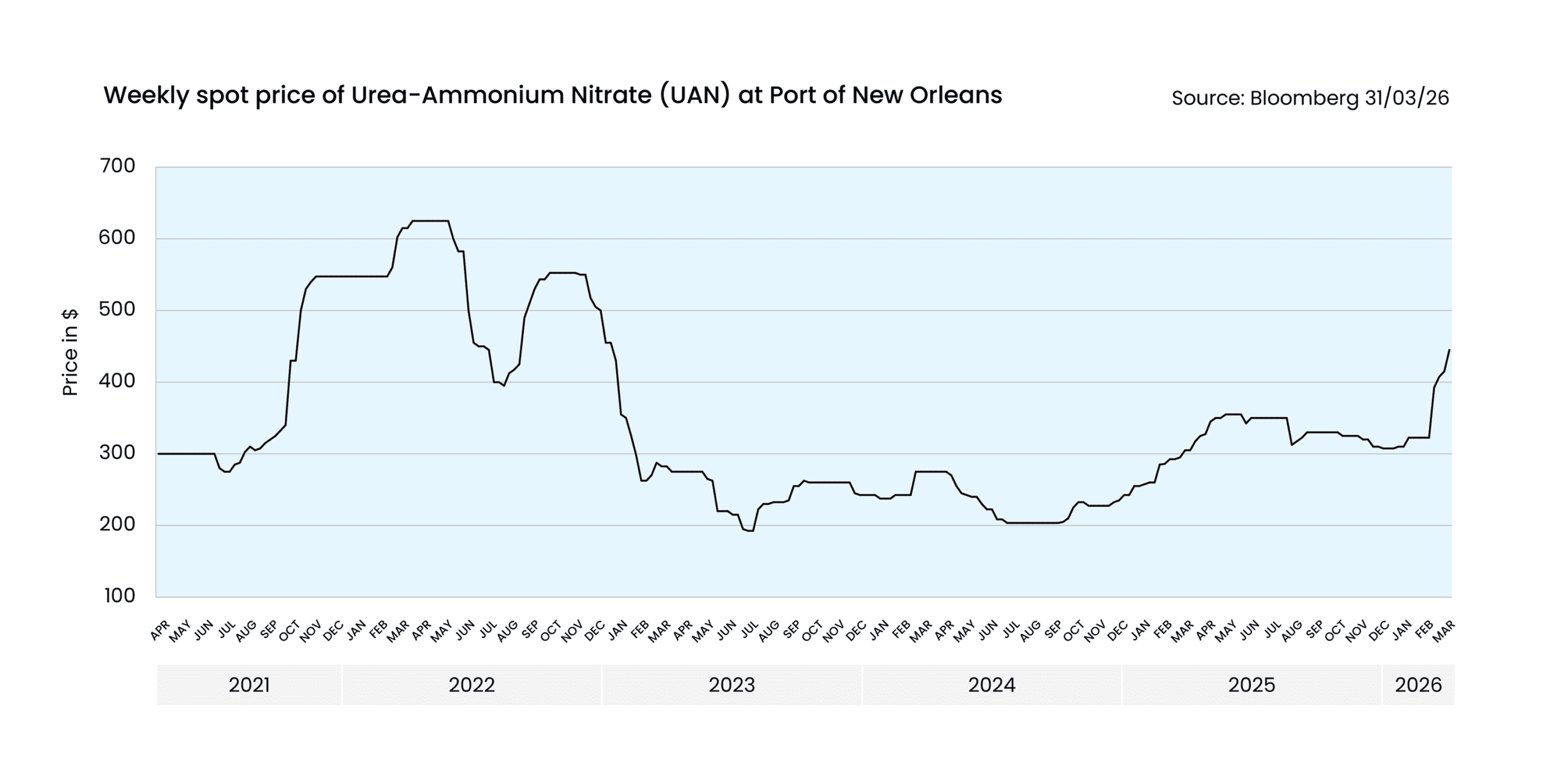
The chart below shows the price of urea ammonium nitrate, commonly referred to as UAN. It’s one of the most widely used fertilisers across the globe: efficient, versatile and a liquid, so therefore easy to apply (many other fertilisers aren’t like this). But one of the downsides is that its production is highly energy-intensive.
A key supplier of fertiliser is the Middle East. With the increase in production costs and the near total closure of the Strait of Hormuz, prices of fertiliser have significantly risen. This could result in higher global food prices if they remain high for a long time.
The information contained is correct as at the date of the article. The information contained does not constitute investment advice and is not intended to state, indicate or imply that current or past results are indicative of future results or expectations. Where the opinions of third parties are offered, these may not necessarily reflect those of St. James’s Place.
Source: London Stock Exchange Group plc and its group undertakings (collectively, the “LSE Group”). ©LSE Group 2026. FTSE Russell is a trading name of certain of the LSE Group companies.
“FTSE Russell®” is a trademark of the relevant LSE Group companies and is used by any other LSE Group company under license. All rights in the FTSE Russell indexes or data vest in the relevant LSE Group company which owns the index or the data. Neither LSE Group nor its licensors accept any liability for any errors or omissions in the indexes or data and no party may rely on any indexes or data contained in this communication. No further distribution of data from the LSE Group is permitted without the relevant LSE Group company’s express written consent. The LSE Group does not promote, sponsor or endorse the content of this communication.
© S&P Dow Jones LLC 2026; all rights reserved
Source: MSCI. Certain information contained herein, including without limitation text, data, graphs, charts (collectively, the “Information”) is the copyrighted, trade secret, trademarked and/or proprietary property of MSCI Inc. or its subsidiaries (collectively, “MSCI”), or MSCI’s licensors, direct or indirect suppliers or any third party involved in making or compiling any Information (collectively, with MSCI, the “Information Providers”), is provided for informational purposes only, and may not be modified, reverse-engineered, reproduced, resold or redisseminated in whole or in part, without prior written consent.
Source: Bloomberg. BLOOMBERG®” and the Bloomberg indices listed herein (the “Indices”) are service marks of Bloomberg Finance L.P. and its affiliates, including Bloomberg Index Services Limited (“BISL”), the administrator of the Indices (collectively, “Bloomberg”) and have been licensed for use for certain purposes by the distributor hereof (the “Licensee”). Bloomberg is not affiliated with Licensee, and Bloomberg does not approve, endorse, review, or recommend the financial products named herein (the “Products”). Bloomberg does not guarantee the timeliness, accuracy, or completeness of any data or information relating to the Products.
SJP Approved 07/04/2026