WeeklyWatch – US–Iran ‘tug of war’ rages on

28th April 2026
Stock Take
US markets rise despite ongoing Iran conflict
Positive sentiment towards technology and AI continues, and another good week of corporate earnings resulted in a boost for US markets – including new highs for the S&P 500 and the Nasdaq Composite.
Nearly one third of companies in the S&P 500 have now revealed their first quarter earnings, with a higher-than-average number reporting positive earnings, surpassing expectations. Buyers sought out chip manufacturers, which boosted investor sentiment in the technology sector. It’s widely believed by investors that these companies will have a significant role as AI use continues to expand and competition between the main players increases.
The Equity Strategist at St. James’s Place, Carlota Estragues Lopez, commented on the US market’s narrow reliance on technology since the Iran war began, saying that traditional hedges such as fixed income and gold haven’t worked as well as they have previously. She added:
“This greater uncertainty has meant investors have been reluctant to sell risk to avoid being surprised on the upside.”
Continued higher oil price hinders Europe
There was a rise of 17% in the price of Brent crude oil last week – its largest move since the start of the war. No progress has been made with peace talks, and 10% of global oil supply is sat in the Strait of Hormuz, meaning that demand continues to outstrip supply. The US is benefiting as they produce around 16% of global oil output annually, and their government reported that exports of crude and petroleum products have hit a record of nearly 12.9 million barrels per day.
A combination of factors led to European stock markets finishing the week in negative territory, including weak regional economic data, limited exposure to technology and AI, and dependence on energy supplies from the Middle East. Benchmarks in Germany and France closed more than 2% lower, and the FTSE 100 fell by 2.7%.
Halving the growth outlook for Germany
Germany is the eurozone’s largest economy and importer of energy. Last week, they cut their annual economic growth (GDP) forecast for the year to 0.5%. And for 2027, they’ve reduced the figure from 1.3% to 0.9%. Even though these downgrades were expected, it remains disappointing as there was a tentative 0.2% expansion in 2025, following the two-year shrink in their economy. Russia’s invasion of Ukraine created a big energy shock for Germany and was largely responsible for the nation’s recent economic weakness. On top of an already poor week, Germany’s composite PMI survey – an important indicator of business activity – has also worsened because of higher energy, fuel and transport costs.
It’s a similar scenario for the eurozone’s second largest economy, France. Input prices for business have risen to a three-year high. Currently, German companies have been more aggressive than their French counterparts when it comes to passing additional costs onto consumers.
Retail sales boosted by UK motorists
UK retail sales in March were 0.7% higher than February’s figures, surpassing expectations; meanwhile, domestic consumer confidence has fallen to its lowest level in a year. One of the main reasons for these mixed readings is the rise in fuel sales as motorists prepare for more increases in pump prices and stock up. Average UK diesel prices (incl. VAT) have increased by 34% since the beginning of the US–Iran war, while petrol prices have increased by 19%. Excluding this ‘stock-building’ by motorists, retail sales were a calmer 0.2%.
Path opens for a new Fed chair
It’s been announced that the US Justice Department has ended the investigation into Jerome Powell, the current chair of the US central bank (Fed). Powell had said he’d remain as chair as long as investigations were underway.
Most commentators believe the end of the investigations should help pave a clearer path forward for President Trump’s nomination, Kevin Warsh. Powell’s term comes to an end in May, and the confirmation should bring an end to uncertainty about the transition, which will inevitably be welcomed by markets.
Warsh was a Fed governor during the 2008 global financial crisis and is regarded as an inflation hawk – someone who’s careful when it comes to cutting interest rates too early. Trump’s public preference for lower interest rates seem to conflict with Warsh’s previous comments regarding inflation. But Warsh has indicated that there may be room for US interest rates to be cut from their current levels, which may be possible thanks to the AI productivity gains.
Wealth Check
St. James’s Place supports government campaign to boost British investing
A nationwide campaign has been launched in the UK to showcase the benefits of investing, brought to you by ‘Savvy the squirrel’.
Invest for the Future is a multi-year campaign which is headed up by the UK trade body, the Investment Association (IA), and is supported by the government and numerous UK financial services firms, which includes St. James’s Place.
The campaign’s research reveals that seven million adults in the UK hold at least £10,000 in cash savings.1 But within that number, nearly half (44%) of savers have no equity-linked investments, despite cash holdings having their own drawbacks. High inflation can erode the value of cash over time, particularly when savings interest rates are low.
This new campaign aims to break down some of the investment barriers and encourage more people by talking more about how it works and debunking myths and fears surrounding risks. The campaign aims to make the benefits of long-term investing clearer and build people’s confidence with the hope that it will create a cultural shift in investment attitude.
Source
1Opinium research among 4,000 UK adults conducted between 7th April and 12th April 2026.
Risk for the Pension Schemes Bill over mandation powers
Doubt over the future of the Pension Schemes Bill has arisen after the House of Commons rejected it again last week.
The House of Lords and House of Commons agree on most parts of the legislation and intended benefits. However, they disagree about the government’s proposed mandation powers, which would allow the government to allocate large portions of retirement savings into UK private market investments.
The House of Lords have repeatedly raised worries that powers like this could be used to place pension assets into projects that benefit the government and are not in the best interests of savers. The issue has gone back and forth between the Commons and the Lords for some months, but if a consensus can’t be reached before the end of the parliamentary session this week, the bill could fail.
The value of an investment with St. James’s Place will be directly linked to the performance of the funds selected and the value may therefore fall as well as rise. You may get back less than you invested.
Investing does not provide the security of capital associated with a deposit account with a bank or building society, as the value & income may fall as well as rise.
In the Picture
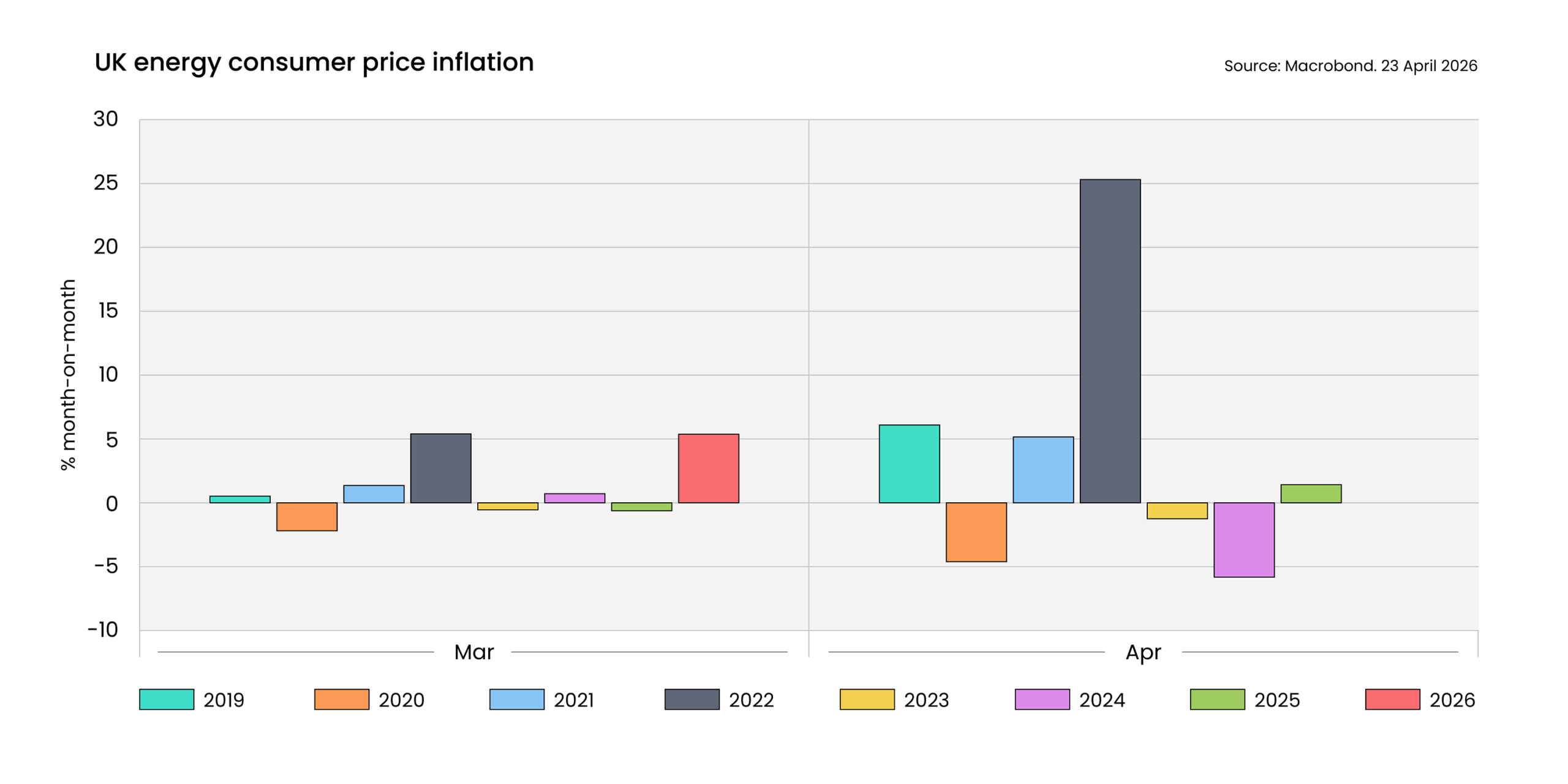
The chart below reveals the energy component in UK consumer inflation over March and April, and dates back to 2019. 2022 stands out as this is when Russia invaded Ukraine, which resulted in a sharp rise in energy prices. In 2026, the red bar for March shows the first month’s impact of the Iran war, which nearly matches 2022. Data for April 2026 isn’t available yet, but a similar dramatic rise may not be too surprising.
The information contained is correct as at the date of the article. The information contained does not constitute investment advice and is not intended to state, indicate or imply that current or past results are indicative of future results or expectations. Where the opinions of third parties are offered, these may not necessarily reflect those of St. James’s Place.
Source: London Stock Exchange Group plc and its group undertakings (collectively, the “LSE Group”). ©LSE Group 2026. FTSE Russell is a trading name of certain of the LSE Group companies.
“FTSE Russell®” is a trademark of the relevant LSE Group companies and is used by any other LSE Group company under license. All rights in the FTSE Russell indexes or data vest in the relevant LSE Group company which owns the index or the data. Neither LSE Group nor its licensors accept any liability for any errors or omissions in the indexes or data and no party may rely on any indexes or data contained in this communication. No further distribution of data from the LSE Group is permitted without the relevant LSE Group company’s express written consent. The LSE Group does not promote, sponsor or endorse the content of this communication.
© S&P Dow Jones LLC 2026; all rights reserved
Source: MSCI. Certain information contained herein, including without limitation text, data, graphs, charts (collectively, the “Information”) is the copyrighted, trade secret, trademarked and/or proprietary property of MSCI Inc. or its subsidiaries (collectively, “MSCI”), or MSCI’s licensors, direct or indirect suppliers or any third party involved in making or compiling any Information (collectively, with MSCI, the “Information Providers”), is provided for informational purposes only, and may not be modified, reverse-engineered, reproduced, resold or redisseminated in whole or in part, without prior written consent.
Source: Bloomberg. BLOOMBERG®” and the Bloomberg indices listed herein (the “Indices”) are service marks of Bloomberg Finance L.P. and its affiliates, including Bloomberg Index Services Limited (“BISL”), the administrator of the Indices (collectively, “Bloomberg”) and have been licensed for use for certain purposes by the distributor hereof (the “Licensee”). Bloomberg is not affiliated with Licensee, and Bloomberg does not approve, endorse, review, or recommend the financial products named herein (the “Products”). Bloomberg does not guarantee the timeliness, accuracy, or completeness of any data or information relating to the Products.
SJP Approved 27/04/2026