WeeklyWatch – Market readiness amid Iran conflict

3rd March 2026
Stock Take
The ripple effect of the Iran strikes
The weekend saw another escalation in the conflict across the Middle East, where coordinated strikes were conducted by the US and Israel against Iran. As a result, uncertainty across the global markets has risen sharply. Investors weren’t completely unprepared; they’d anticipated a strong possibility of actions like these following the pre-emptive strikes that targeted Iran’s nuclear facilities last summer. In addition, the well-publicised deployment of US military resources to the region already had many suspecting it was a case of ‘when, not if’ the US would act.
Since the weekend, the conflict has extended beyond Iran – retaliatory strikes by the regime across the region have increased concern about how far the conflict may spread.
From an economic perspective, Iran has significant influence over the global economy, due to its effective control over the Strait of Hormuz. The narrow waterway allows for the passage of approximately 20% of the world’s oil and 90% of the oil being delivered to Asian markets. Last night, the Iranians closed the waterway.
The Chief Economist at St. James’s Place, Hetal Mehta, highlighted that there may be some impact on petrol prices and eventually on UK inflation if oil prices increase for more than a few days. Giving a worst-case illustration: if oil prices rise to over $120 a barrel, there could be an increase in inflation from 3% to over 4%. Mehta says:
“For every 1% increase in inflation, consumer spending would be affected and in turn this could take 0.2% to 0.3% off UK growth.”
But she also indicates that a rapid change in domestic energy prices will come too late to have an impact on the Office for Budget Responsibility’s forecasts, which are due to be published today alongside the Chancellor’s Spring Statement.
Anticipated market movement
Yesterday (2nd March) saw global markets react fairly predictably. The stock markets are lower, and ‘safe haven’ assets like government bonds, gold and the US dollar have risen. The price of oil increased by over 10%, but it drifted back as the day progressed; it remains higher than at the end of last week. A modest increase in production to help stabilise the market has been agreed on by OPEC (an organisation enabling the cooperation of leading oil-producing and oil-dependent countries).
Concern among economists may grow if the disruption continues, as it could result in higher oil prices and consequently create higher inflation, which would impact global GDP.
A case of watch and see?
St. James’s Place Director of Investment Research, Joe Wiggins, says that it’s easier to be disciplined when the markets are going up. But in the current situation of stress and uncertainty is when investors need to be most disciplined. Wiggins’ advice to investors puts forward five questions to ask whenever there’s a shock to the market:
- Do I have confidence in predicting the outcome of the current situation?
- Can I reliably anticipate the financial market implications?
- Are any of these potential market impacts likely to be material over my investment horizon?
- Is my portfolio appropriately diversified for a range of possible outcomes?
- Have my investment objectives changed in any way?
For long-term investors, the answers to these questions are most likely to be a strong “no”. Recent events are the very reason why investors should avoid the temptation to change up their approach.
Wiggins also cites a study that analysed the New York Times’ coverage of different topics dating back 160 years and what impact this had on future stock market returns.1 It revealed that the topic that was the strongest predictor of higher stock market returns over the next 1 to 36 months was ‘war’.
This may seem unexpected; however, the explanation is as simple as it is sensible. The knee-jerk reaction for some investors and traders in this environment would be to sell if they get unnerved by short-term uncertainty. However, lower prices make valuations more attractive and push up future expected returns – this is the reward for investors who chose to maintain the course or take opportunities to purchase when prices were lower. Wiggins adds:
“That’s by no means a prediction of what will happen, but it reflects that our gut reaction to such events [is] often wrong”.
The Director of Portfolio Management at St. James’s Place, Robin Ellis, reinforced Wiggins’ statement and emphasised the significance of diversification, discipline and a long-term mindset. Ellis states that preparation plays a key role: ensuring that portfolios are diversified before periods of market volatility is more important than reactive moves taken during times of crisis. Market events like this create high levels of uncertainty, evolve quickly and cause market fluctuations. It may be tempting to try to predict how events will unfold, but this can destroy value over the long term. Seeing past the noise, staying invested and allowing returns to compound over the long term is generally the best strategy when it comes to building long-term wealth.
Source
1Hirshleifer, D, Mai, D.Y., and Pukthuanthong, K. (2023). War Discourse and Disaster Premia: 160 Years of Evidence from Stock and Bond Markets, NBER. Available at: www.nber.org/papers/w31204 (Accessed: 03/03/2026).
Wealth Check
Chancellor pushed to scrap salary sacrifice pension cap
Ahead of today’s Spring Statement, St. James’s Place – along with several other major pension and wealth management companies – gave their support to the campaign urging Chancellor Rachel Reeves to reverse her plan to cap the tax relief on salary sacrifice pension arrangements.
In last year’s Autumn Budget, Reeves stated that from April 2029, the amount of salary sacrifice pension contributions exempt from national insurance contributions (NICs) for employees and employers would be capped at £2,000 per year.
However, many experts, including pension ministers, are concerned that limiting the NIC tax relief will have a negative long-term impact on pension saving. The issue has been raised that the UK population doesn’t pay enough into retirement savings. The cost of living continues to make it more challenging for people to put money into retirement contributions, and it’s believed that the new rule will make it even more difficult for people to save. Additionally, critics have weighed in on the conversation, stating that the changes pose a risk to the nation’s confidence in saving into a pension.
With a pension salary sacrifice scheme, an employee’s contract is amended to reduce their salary in exchange for increased contributions made by the employer into a pension. The result is relief on income tax for the employee, as well as savings on NICs for both the employee and employer.
St. James’s Place has played an active role in supporting the reversal of the raid on salary sacrifice.
The campaign came about following analysis carried out by the Office for Budget Responsibility (OBR), which suggested that the impact of the salary sacrifice cap would affect more people than expected, not just those in higher tax rate bands.
The measure is estimated to bring in £4.7 billion in revenue for the government in the 2029/30 tax year, according to the OBR.2
A “highly uncertain” behavioural response has been cited by the OBR as a possible response if the cap on tax-free contributions to a pension via salary sacrifice is introduced. This could extend beyond the 4.3 million people estimated to be affected by the measure.
NOTE: Chancellor Rachel Reeves delivered her Spring Statement earlier today. There will be future updates and insights on what it means for your personal finances.
Calls for improvement to the insurance market by the FCA
At the heart of the Financial Conduct Authority’s strategic market plans is to improve insurance claims handling and increase consumer access to cover.
In the latest report on the insurance sector, the UK’s financial regulator stated that they want to help consumers navigate the insurance market more easily. They’ve called on insurers to discover ways to improve access to products and services, and shown that some of the most vulnerable people in society don’t have access to insurance.
The levels and bases of taxation and reliefs from taxation can change at any time. Tax relief is dependent on individual circumstances.
Source
2Office for Budget Responsibility (February 2026).
In the Picture
Record high tax take in January due to self-assessment payments
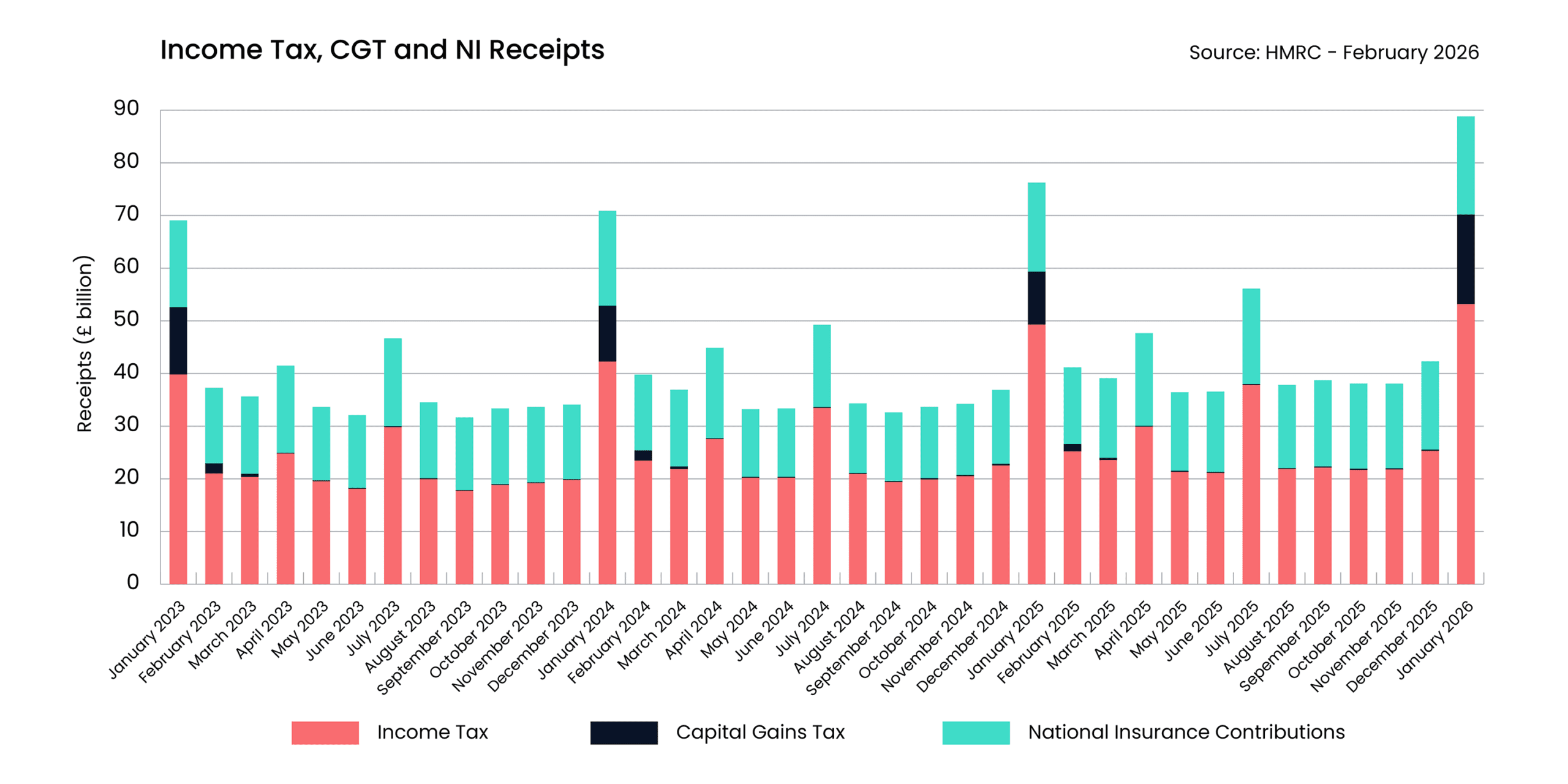
During January, we saw one of the highest volumes of monthly tax receipts, which was all down to self-assessment payments hitting new highs.
As illustrated in the chart below, January usually records increased receipts as 31st January is the self-assessment deadline – and this year was no different. Payments from income tax, capital gains tax (CGT) and national insurance (NI) reached £88.8 billion – way up from the £76.3 billion recorded in January 2025.
As income tax thresholds are frozen until at least 2031, receipts are expected to increase in the years ahead. The freezing of thresholds acts as a stealth tax, putting more workers into higher income tax bands as wages go up, ultimately increasing the overall tax take for the government.
Times of high inflation, like the ones experienced over the last few years, have also contributed to rising receipts. Inflation usually increases salaries, generates higher income tax revenues and increases the nominal value of assets, which in turn leads to larger CGT liabilities when gains are realised.
The value of an investment with St. James’s Place will be directly linked to the performance of the funds selected and may fall as well as rise. You may get back less than the amount invested.
Past performance is not indicative of future performance.
The information contained is correct as at the date of the article. The information contained does not constitute investment advice and is not intended to state, indicate or imply that current or past results are indicative of future results or expectations. Where the opinions of third parties are offered, these may not necessarily reflect those of St. James’s Place.
Source: London Stock Exchange Group plc and its group undertakings (collectively, the “LSE Group”). ©LSE Group 2026. FTSE Russell is a trading name of certain of the LSE Group companies.
“FTSE Russell®” is a trademark of the relevant LSE Group companies and is used by any other LSE Group company under license. All rights in the FTSE Russell indexes or data vest in the relevant LSE Group company which owns the index or the data. Neither LSE Group nor its licensors accept any liability for any errors or omissions in the indexes or data and no party may rely on any indexes or data contained in this communication. No further distribution of data from the LSE Group is permitted without the relevant LSE Group company’s express written consent. The LSE Group does not promote, sponsor or endorse the content of this communication.
© S&P Dow Jones LLC 2026; all rights reserved
Source: MSCI. Certain information contained herein, including without limitation text, data, graphs, charts (collectively, the “Information”) is the copyrighted, trade secret, trademarked and/or proprietary property of MSCI Inc. or its subsidiaries (collectively, “MSCI”), or MSCI’s licensors, direct or indirect suppliers or any third party involved in making or compiling any Information (collectively, with MSCI, the “Information Providers”), is provided for informational purposes only, and may not be modified, reverse-engineered, reproduced, resold or redisseminated in whole or in part, without prior written consent.
Source: Bloomberg. BLOOMBERG®” and the Bloomberg indices listed herein (the “Indices”) are service marks of Bloomberg Finance L.P. and its affiliates, including Bloomberg Index Services Limited (“BISL”), the administrator of the Indices (collectively, “Bloomberg”) and have been licensed for use for certain purposes by the distributor hereof (the “Licensee”). Bloomberg is not affiliated with Licensee, and Bloomberg does not approve, endorse, review, or recommend the financial products named herein (the “Products”). Bloomberg does not guarantee the timeliness, accuracy, or completeness of any data or information relating to the Products.
SJP Approved 02/03/2026