WeeklyWatch – New year, new global changes

7th January 2025
Stock Take
As we welcome in 2025, big changes are on the horizon and high expectations closely follow. The implications of the 2024 elections, tariffs, balancing inflation and reducing interest rates will significantly influence the way financial direction will be decided. So, let’s take a closer look at what 2025 has in store for markets…
A vote for change
2024 seemed to be the year of elections! Over half the global population took to the polls, and many nations opted for change.
The Head of Economic Research at St James’s Place, Hetal Mehta, commented on the events of the last 12 months:
“In a year peppered with many notable elections, the global economy was marked by heightened economic uncertainty in 2024. Despite concerns at the start of the year that restrictive monetary policy would weigh on GDP, growth surprised to the upside and recessions in the key developed market economies were avoided. A gradual cooling of labour markets – lower vacancies and lower wage growth without a significant increase in unemployment – combined with progress in taming inflation, has allowed central banks to pivot policy towards gradual rate cuts. But with the major elections behind us, it’s now time for governments to start implementing their policies.”
Tariffs steering the change
Investors will be keeping a keen eye on the potential use of tariffs across 2025. US President-elect Donald Trump frequently talked about his plans for tariffs during his election campaign and continues to do so to this day. Since Trump made his position clear, other nations have threatened to impose their own tariffs in response.
Inflation is generally the knock-on effect of tariffs, due to the way that costs are distributed across the supply chain. Consequently, this puts Central Banks into a tricky position as they decide whether to reduce interest rates and at what speed.
A look back at US finances over 2024
Expectations surrounding interest rate changes in the US slowed in 2024 as they battled to get inflation to 2%.
Federal Reserve policymaker Adriana Kugler spoke at the annual American Economic Association conference in San Francisco last week and said:
“We are fully aware that we are not there yet – no one is popping champagne anywhere.”
Overall, 2024 proved a good year for US shares, despite its inflation challenges. A second straight annual return of more than 20% (in US dollar terms) was secured by the S&P 500. Additionally, the NASDAQ ended the year up over 20% for the sixth time in eight years.
Canada off to an uncertain start
The Canadian political arena is far from stable. Over the weekend, there were numerous reports predicting that Prime Minister Justin Trudeau would announce his resignation – he confirmed the news yesterday (6th January), ending his nine-year stretch as leader. The population will cast their votes in the general election in October, and Trudeau’s Liberal Party are significantly behind in the current polls. Trudeau said he would stay in office until the party can choose a new leader.
European politics far from settled
Germany are also conducting a general election later in 2025. As it stands, the centre-right Christian Democratic Union and its Bavarian sister party, the Christian Social Union, are the current leaders in the polls, followed by the far-right Alternative for Germany.
In France, François Bayrou was named Prime Minister in December, after the resignation of Michel Barnier. He enters a precarious and potentially hostile parliament, which is likely to make passing any reforms a challenge.
Where Germany and France struggled across the year, many of the nations that underwent immense hardship in the eurozone debt crisis and in the fallout of the 2008 Financial Crisis – including Spain and Greece – reported surprising positive economic news over the course of the year.
UK charting rough waters
There have been several questions surrounding the possibility of ‘stagflation’ in 2025 – higher inflation with stagnant economic growth. The Bank of England will be required to put their heads together in order to reduce interest rates to encourage economic growth while ensuring that they’re not overwhelmed by inflationary pressures.
Wealth Check
Optimising your domestic money management
We’re told time and time again that we need to manage our money effectively – and for good reason!
Making a short-term, last-minute, snap or impulsive financial decision can be costly if it results in late payments, lost interest or even monetary penalties. But creating good financial habits can make a huge difference. Getting your house in order and starting regular savings are an excellent practice and can really boost both your financial and emotional well-being.
Wellesley’s top 5 tax-smart tips for your 2025 money management
- Optimise your allowances
Are you aware of how many tax allowances you can access and whether you’re making the most of them? A lot of people remember to top up their ISAs as much as they can before tax year-end, but there are still other allowances that are overlooked and ‘carry forwards’, which can save you money.
For example, in addition to the £60,000 annual pension allowance (or 100% of your earnings, whichever is lower) on which you can get tax relief on pension payments, HMRC will allow you to carry forward unused allowances from the previous three tax years.
- Check the values
Do you frequently check how your pensions are doing? Or the interest your savings accounts or ISAs have earned? Compiling a list of all your assets, including pensions, property and premium bonds, is a great tax-smart start – and with regular reviews, it becomes a smart money habit for the long term. You also may have more than one pension pot if you’ve changed jobs. Additionally, if you have an accessible cash fund for emergencies, a good question to ask yourself is whether there’s enough to keep you and your family afloat for up to six months if needed.
- Refresh and amend your spending
How many memberships and subscriptions are you signed up for? Ensuring that you check on this or whether other family members are still using the service you’re paying for is another smart money habit. Monthly payments add up, and you may want to consider changing to another provider or unsubscribing from the service completely.
- ISAs, savings and pensions contributions
By getting into the practice of regular, monthly payments into your savings or pension is a great tax-smart strategy. By the end of the tax year, you’ll be ahead of the game and avoid the rush to boost up tax-efficient contributions before 5th April. Regular contributions to any investment type helps bring stability in a volatile market.
- Have regular meetings with your financial adviser
Finding an hour per week to check your payments and interest rates saves you time and tax in the long term. Having a financial adviser for support can help you keep your finances on track and assess your trajectory to achieving your long-term investment goals and objectives, which is just as beneficial for your financial health.
The value of an investment with St. James’s Place will be directly linked to the performance of the funds selected and may fall as well as rise. You may get back less than the amount invested.
Investing does not provide the security of capital associated with a deposit account with a bank or building society.
The levels and bases of taxation, and reliefs from taxation, can change at any time and are generally dependent on individual circumstances.
Savings accounts are not available through St. James’s Place.
In The Picture
Growth has been slow across Europe, and business confidence continues to be weak. In comparison, the US’s statistics show a lot more strength.

The Last Word
“This year we will show Britain can change…politics can be a force for good and we can unite the NHS behind a plan for reform.”
– British Prime Minister Keir Starmer on his government’s plan for the NHS.
The information contained is correct as at the date of the article. The information contained does not constitute investment advice and is not intended to state, indicate or imply that current or past results are indicative of future results or expectations. Where the opinions of third parties are offered, these may not necessarily reflect those of St. James’s Place.
Source: London Stock Exchange Group plc and its group undertakings (collectively, the “LSE Group”). ©LSE Group 2025. FTSE Russell is a trading name of certain of the LSE Group companies.
“FTSE Russell®” is a trademark of the relevant LSE Group companies and is used by any other LSE Group company under license. All rights in the FTSE Russell indexes or data vest in the relevant LSE Group company which owns the index or the data. Neither LSE Group nor its licensors accept any liability for any errors or omissions in the indexes or data and no party may rely on any indexes or data contained in this communication. No further distribution of data from the LSE Group is permitted without the relevant LSE Group company’s express written consent. The LSE Group does not promote, sponsor or endorse the content of this communication.
© S&P Dow Jones LLC 2025; all rights reserved.
Source: MSCI. MSCI makes no express or implied warranties or representations and shall have no liability whatsoever with respect to any MSCI data contained herein. The MSCI data may not be further redistributed or used as a basis for other indices or any securities or financial products. This report is not approved, endorsed, reviewed or produced by MSCI. None of the MSCI data is intended to constitute investment advice or a recommendation to make (or refrain from making) any kind of investment decision and may not be relied on as such.
SJP Approved 06/01/2025
WeeklyWatch – Finding economic stability among challenges

17th December 2024
Stock Take
Bayrou steps in to try and calm the political storm
French President Macron will be hoping to avoid any more Christmas horrors from now on as he pins hopes on his new prime minister, Françoise Bayrou, to unite the messy political arena.
Bayrou is widely considered a centrist in French politics and replaces Michel Barnier as prime minister after his resignation following a no confidence vote. Barnier’s leadership only lasted for a few months, and he was unable to pass a 2025 budget due to intense opposition from both the left and right. If a new budget isn’t passed, then under French law, the government must use the prior year’s budget to avoid the danger of a government shut down.
How has the chaos affected French finances?
Needless to say, Bayrou is entering a challenging scene. The chaos that preceded Barnier’s exit from leadership still prevails and there cannot be a new election until the middle of 2025. The turbulence of the situation was made noticeable through Moody’s downgrading of France’s credit rating on Friday last week as a result of a high deficit.
Among the political and economic difficulties, French equities have unsurprisingly not performed well this year. But it’s worth bearing in mind that markets don’t always perform in accordance with economic performance on a wider scale.
Hopping over the border to Germany
France’s neighbours seem to be exemplifying how a market can perform well despite further challenges. Germany has had a tough time with its economy over the course of this year; however, year-to-date, the German DAX index is up over 20% and trading at record highs. It celebrated further success when it recently broke the 20,000 mark for the first time.
The gradual fall in interest rates has also helped the German market, and more is hoped to come. The European Central Bank (ECB) fuelled these hopes last Thursday when they reduced interest rates by another 0.25% – the fourth move in 2024. This reinforces lower economic growth projections over the next few years in addition to an expected mundane inflationary backdrop.
The ECB President, Christine Lagarde, has given strong indications that more interest rate cuts will take place in 2025; she stated:
“If the incoming data continue to confirm our baseline, the direction of travel is clear and we expect to lower interest rates further.”
Could Trump’s planned tariffs cause inflation trouble?
President-elect Donald Trump has recently had a lot to say about his proposed tariffs under his leadership, and they could have a large effect on inflation.
The US Labor Department announced last week that consumer prices increased by 2.7% in November, which was up from the 2.6% posted in October. This showcased that the pressure of inflation still remains prominent in the US. Despite the small increase in figures, the Fed are still likely to make further interest rate cuts after their meeting this week.
Attention turns to interest rates for the UK
The Bank of England (BoE) are scheduled to meet this Thursday to further discuss interest rates.
The latest economic information showed that the UK’s economy shrank in October on the back of another fall in September. The UK economy has been expected to slow down in the second half of the year after better-than-expected growth during the first half of the year.
The Head of Economic Research at St James’s Place, Hetal Mehta, said:
“GDP declined by 0.1% month on month in October, following a fall in September. While that will most likely mean fourth quarter growth is weaker than what the BoE was expecting, forward-looking indicators are somewhat better. With credit conditions loosening, interest rates moving lower and increased government spending on its way, the UK economy should experience modest growth next year. Signals from the housing market are a good cross-check and show resilience.”
Wealth Check
How well do you understand income tax?
Many people know that income tax is charged at 0%, 20%, 40% or 45% and this is dependent on how much a person earns.
In Scotland, the rates differ slightly, but a 60% tax band isn’t a reality – on paper. But higher-rate taxpayers should stay aware.
Making sense of UK tax
It would be somewhat of an understatement to describe the UK tax system as complicated, but it’s also very appropriate. Tax regulations can change regularly – as seen in the Autumn Budget – and even if an individual is tax savvy, it’s easy to misunderstand or misinterpret the rule changes, and you could walk into a 60% tax trap and not even notice!
How is 60% tax possible?
The name given to this high tax rate is called ‘stealth tax’. It’s an unofficial effected rate of income tax – a 60% rate of income isn’t recognised in any HMRC guidelines.
If you’re earning £100,000 or more, the £12,750 personal allowance (the amount of income you can earn each year without paying income tax) reduces or goes away. As it stands, the allowance reduces at a rate of £1 for every £2 earned above £100,000.
Putting this into more realistic settings, for income between £100,000 and £125,140, £40 of every £100 is taken in income tax. Another £20 is then lost through the reduction of the personal allowance.
In addition, you’ll pay the Employee National Insurance at 2% on the income. All together this totals a 60% tax rate, plus National Insurance. If you’re earning over £125,140 or more, you won’t get any personal allowance at all.
How can pensions make taxes more balanced?
One of the best ways to bring taxable income below the threshold is to put more money into your pension before the end of the tax year. Not only will you reduce your tax bill, but you’ll support your retirement finances at the same time.
If you’re just edging over one of the tax bands, putting more money into your pension can impact your taxes in several ways. Any contribution you make will reduce your taxable income, but we recommend only paying in as much as you can afford.
The maximum amount you can pay into your pension each year is £60,000 – any more and you’ll lose government tax relief on your contributions.
The value of an investment with St. James’s Place will be directly linked to the performance of the funds you select and the value can therefore go down as well as up. You may get back less than you invested.
The levels and bases of taxation, and reliefs from taxation, can change at any time and are generally dependent on individual circumstances.
In The Picture
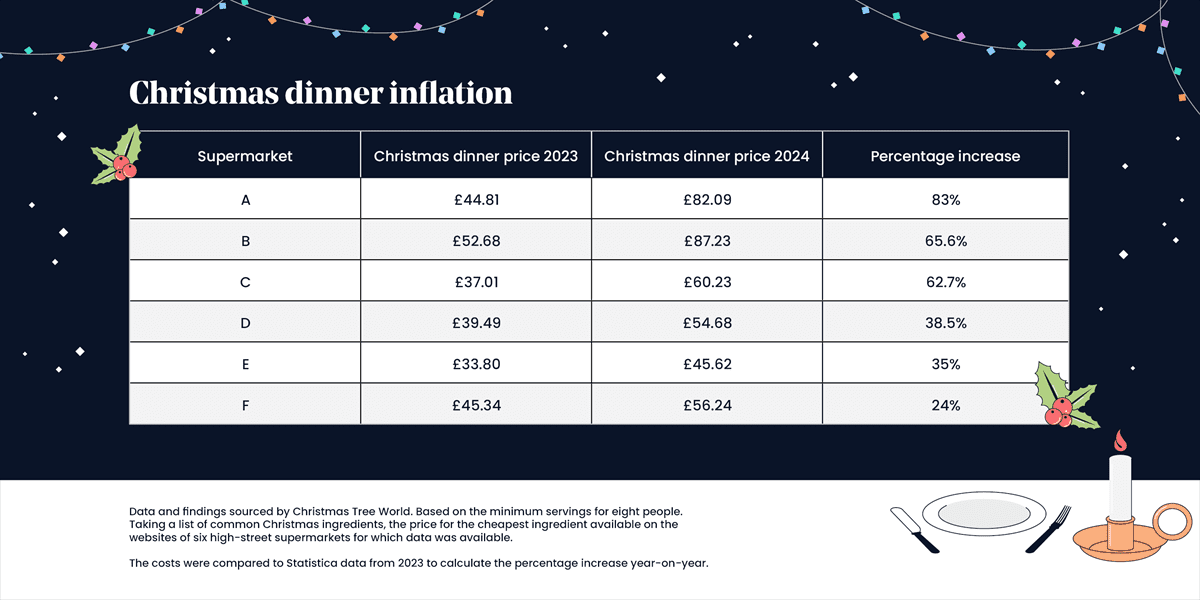
Despite the fall in inflation across the year, Christmas dinners are looking likely to be more expensive than last year’s…
The Last Word
“The darkest days of winter look to be behind us.”
– ECB President Christine Lagarde as she expresses her views on inflation.
Thank you to all our readers for 2024 and we’ll be back on 7th January 2025.
The information contained is correct as at the date of the article. The information contained does not constitute investment advice and is not intended to state, indicate or imply that current or past results are indicative of future results or expectations. Where the opinions of third parties are offered, these may not necessarily reflect those of St. James’s Place.
Source: London Stock Exchange Group plc and its group undertakings (collectively, the “LSE Group”). ©LSE Group 2024. FTSE Russell is a trading name of certain of the LSE Group companies.
“FTSE Russell®” is a trademark of the relevant LSE Group companies and is used by any other LSE Group company under license. All rights in the FTSE Russell indexes or data vest in the relevant LSE Group company which owns the index or the data. Neither LSE Group nor its licensors accept any liability for any errors or omissions in the indexes or data and no party may rely on any indexes or data contained in this communication. No further distribution of data from the LSE Group is permitted without the relevant LSE Group company’s express written consent. The LSE Group does not promote, sponsor or endorse the content of this communication.
© S&P Dow Jones LLC 2024; all rights reserved.
Source: MSCI. MSCI makes no express or implied warranties or representations and shall have no liability whatsoever with respect to any MSCI data contained herein. The MSCI data may not be further redistributed or used as a basis for other indices or any securities or financial products. This report is not approved, endorsed, reviewed or produced by MSCI. None of the MSCI data is intended to constitute investment advice or a recommendation to make (or refrain from making) any kind of investment decision and may not be relied on as such.
SJP approved 16/12/2024
WeeklyWatch – Markets remain calm despite political turmoil

10th December 2024
Stock Take
The news this year has largely been dominated by the UK and US elections, as well as the conflict in Ukraine and the Middle East. As we head to the end of 2024, however, it’s France and South Korea drawing the focus.
French divisions
On Wednesday last week, French Prime Minister Michel Barnier stepped down after losing a vote of no confidence.
There’s currently a division in the French parliament between President Macron’s centrist party, a left-wing alliance and the right-wing National Rally. The prime minister had attempted to navigate this challenging dynamic to secure approval for next year’s budget, but failed to find a compromise that could win the support of two of the three factions.
Barnier’s resignation presents Macron with a significant challenge. As president, he has the authority to appoint the next prime minister, but the nominee must gain parliament’s approval to avoid the same issues as Barnier. With Macron having no option to call another election until mid-2025, Barnier’s successor will face the same challenges until then. Nevertheless, Macron announced on Friday that he intends to name the new prime minister in the coming days.
Ripple effect on the markets
In the aftermath of Barnier’s resignation, Partner at TwentyFour Asset Management Felipe Villaroel identified a contrast between the political disruption and fairly calm response from the financial markets in the recent fallout. He stated:
“As opposed to previous problematic episodes in the eurozone, there is no imminent threat of a ‘Frexit’. A US-style government shutdown scenario is not on the cards; if there is no support for a new budget, then a version of 2024’s would apply next year. This means the French government can continue receiving taxes, spending monies and, most importantly, paying bond coupons. Therefore, from a markets perspective the worst-case scenario here is far less damaging than previous examples of government budget stand-offs.”
There was a surprise rise in the Euronext France CAC 40 Index by 2.78% last week, with improved performance in the later part of the week.
Uproar against martial law
Following close on the heels of France’s chaos came the unfolding events in South Korea when President Yoon Suk Yeol attempted to enact martial law on the country. His attempt failed when the country’s National Assembly rejected it, but the full implication of the political fallout is unclear.
Attempts were subsequently made to impeach Yoon, but these failed when his party wouldn’t back the motion. Calls for Yoon’s resignation have continued, and Yoon is currently under an international travel ban.
There was a notable response to the fallout with a resulting fall in the Korea Stock Exchange of 1.13% in local currency.
Wider political relations unfold across Asia
The exchanges between China and the US regarding their trade war continued last week. China announced that they were placing restrictions on a number of rare earth mineral exports to the US. These minerals are highly important in the US’s manufacturing of a wide variety of technologies which includes semiconductors.
Head of Asia and Middle East Investment Advisory at St James’s Place, Martin Hennecke, comments on the latest developments:
“Events like the political turmoil in South Korea or the rare earth export restrictions applied by China in response to new semiconductor export restrictions by the US are hard to predict. It can serve as a good reminder of the importance of the three factors of diversification: avoiding short-term speculation as well as avoiding leverage coupled with overconfidence on specific predictions.”
How did this affect the markets?
China’s attempts to cause disruption for the US wasn’t enough to prevent the S&P 500 securing a record high at the end of last week. Jobs data announced on Friday continued to boost the expectation of another interest rate cut.
On home soil, the FTSE 100 ended the week pretty flat, even though the Bank of England Governor, Andrew Bailey, told the Financial Times that he was aiming to initiate four interest rate cuts in 2025, and at the end of the week house prices hit a record high.
Wealth Check
Gifting cash or assets is a practical, thoughtful present that can open up many opportunities – from paying for a family holiday to covering an everyday need like extra days at nursery for a new grandchild. It could also kick-start savings to turn a dream into a reality.
Cash gifts aren’t your only option. There are many tax-smart ways to gift to your family – any of which could save you a significant amount of tax.
Have you considered a Christmas cash gift?
Gifting cash can provide a welcome boost to your loved ones, with lasting benefits beyond the immediate as it could reduce your Inheritance Tax liability as well. The annual gift allowance allows you to give away up to £3,000 a year, as well as small gifts of up to £250, reducing the size of your estate and your Inheritance Tax liability.
A Junior ISA – a great present for Christmas
Much like other ISAs, Junior ISAs (JISAs) are a tax-efficient way to save and also encourage children to develop smart saving habits. A parent or legal guardian can open a JISA for a child living in the UK and under the age of 18 (some exemptions exist for children living outside the UK). Anyone can contribute to the JISA once it’s been opened – it can be a great opportunity for a new Christmas tradition!
Starting your child’s pension early isn’t just for Christmas
Let’s be honest, no eight-year-old is putting a child’s pension on their Christmas wish list alongside a LEGO set or games console. For a parent or guardian, however, starting a pension on their behalf is a meaningful, forward-thinking gift. It not only gives a great start to their future, but it also instils valuable lessons about saving regularly and setting aside extra money for the long term.
Whichever road you choose in life, money will help make it a reality. So, start giving and enjoy a tax-smart Merry Christmas! If you need some guidance about gifting and taxes, we’re here to help – contact us for a no-obligation consultation today.
The value of an investment with St. James’s Place will be directly linked to the performance of the funds selected and may fall as well as rise. You may get back less than the amount invested.
The levels and bases of taxation and reliefs from taxation can change at any time. Tax relief is generally dependent on individual circumstances.
In The Picture
The political challenges that South Korea and France are facing aren’t new – both countries have been struggling this year.
Past performance is not indicative of future performance.
Please note it is not possible to invest directly into a financial index and the figures shown do not take into account any charges applicable to the appropriate investment wrapper or any relevant tax charges.

The Last Word
“The developments in Syria in recent hours and days are unprecedented, and we are speaking to our partners in the region and monitoring the situation closely.”
– UK Prime Minister Sir Keir Starmer comments on the fall of Syria’s Bashar al-Assad.
The information contained is correct as at the date of the article. The information contained does not constitute investment advice and is not intended to state, indicate or imply that current or past results are indicative of future results or expectations. Where the opinions of third parties are offered, these may not necessarily reflect those of St. James’s Place.
Source: London Stock Exchange Group plc and its group undertakings (collectively, the “LSE Group”). ©LSE Group 2024. FTSE Russell is a trading name of certain of the LSE Group companies.
“FTSE Russell®” is a trademark of the relevant LSE Group companies and is used by any other LSE Group company under license. All rights in the FTSE Russell indexes or data vest in the relevant LSE Group company which owns the index or the data. Neither LSE Group nor its licensors accept any liability for any errors or omissions in the indexes or data and no party may rely on any indexes or data contained in this communication. No further distribution of data from the LSE Group is permitted without the relevant LSE Group company’s express written consent. The LSE Group does not promote, sponsor or endorse the content of this communication.
© S&P Dow Jones LLC 2024; all rights reserved.
Source: MSCI. MSCI makes no express or implied warranties or representations and shall have no liability whatsoever with respect to any MSCI data contained herein. The MSCI data may not be further redistributed or used as a basis for other indices or any securities or financial products. This report is not approved, endorsed, reviewed or produced by MSCI. None of the MSCI data is intended to constitute investment advice or a recommendation to make (or refrain from making) any kind of investment decision and may not be relied on as such.
SJP approved 09/12/2024
WeeklyWatch – Sales, tariffs and politics on the menu

3rd December 2024
Stock Take
Let the holiday celebrations and sales commence!
It was a big week for finances in the US last week with both Thanksgiving and Black Friday taking place, with the latter providing insight into the level of confidence in US retail.
Mastercard SpendingPulse revealed an increase of 3.4% in Black Friday sales compared to last year overall.1 Most of the increase was made up of online retail sales, and in-store sales were up just 0.7% according to Mastercard. The statistics reveal that there is a level of confidence in US consumers across the nation; however, it should be highlighted that these figures aren’t adjusted for inflation.
Speaking of inflation…
It was revealed last week by the US Commerce Department that personal consumption expenditures increased by 2.3% in the 12 months leading up to October; these figures were up on the September figures of 2.1%. A rise is significant, and the Fed included these numbers in their interest rate calculations, but it still remains close to the Fed’s 2% target.
Trump reveals more of his financial plans
President-elect Donald Trump has made more of his potential tariff plans public. His first one is to place a 25% tariff on Mexican and Canadian imports.
In 2018, Trump signed the US-Mexico-Canada Agreement (USMCA), which has been highly influential in shaping North American trade since then. With the agreement due for renewal in 2025, these tariff threats could be part of an aggressive negotiation tactic.
Chief Investment Officer at BlueBay Mark Dowding seems to agree. He implies that Trump’s tariff proposals may be being put forth while keeping focus on future immigration arrangements with Mexico and placing pressure on Canadian Prime Minister Justin Trudeau as the country goes into their next election year. Dowding notes:
“The market consensus appears to be that Trump’s bark is worse than his bite and that it’s possible to look through his comments without taking them at face value.”
Trump nominates more officials
Away from tariffs, Hedge Fund Manager Scott Bessent was announced as Trump’s nominee as Treasury Secretary.
Bessent’s background means that he’s being perceived as a market-friendly operator who will likely place a strong priority on economic stability. News of this stance will be well received by those who are wary of the impact of Trump’s economic policies.
This news also helped to boost the S&P 500 and NASDAQ index, which rose 1.06% and 1.13% respectively over the course of the week. But the most significant shift was from the smaller companies’ universe. The Russell 2000 index – the smallest 2,000 companies in the Rusell index) – entered into new record-breaking territory having moved past the level set three years ago.
Uncertainty across French finances and politics
France’s deterioration on the political stage has had a big negative impact on markets. As it stands, Prime Minister Michel Barnier holds a fragile hand of power over parliament while he is bombarded with blocks from both the political left and right. The far-right National Rally party leaders have been calling for several budget concessions in exchange for not supporting a no confidence vote against Barnier’s government. However, if Barnier relies on constitutional powers to push a social security financing bill through, the left-wing members of parliament can put forward a vote of no confidence.
In the midst of so much insecurity, it’s no surprise that French equities suffered over the week. But overall, the MSCI Europe ex. UK did manage to make a 0.3% gain.
The FTSE 100 also rose by 0.3%, boosted by gains in retail and property stocks – the latter enhanced by growing property prices. Nationwide has said that house prices rose 1.2% month-on-month in November and that house prices are just 1% below their all-time peak.
BlueBay is a fund manager for St. James’s Place.
Source
1Mastercard SpendingPulse, 02/12/2024
Wealth Check
Home sweet home
Purchasing your home is likely to be the largest single purchase you’ll ever make – and for many people, it’s their most valuable asset.
As a homeowner, you can access both short- and long-term key tax benefits that help both you and your family. In this section, we’ll explore the tax advantages of home ownership. You may know some, but there may be a few others that you may not have considered.
Stamp Duty Land Tax (SDLT)
As a first-time house buyer, you’ll become eligible for one of the largest tax breaks for homeowners, which is first-time buyer’s relief from SDLT. This applies to the £425,000 of a property’s value if the home is worth £625,000 or less.
- If the asking price for the property is between £425,000 and £625,000, you’ll pay 5% SDLT.
- If the house costs more than £625,000, the normal rate of SDLT will be paid, which is between 5% and 12% of the price.
The 0% stamp duty threshold for first-time buyers will be reduced to £300,000 from 31st March 2025.
Rent a Room Scheme
The current cost of living crisis and continuous increase in prices have resulted in households having to budget more extensively. One of the first things we look to do when budgets are stretched is to find areas where we can save money. A lot of homeowners are considering renting out a room in their main property as an occasional Airbnb, a bed and breakfast or a longer-term let for lodgers.
By using the government’s Rent a Room Scheme, you can reap a good tax benefit.
The Head of Mortgages at SJP, Paul Johnson, says:
“People don’t seem to use, or even be aware of, the Rent a Room Scheme. Not only might you qualify for up to £7,500 tax-free income from renting a furnished room in your home, but some mortgage lenders will also accept it as an income. In general, it’s a little-known – and under-utilised – tax break.”
Please note that the tax allowance is halved to £3,750 if you share the income with your partner or a joint owner.
The levels and bases of taxation, and reliefs from taxation, can change at any time and are generally dependent on individual circumstances.
In The Picture
As we explore the S&P 500 through each generation, we can see both the volatility of equity markets and the potential for long-term investment returns.

The Last Word
“If we want to stop the hot stage of the war, we should take under NATO umbrella the territory of Ukraine that we have under our control. That’s what we need to do fast, and then Ukraine can get back the other part of its territory diplomatically.”
–Volodymyr Zelensky, President of Ukraine, as he speaks to Sky News on how NATO could potentially end the current hostilities in Ukraine.
The information contained is correct as at the date of the article. The information contained does not constitute investment advice and is not intended to state, indicate or imply that current or past results are indicative of future results or expectations. Where the opinions of third parties are offered, these may not necessarily reflect those of St. James’s Place.
Source: London Stock Exchange Group plc and its group undertakings (collectively, the “LSE Group”). ©LSE Group 2024. FTSE Russell is a trading name of certain of the LSE Group companies.
“FTSE Russell®” is a trademark of the relevant LSE Group companies and is used by any other LSE Group company under license. All rights in the FTSE Russell indexes or data vest in the relevant LSE Group company which owns the index or the data. Neither LSE Group nor its licensors accept any liability for any errors or omissions in the indexes or data and no party may rely on any indexes or data contained in this communication. No further distribution of data from the LSE Group is permitted without the relevant LSE Group company’s express written consent. The LSE Group does not promote, sponsor or endorse the content of this communication.
© S&P Dow Jones LLC 2024; all rights reserved.
Source: MSCI. MSCI makes no express or implied warranties or representations and shall have no liability whatsoever with respect to any MSCI data contained herein. The MSCI data may not be further redistributed or used as a basis for other indices or any securities or financial products. This report is not approved, endorsed, reviewed or produced by MSCI. None of the MSCI data is intended to constitute investment advice or a recommendation to make (or refrain from making) any kind of investment decision and may not be relied on as such.
SJP approved 02/12/2024
WeeklyWatch – Inflation and interest rate directions altered

26th November 2024
Stock Take
UK battles with inflation
The week began with the revelation that further increases to energy bills saw inflation leap to 2.3% from 1.7% in September, and then reached its highest level in six months in October. This means that the Bank of England (BoE) must remain cautious when it comes to further interest rate cuts. For both policymakers and households, there was an unforeseen clean sweep of higher headline, core and services inflation.
As a result, expectations of a further rate cut next month have been dashed by BoE governor Andrew Bailey. He cited that a gradual approach to easing interest rates was the more sensible path due to the unknown impact on inflation levels after employer National Insurance contributions were increased under the Budget.
It’s forecasted by the BoE that the Budget measures will keep consumer price inflation at 2.7% by the end of 2025, and it’s unlikely that it will fall below the 2% target until mid-2027 – a full year later than the Bank was expecting back in August this year.
Pre-budget anxiety bites back
Inflation wasn’t the only disappointment for the UK. Pre-Budget nerves were highlighted as the reason for the bigger-than-expected drop in UK retail sales in October. Clothing sales were “notably poor” according to the Office for National Statistics, with the mild weather playing a role in delaying purchases of warmer garments.
Borrowing puts pressure on Reeves
Chancellor Rachel Reeves faces a larger-scale challenge than first thought – the news broke last week that the government had borrowed more money than expected in October. The implementation of inflation-linked pay increases in the public sector, one of the government’s initial policy announcements, resulted in a 13.5% rise in staff costs.
The government’s spending ambition is to boost economic growth, but as the week drew to a close, it was revealed that plans to increase taxes on businesses were a contributing factor to the first contraction in UK private sector activity in 13 months. In the same report, it was revealed that for the second successive month, employers made cuts to their staffing levels.
Japan takes purposeful steps forward
Markets were busy at the start of the week, analysing the comments made from the Bank of Japan’s (BoJ) governor, Kazuo Ueda, who stated that Japan’s economy was making positive steps towards its inflation target. His words come after the rise in wages and sturdy profits. But Ueda demonstrated that he was under no illusion concerning the external risks, including US president-elect Trump’s economic policy. He also stated that the BoJ wouldn’t wait for these uncertainties to go before going ahead with raising interest rates.
Investors were somewhat let down by Japan’s unclear direction, and after hearing Ueda’s words, they interpreted this as a sign that a December rate hike is likely to go ahead. This prediction is further supported by the information revealed on Friday that showed that core inflation figures in October stayed above the central bank’s 2% target. The negative interest rate era was ended in March by the BoJ and the last raise in short-term policy rate came in July to 0.25%.
Are rising tensions over Ukraine affecting financial policy?
Escalating tensions between Russia and the US regarding Ukraine caused investors to shy away from riskier investments, and on Tuesday, investors turned to more safe-haven assets.
Russia’s nuclear doctrine was updated by President Putin in response to the US allowing American-made missiles to be fired deep into the country. As a result, European stocks hit a three-month low and there was a sharp retreat in US Treasury yields – after being boosted over the last few weeks by Trump’s tariff plans, stickier inflation readings and lowered rate cut expectations.
Eyes also on US tech giant
The third-quarter earnings report from Nvidia – the world’s most valuable company – was eagerly awaited by investors. They were keen to look for clues ascertaining to the heralding of artificial intelligence (AI) – responsible for driving a large amount of the market’s rally this year – and whether it can be maintained.
However, despite a delivery of exceeded expectations when it came to revenue and profits, Nvidia’s fourth-quarter growth forecast fell below the high-level predictions of investors. The tech giant conveyed that revenue growth would slow down to around 70% from 94% in the third quarter. The figures still reflect strong demand for Nvidia’s AI chips and suggest that the AI tailwind may still be a big driving force in equities in 2025.
How are global stocks faring?
On Thursday, global stocks notched higher regardless of Nvidia’s forecast putting a dampener on the technology sector. These stocks were also affected by the demand from the US Department of Justice that Alphabet must sell Chrome to put an end to Google’s search monopoly – it’s estimated that 90% of all global online searches are attributed to Google.
Increasing geopolitical concerns meant that markets were cautious, but this didn’t stop global stocks finishing the week in positive territory; investors took time to think about president-elect Trump’s likely policies and their subsequent impact on the US economy. One possible outcome is that his policies will be moderated in order to prevent an increase in inflation; high inflation discontent was one of the big reasons as to why Trump won office.
There were also weekly gains for Wall Street’s leading indices, and the FTSE 100 celebrated its best week in six months as a result of a weaker pound boosting exporters. However, Europe’s Stoxx suffered a fourth straight week of losses.
Mark Dowding of BlueBay Asset Management suggested:
“We think that with economic data remaining upbeat, the Fed will probably deliver the last cut in the mini-cycle for the time being, in either December or January, then signal that rates are on hold for a period. This will conveniently allow Powell and colleagues to assess the actions of Trump’s team before taking additional action, as we progress through 2025.”
Wealth Check
Moving forward with care when scaling back your business
Scaling back a business is challenging, but careful planning can protect you and your team.
If your company is going through a rough patch, keeping good data is essential according to Andrew Shepperd, the Co-founder and Director of consultancy Entrepreneurs Hub. He states:
“When times are tough, you’ll get peace of mind just knowing where you are. Your data might show that, with some changes, you can make it through in 12 to 18 months and face the challenges with more confidence.”
What can I do to best support my business?
To avoid the closure of your business, there are many things that you can consider, including:
- Increasing your efficiency through automation
- Cutting non-essential costs
- Improving credit collection
- Striving for better payment terms with customers and suppliers
- Renegotiating bank loans
- Reducing supply-chain risks
- Selling non-essential assets
If you’re at risk of insolvency because of one or two unpaid invoices, you can consider taking out trade credit insurance and protect yourself against non-payments.
Asking the tough questions
Ensure that you conduct thorough checks in each business segment; this will make sure that if you choose to cut back in one area, it doesn’t affect another.
When carrying out your checks, you’ll need to ask yourself some tough questions:
- Have I focused too much on pet projects and ignored more profitable areas?
- Have I kept busy with day-to-day needs but haven’t addressed the core threats to your business’ profits?
- Have I taken on too many low-profit customers? Do I need to be more discerning when it comes to my customer base?
- Do I need to place more focus on improving customer proposition and invest more in marketing and salespeople?
Third-party advice could be the key
Third-party advice can be highly valuable in helping you face up to these issues and set emotional attachment to staff or areas of the business to the side.
Bailey goes on to say:
“Talk to your accountant and financial planner to get a full picture of your standing. Do you have to close, or are there other options? For example, could you sell all or part of your business to a larger firm that could use economies of scale to run it more efficiently and underpin staff employment? Large companies often buy small ones just for ‘team and tech’ – the revenue is so small, it’s inconsequential, but the value of staff and their skills can take years to build, so a larger company may be attracted and, by acquisition, instantly add that skill competency to their business.”
How do I bounce back?
Insolvency is what takes place when a company can no longer pay its debts, whether that’s down to an inability to pay bills and run out of cash or you have more liabilities than assets.
If a new start-up is on the cards, then there are a few things to bear in mind:
- Any new trading name must not have any association with a former limited company.
- Reduce your liabilities early on will help you come back stronger. If you’re a limited company, the owner’s personal liability for business debts is limited to the amount they invested in the firm. You’re not personally responsible for paying the firm’s debts in the event of closure.
- Avoid offering personal guarantees of business loans; this can make you liable. Try and negotiate them out of agreements, and move family members of the business, particularly if they’re inactive.
- Make sure that you understand employee’s rights in insolvency, including redundancy and the Protection of Employment (TUPE) rules, if selling is a concern.
- Get advice on tax implications surrounding solvent liquidation, e.g. any remaining profit in the business could be taxable, but you might be able to use the Business Asset Disposal Relief.
- Always keep good records.
The levels and bases of taxation, and reliefs from taxation, can change at any time. The value of any tax relief depends on individual circumstances.
In The Picture
Head of Economic Research at St James’s Place, Hetal Mehta, says:
“While headline inflation has broadly fallen to the 2% target since the spike in energy prices, core inflation – which excludes volatile items like food and energy – remains close to 3% and wages are growing at around 4%. We expect inflation to remain higher for longer, reinforcing the importance of holding a well-diversified portfolio designed to navigate different economic conditions.”

The Last Word
“Nuclear will play a vital role in our clean energy future. That is why we are working closely with our allies to unleash the potential of cutting-edge nuclear technology. Advanced nuclear technology will help decarbonise industry by providing low-carbon heat and power, supporting new jobs and investment here in the UK.”
– Ed Miliband, Energy Secretary, responding to the new agreement for civil nuclear collaboration signed by the UK and US and COP29 in Baku, helping strengthen energy security.
The information contained is correct as at the date of the article. The information contained does not constitute investment advice and is not intended to state, indicate or imply that current or past results are indicative of future results or expectations. Where the opinions of third parties are offered, these may not necessarily reflect those of St. James’s Place.
Source: London Stock Exchange Group plc and its group undertakings (collectively, the “LSE Group”). ©LSE Group 2024. FTSE Russell is a trading name of certain of the LSE Group companies.
“FTSE Russell®” is a trademark of the relevant LSE Group companies and is used by any other LSE Group company under license. All rights in the FTSE Russell indexes or data vest in the relevant LSE Group company which owns the index or the data. Neither LSE Group nor its licensors accept any liability for any errors or omissions in the indexes or data and no party may rely on any indexes or data contained in this communication. No further distribution of data from the LSE Group is permitted without the relevant LSE Group company’s express written consent. The LSE Group does not promote, sponsor or endorse the content of this communication.
© S&P Dow Jones LLC 2024; all rights reserved.
Source: MSCI. MSCI makes no express or implied warranties or representations and shall have no liability whatsoever with respect to any MSCI data contained herein. The MSCI data may not be further redistributed or used as a basis for other indices or any securities or financial products. This report is not approved, endorsed, reviewed or produced by MSCI. None of the MSCI data is intended to constitute investment advice or a recommendation to make (or refrain from making) any kind of investment decision and may not be relied on as such.
SJP approved 25/11/2024
WeeklyWatch – ‘Trump Trade’ sways US markets

19th November 2024
Stock Take
Investors respond to the president-elect’s agenda
After the preceding week’s relentless news cycle, markets had less to absorb last week.
Wall Street kicked off the week by extending its post-election rally and hitting new highs. However, global stocks pulled back as the so-called ‘Trump Trade’ saw investors lean towards assets likely to benefit from the president-elect’s proposed policies. Among these were plans for aggressive tax cuts targeting workers, businesses and retirees.
Forecasters project that Trump’s tax and spending agenda could add $7.5 trillion to the already substantial $35 trillion national debt. A Reuters poll found that 62% of Americans expect his policies to drive the debt even higher. Vaccine makers also weighed on the market after Trump indicated he wanted Robert F. Kennedy Jr., a vocal anti-vaccine advocate, to lead the Department of Health and Human Services.
The week ended with Wall Street giving back some of its recent gains, as some investors took profits after the post-election surge.
Consumer inflation weighs on markets
Last week also saw investors focus on the latest US consumer inflation figures and what they might mean for interest rates.
On Wednesday, the US Department of Labor reported that consumer price inflation accelerated last month, reaching an annual rate of 2.6%. Shortly after, it was revealed that rising service costs had driven up US producer inflation in October as well. This slowdown in progress toward the lower inflation target fuelled speculation that the Federal Reserve may scale back the extent of its anticipated interest rate cuts.
Wall Street tracked higher on the view that the inflation data kept the Fed on track to cut rates in December, but its performance was ultimately impacted by the aforementioned Trump Trade movements. The MSCI World Index also slipped to register its biggest weekly drop in two months as investors digested the prospect of a slower pace of interest rate cuts ahead.
Looking further ahead, in comments on Thursday, Fed chair Jerome Powell said there was no rush to lower interest rates given the strength of the economy, but he would not be drawn on the politics of what impact Trump’s tariff and tax plans might have on future moves.
US households faring well
Meanwhile, a fall in weekly jobless claims suggested the sharp drop in job growth in October was an anomaly and the US labour market was still pottering along.
In another indicator of the health of the US economy, retail sales rose 0.4% last month – more than expected – as US households splurged on motor vehicles and electrical goods. Traders subsequently pared back expectations that the Fed would deliver its third rate cut in December.
China under pressure
Heading east, Asian markets retreated as Beijing’s latest stimulus measures failed to meet investor expectations. Deflationary pressures in China were highlighted by news that consumer prices in October rose at their slowest pace in four months, weighed down by declining food prices.
A sustained recovery in consumer spending hinges on a revival of the domestic housing market. With 70% of household wealth tied up in the struggling real estate sector, Chinese consumers remain cautious with their spending. Meanwhile, factory-gate prices experienced their steepest decline in 11 months, marking the 25th consecutive monthly drop and underscoring the significant deflationary challenges facing policymakers.
UK grocery inflation on the up
In contrast to China, UK grocery inflation edged higher for the second month in a row – just as supermarkets warned of the inflationary impact of the tax rises announced in the recent Budget.
The annual grocery inflation rose to 2.3%, up from 2% the previous month. Retailers noted that consumers have begun their Christmas shopping early, with grocery sales hitting their highest level of the year so far – despite sharp price increases in items like chocolate confectionery.
A questionable Q3
Concerns about the Budget was blamed for a slowdown in the UK economy. According to the Office for National Statistics, the economy grew by just 0.1% in the third quarter, down from 0.5% in the previous quarter, and contracted in September. A key factor was a slowdown in the services sector, which includes retail, hospitality and leisure.
The UK’s third-quarter performance lagged behind other major economies, including the US, France, Germany and Japan, highlighting the challenge for Chancellor Rachel Reeves, who has emphasised that boosting growth is the government’s “number one mission”.
Wealth Check
Are you missing out on the support you need? The role of financial advisers during times of vulnerability
Who would your first port of call be if you found yourself in challenging circumstances? Would you turn to your financial adviser for guidance or support?
Whether due to a bereavement, unexpected job loss, an accident or even a physical or mental health condition, we all face vulnerable moments in life. In fact, one in two people will experience such a time at some point in their lives.1
The taboo around vulnerability
Despite this, the latest chapter of St. James’s Place’s ‘Real Life Advice Report’ reveals a concerning finding: fewer than half of us seek help from our financial advisers during these difficult times.2 This is despite the fact that one in four of those surveyed said that financial advice had made them feel more secure when facing personal challenges.
What do we mean by vulnerability?
Two and a half million people across the UK first seek out professional advice as a result of a major life event or change. A change doesn’t always mean a challenge. However, we see that traumatic events can impair our decision-making and knock our confidence. All of these can increase our risk of financial vulnerability.
So why did more than half (52%) of respondents say they shy away from asking our financial advisers for support when they’re struggling?
Anna Blake, Chair of the Vulnerable Clients Steering Group at St. James’s Place, surmises:
“People can be reluctant to disclose vulnerabilities because they worry that it will negatively impact how they are perceived or how they’re treated.”
Advice can be a force for good
The report calls on the financial services industry to help bridge the vulnerability advice gap. Blake says she’s seen a three-fold increase in the number of clients being identified as having characteristics of vulnerability since July 2020. She adds:
“As an industry, we need to get better at communicating our value and come together to address our gaps and champion our strengths. If we do so, we have an opportunity to make a real difference and demonstrate more clearly how advice is a force for good in supporting all clients at risk of vulnerability.”
We can help you
Protect your financial future with a trusted adviser by your side. Don’t hold half of us back from asking for support when you need it most. Get in touch to secure peace of mind.
Sources:
1Financial Conduct Authority, 8 November 2023.
2The Real Life Advice Report was commissioned by St. James’s Place. Opinium surveyed just under 12,000 UK adults between May and August 2024. Quotas and post-weighting were applied to the sample to make the dataset representative of the UK adult population. Quantative data referenced is sourced from the first poll which had a total sample of 7,995 respondents.
In The Picture
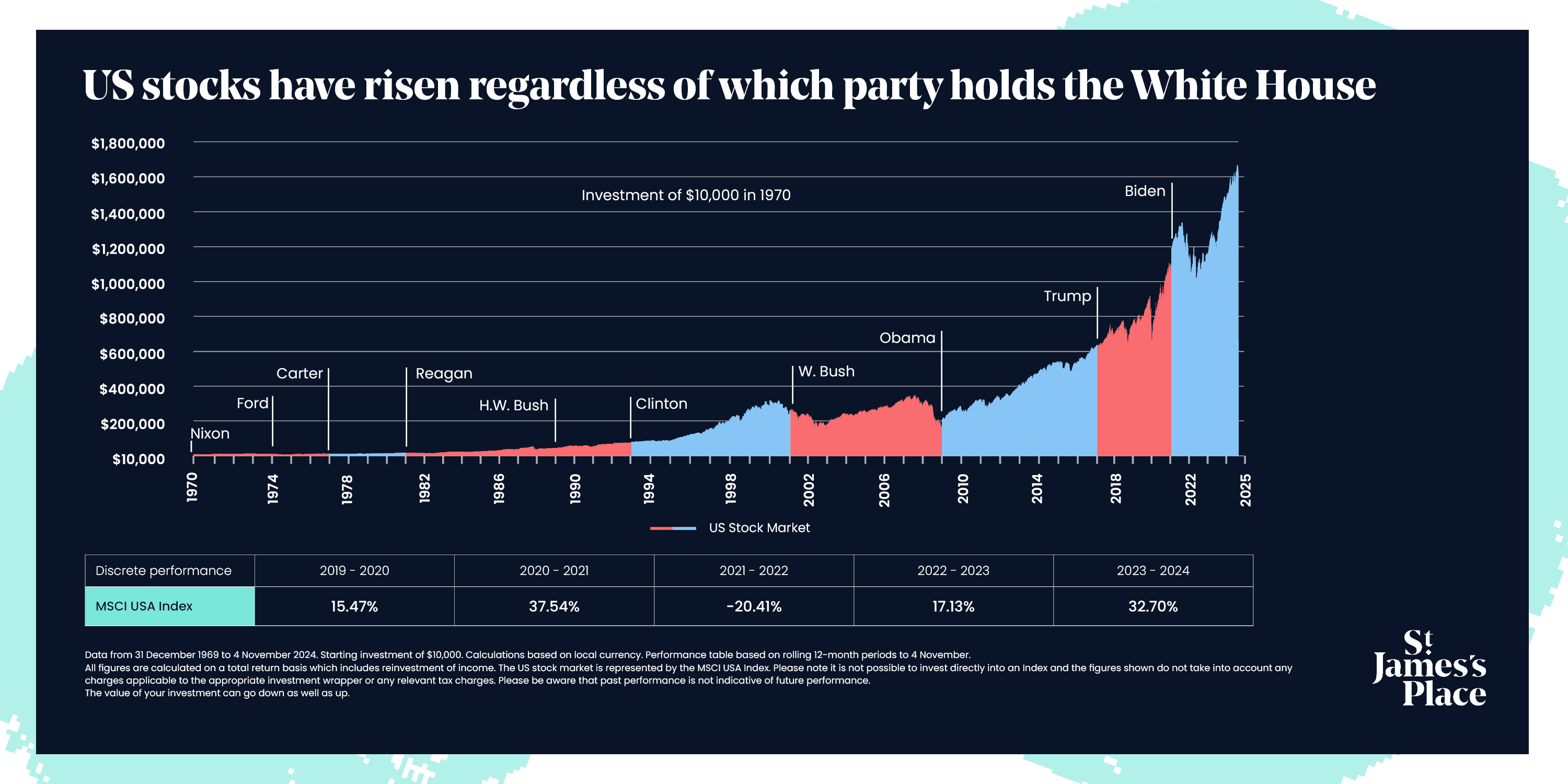
With last week’s announcement that the Republican Party has gained full control of Congress, the chances of President-elect Donald Trump’s policies being implemented have significantly increased. But what could this mean for the markets? The chart below highlights a compelling reality from the past 50+ years: for long-term investors, US stocks have consistently delivered positive returns.
The Last Word
“The economy is not sending any signals that we need to be in a hurry to lower rates. The strength we are currently seeing in the economy gives us the ability to approach our decisions carefully.”
– Chair of the Federal Reserve, Jerome Powell, dampened investors’ hopes of a further interest rate cut this year.
The information contained is correct as at the date of the article. The information contained does not constitute investment advice and is not intended to state, indicate or imply that current or past results are indicative of future results or expectations. Where the opinions of third parties are offered, these may not necessarily reflect those of St. James’s Place.
Source: London Stock Exchange Group plc and its group undertakings (collectively, the “LSE Group”). ©LSE Group 2024. FTSE Russell is a trading name of certain of the LSE Group companies.
“FTSE Russell®” is a trademark of the relevant LSE Group companies and is used by any other LSE Group company under license. All rights in the FTSE Russell indexes or data vest in the relevant LSE Group company which owns the index or the data. Neither LSE Group nor its licensors accept any liability for any errors or omissions in the indexes or data and no party may rely on any indexes or data contained in this communication. No further distribution of data from the LSE Group is permitted without the relevant LSE Group company’s express written consent. The LSE Group does not promote, sponsor or endorse the content of this communication.
© S&P Dow Jones LLC 2024; all rights reserved.
Source: MSCI. MSCI makes no express or implied warranties or representations and shall have no liability whatsoever with respect to any MSCI data contained herein. The MSCI data may not be further redistributed or used as a basis for other indices or any securities or financial products. This report is not approved, endorsed, reviewed or produced by MSCI. None of the MSCI data is intended to constitute investment advice or a recommendation to make (or refrain from making) any kind of investment decision and may not be relied on as such.
SJP approved 18/11/2024
WeeklyWatch – The world reacts to a Trump presidency

12th November 2024
Stock Take
A new president is chosen
The next US Federal Reserve rate-setting would usually dominate the attention of the markets, but last week, only one news story captured the attention of investors.
After a closely contested campaign full of controversial moments and political twists and turns, Donald Trump emerged as the victor – also marking one of the most astonishing political resurgences. Trump becomes the oldest person ever to be elected as president, the second president in history to serve non-consecutive terms and the first to have a criminal conviction – and is indicted on further charges.
Trump’s immediate impact
On Wednesday, Wall Street opened at a new record high, this was partially out of relief that the result was uncontested. The dollar recorded its largest one-day gain in over two years as the result became more certain, feeding expectation that under Trump’s presidency, it’ll be strengthened.
The new president plans to cut taxes and raise tariffs, which is likely to cause higher inflation and growth. For the Fed, this will mean that they’ll need to keep interest rates high in order to stop the economy from overheating.
More highs were seen on Wednesday in the US bond yields, which increased significantly. Investors predict that Trump’s administration will look to borrow more money, which will demand a higher return for their money as a result.
Unexpected financial results
In the earlier part of the week, it was revealed that activity in the US services sector increased to more than a two-year high across the month of October. This information was added to further evidence that the US economy is stronger than expected. Some investors have consequently questioned whether the Fed have miscalculated when it began its easing cycle, making a large 50-basis point rate cut in September.
In the conclusion of their two-day meeting, the Fed announced a more conservative 25-basis point cut in interest rates on Thursday. Chairman Jerome Powell stated that it was too early to predict how the new Trump administration’s agenda will impact the US economy and how the Fed will or should respond.
After the Fed’s news, Wall Street continued its march as investors mulled over the prospect of further tax cuts, looser regulation and trade tariffs. By the end of the week, the S&P 500 had increased by more than 4%, far surpassing 6,000 points to record its largest weekly gain of the year.
Global change under Trump
Could the new president halt the UK’s economic growth plans? It’s been suggested by the National Institute of Economic and Social Research that the UK could be one of the countries most affected by Trump’s proposed financial changes. The large increase in trade tariffs could have a big impact on the UK’s economic growth, with investors predicting that it will slow to 0.4% in 2025, far down from its original forecast of 1.2%.
The Bank of England (BoE) acknowledged that the Budget will cause an increase in inflation and went ahead with its expected interest rate cut from 5% to 4.75% but indicated that rates could take longer to fall again. Inflation fell below the 2% target in September, but most have expected to see it rise again. The BoE has consequently pushed back their expectation for inflation to drop back to target from mid-2026 to mid-2027.
Rate cuts on both sides of the Atlantic
Future rate cut expectations are being widely postponed or scaled back for both the UK and the US after recent events and changes. Until Trump’s plans are clarified, the Fed will have to tread carefully. And until the dust settles on Labour’s Budget, the BoE must proceed with caution.
Ramifications for China
Under Trump’s protectionist policies, China could be facing significant challenges. The spotlight has been on the nation’s exports bearing responsibility for its struggling economy. Data from last week revealed that they were growing at their quickest rate in over two years as factories hurried their goods out of fear of more tariffs from the US and European Union.
China’s top export market is the US; it’s worth more than $500 billion a year. However, Trump wants to focus efforts on boosting manufacturing in the US and, as a result, proposed tariffs of 60% or more on Chinese goods.
Furthermore, on Friday, a local government debt package was announced by China as an attempt to stabilise the economy, detracting from the need to boost growth. Market mood dampened as a result.
As investors begin to reflect on the US election results, the Group Chief Investment Officer at Schroders, Johanna Kyrkland, predicts a soft landing for the US economy but identifies that the main risks are on trade and the impact of a protective stance on growth outside the US. She says:
“We expect the Chinese authorities to continue with measures to offset this. Europe becomes more of a concern, however, as it could then become caught in the crosshairs of a more hostile trade environment – without the unified leadership required to tackle it.”
Germany slips back
While the world watched events unfold in Washington, Germany endured more political uncertainty. After Chancellor Olaf Scholz sacked Finance Minister Christian Lindner, the coalition government collapsed. As a result, Europe’s most prominent economy is drifting without direction at a time when growth has stalled and the EU nervously waits for the unfolding details of a Trump presidency – unchartered waters seem to be coming their way.
Wealth Check
Gaining a competitive advantage with strong staff well-being
The latest labour market outlook from the Chartered Institute of Personnel and Development shows a trend dubbed ‘The Big Stay’, with employees opting to stay put at work.1 For a business leader, this may appear positive, but employees may stay at their workplace for reasons that resonate more with disengagement rather than loyalty to the business.
Studies by AXA and CEBR suggest that employees are becoming increasingly disengaged, burning out and facing more stress and mental health challenges. At 23.3 million sick days a year, the absence rate is higher than it’s been for a decade, underlining the need for organisations to prioritise well-being.2
What does it mean to ensure employee well-being and why is it important?
Employee well-being encompasses the financial, physical and mental health of your team. When businesses make this a priority, they’re likely to see employees with increased satisfaction and motivation, positively boost workplace culture and ensure better retention of staff.
Small businesses often feel the pinch of this, as they often lack time and money to invest in well-being initiatives despite recognising the benefits. For example, with the average employee absence at 7.8 days per year, businesses must consider if they can afford the impact of prolonged absences.1
Two top tips on how to support employee well-being
- Well-being initiatives should aim to meet your employees’ needs. This can include a variety of measures, including help with the increasing cost of living, adaptable and flexible working arrangements, mental health support or providing access to a financial adviser. By having an open line of communication with employees, employers can determine what matters most and can act accordingly to ensure that the business can prioritise and act on these needs and make the most impact.
- It’s becoming increasingly challenging for people to separate their personal and work lives. Managers must do what they can to understand these issues – being open with employees creates a caring environment in which employees are more likely to feel comfortable and share their concerns. Supporting employees isn’t purely financial, arrangements such as flexible working hours could make a big difference.
How does financial advice support employee well-being?
The cost-of-living crisis is impacting the vast majority of households up and down the country. As a result, financial well-being has become a strong priority in many businesses. Financial advisers can assist workers in managing debt, investments and their plans for retirement. But this shouldn’t be used to pressure employees; financial situations are often a delicate matter, and they may wish to manage their finances privately.
If you’re interested in how financial advice can benefit you and employees at your company, get in touch with us. We’re ready and able to advise and support businesses at every stage.
The value of an investment with St. James’s Place will be directly linked to the performance of the funds selected and may fall as well as rise. You may get back less than the amount invested.
Sources
1Chartered Institute of Personnel and Development, 12 October 2023 (survey in over 900 organisations covering 6.5 million employees).
2AXA UK & Centre of Economic and Business Research, accessed 29 March 2023.
The Last Word
“I want to thank the American people for the extraordinary honour of being elected your 47th president and your 45th president. And to every citizen, I will fight for you, for your family and your future.”
– Donald Trump, thanking voters as he prepares to step into the role of America’s 47th president in January 2025.
The information contained is correct as at the date of the article. The information contained does not constitute investment advice and is not intended to state, indicate or imply that current or past results are indicative of future results or expectations. Where the opinions of third parties are offered, these may not necessarily reflect those of St. James’s Place.
Source: London Stock Exchange Group plc and its group undertakings (collectively, the “LSE Group”). ©LSE Group 2024. FTSE Russell is a trading name of certain of the LSE Group companies.
“FTSE Russell®” is a trademark of the relevant LSE Group companies and is used by any other LSE Group company under license. All rights in the FTSE Russell indexes or data vest in the relevant LSE Group company which owns the index or the data. Neither LSE Group nor its licensors accept any liability for any errors or omissions in the indexes or data and no party may rely on any indexes or data contained in this communication. No further distribution of data from the LSE Group is permitted without the relevant LSE Group company’s express written consent. The LSE Group does not promote, sponsor or endorse the content of this communication.
© S&P Dow Jones LLC 2024; all rights reserved.
Source: MSCI. MSCI makes no express or implied warranties or representations and shall have no liability whatsoever with respect to any MSCI data contained herein. The MSCI data may not be further redistributed or used as a basis for other indices or any securities or financial products. This report is not approved, endorsed, reviewed or produced by MSCI. None of the MSCI data is intended to constitute investment advice or a recommendation to make (or refrain from making) any kind of investment decision and may not be relied on as such.
SJP approved 11/11/2024
WeeklyWatch – The Budget starts to make its mark

5th November 2024
Stock Take
After the UK Budget but before the US election. Are we in the eye of the storm?
For weeks, there’s been widespread speculation as to what the UK Budget would deliver, and now investors finally have their answer. UK Chancellor Rachel Reeves took centre stage in parliament last week to announce her inaugural Budget.
Have UK equities been affected?
Reeves announced a range of tax rises that will coincide with expansion in government spending. When it came to UK equity markets, the Budget didn’t cause too many issues; the FTSE 100 finished the week down only slightly, dropping 0.87%.
The Head of Economic Research at St. James’s Place, Hetal Mehta, noted:
“While it was one of the biggest tax-raising Budgets of recent decades, it was also one of the biggest fiscal loosening announcements too. The government has got public spending, as a share of GDP, broadly moving sideways rather than declining as per the previous OBR forecasts and boosted investment so that the overall level of longer-term GDP will be 1.4% higher. However, most of the uplift comes in the next couple of years.
“Given the change to the fiscal rules and the definition of debt, it is surprising to see the fiscal headroom only increased slightly from the record low of the previous chancellor. Complying with the rules within a three-year horizon could give some scope for more stimulus ahead of the next election, but that will depend on how the economy performs.”
Market reactions
The UK’s AIM Index was one of the most immediate reactions to the Budget. Market investments here can potentially be Inheritance-Tax-Free; the benefit was made to encourage investments in the higher-risk market. It had been widely predicted that the government would move to scrap this benefit; instead, Reeves halved it.
This caused a needed (albeit likely to be short-term) boost for the AIM market, resulting in a 2.3% rise; most of these gains were made after the Budget was announced on Wednesday.
A renewed direction for the Bank of England?
Later this week, the Bank of England’s Monetary Policy Committee are due to meet. While the Budget isn’t expected to affect immediate interest rate decisions, medium- to long-term effects could create a gradual altering of course.
Europe struggling to stimulate economic growth
Across mainland Europe, attempts to boost economies continued to provide uncomfortable results. The MSCI Europe ex UK fell 1.2% in Euro terms, despite positive economic figures. The eurozone GDP growth hit 0.4% in the third quarter, which doubled predictions.
Nations exceeding forecasts included Germany, Spain and France, and Ireland revealed a growth of 2.0% in their GDP rate for the quarter.
Portfolio Manager at TwentyFour Asset Management George Curtis noted:
“Part of the confidence of the European Central Bank’s growth forecast – stronger growth this year than last year – came from excess savings, which European consumers held onto after the pandemic as a result of the gas crisis stemming from Russia’s invasion of Ukraine. With an unemployment rate that remains at record lows in the eurozone (it actually fell again in August), declining deposit rates and stronger consumer sentiment should drive stronger consumption, and indeed we started to see broader signs of this in the third quarter numbers with stronger domestic consumption across most countries.”
US standings before presidential election
Last week, the S&P 500 and NASDAQ slipped during a busy week among earning reports. In part, this was as a result of cautious updates from several large companies, including Microsoft.
The US job report revealed on Friday that the US economy added only 12,000 jobs last month; this is the lowest number recorded since December 2020. Despite this, it shouldn’t be read into too much, as these numbers were affected by weather incidents and strikes.
After the presidential election, the Federal Reserve is set to meet to make further decisions on interest rates. The likelihood of further cuts is high, regardless of the election results.
Wealth Check
Insuring to protect – how does that extend for your health?
Getting insurance for our cars, our home and its contents, holidays and our pets is almost a given. Many would feel uncomfortable travelling knowing that they don’t have medical insurance or letting their car insurance run out. But have you ever considered putting measures in place to protect the most valuable things of all: your family and your quality of life?
What types of financial insurance are available?
Nobody can know what’s just around the corner, and we live in the hope that the worst won’t happen to us. This is why so many different types of insurance exist to cover the things or people we love the most and for how long.
And awareness is growing. In 2023, the Association of British Insurers website reported a record number of people who took out income protection policies.1
The most widely available financial insurance measures are income protection, life assurance and critical illness protection:
- Income protection – This type of coverage pays a percentage of your income so that you’re able to cover bills and other outgoings if you find yourself suddenly out of work, unable to work or unexpectedly lose an income.
- Life insurance – This coverage pays out a lump sum after a death. This policy needs to be written in trust, which ensures that money can be paid without probate, therefore it won’t be liable for Inheritance Tax.
- Critical illness – This coverage also pays out a lump sum, but only in the event that you suffer from a specific illness such as a stroke, cancer or a heart attack.
How does this kind of coverage help you and your loved ones?
This can be of huge help to other family members. While you can’t take out a policy on your children, you can put measures in place to help them be able to afford protection for themselves in the future.
Many people who have required time off work as a result of illness or mental health events have admitted that they’ve been forced to rely on savings in order to get them through these challenging periods, citing that the stress of this action made matters more difficult.
Emergency funds
If you’re putting aside savings for an emergency monetary fund, the recommended amount is enough to cover three to six months of expenditure. This can then act as a buffer while you’re between jobs or get through higher living costs, but it’s not a long-term solution.
Emergency funds can take years to build, but just a few days or weeks can deplete them dramatically.
The levels and bases of taxation, and reliefs from taxation, can change at any time and are generally dependent on individual circumstances.
Trusts are not regulated by the Financial Conduct Authority.
Source:
1Association of British Insurers, 20 March 2024 – ‘Record number of individuals takes out Income Protection Insurance to safeguard finances’.
In The Picture
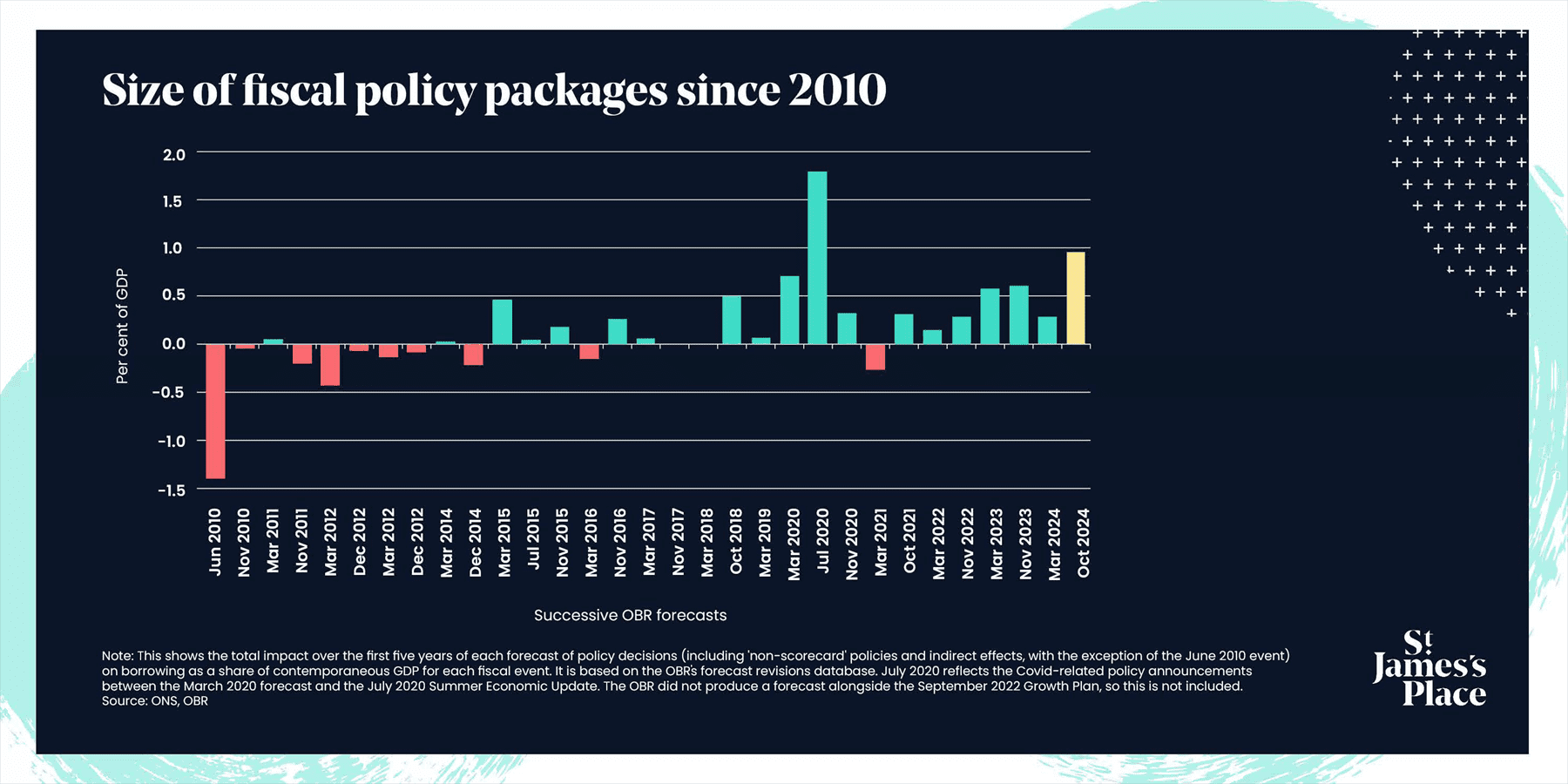
In last week’s Budget, we saw one of the largest increases in government spending in recent years, which will be compensated by tax rises and borrowing.
The Last Word
“The only way to drive economic growth is to invest, invest, invest. There are no shortcuts. And to deliver that investment we must restore economic stability.”
– Rachel Reeves, UK Chancellor, as she delivers her Budget.
The information contained is correct as at the date of the article. The information contained does not constitute investment advice and is not intended to state, indicate or imply that current or past results are indicative of future results or expectations. Where the opinions of third parties are offered, these may not necessarily reflect those of St. James’s Place.
Source: London Stock Exchange Group plc and its group undertakings (collectively, the “LSE Group”). ©LSE Group 2024. FTSE Russell is a trading name of certain of the LSE Group companies.
“FTSE Russell®” is a trademark of the relevant LSE Group companies and is used by any other LSE Group company under license. All rights in the FTSE Russell indexes or data vest in the relevant LSE Group company which owns the index or the data. Neither LSE Group nor its licensors accept any liability for any errors or omissions in the indexes or data and no party may rely on any indexes or data contained in this communication. No further distribution of data from the LSE Group is permitted without the relevant LSE Group company’s express written consent. The LSE Group does not promote, sponsor or endorse the content of this communication.
© S&P Dow Jones LLC 2024; all rights reserved.
Source: MSCI. MSCI makes no express or implied warranties or representations and shall have no liability whatsoever with respect to any MSCI data contained herein. The MSCI data may not be further redistributed or used as a basis for other indices or any securities or financial products. This report is not approved, endorsed, reviewed or produced by MSCI. None of the MSCI data is intended to constitute investment advice or a recommendation to make (or refrain from making) any kind of investment decision and may not be relied on as such.
SJP approved 04/11/2024
WeeklyWatch – US runs out of steam before election

29th October 2024
Stock Take
US hits the wall
After experiencing a good run, US equities stumbled last week as a result of mixed corporate results and the uncertainty arising from the upcoming presidential election.
The S&P 500 has enjoyed numerous weeks of growth, so its slight dip is somewhat expected. The index dropped by just under 1% – a relatively mild reversal when put in perspective. Reasons for its drop were widely attributed to a few large companies.
Big business, big impact
McDonalds saw a fall of 5% in a single day after E.coli was reported at one of its restaurants (which was later traced back to the supplier). Apple also struggled as their share prices dipped after analysts revealed that orders for the new iPhone 16 have failed to meet expectations. The resulting drop of 1.5% had a significant impact on the wider index due to the size of the business.
However, this wasn’t a pattern across all large companies. Tesla made over 20% gains after posting a strong set of results.
Banking on a Federal response
Away from company-specific issues, the Federal Reserve released its latest check-in on the economy in its October Beige Book. The data showed a combination of attempts to moderate inflation and improvements in employment and fed the growing expectation that the Fed is likely to announce a 0.25% reduction in interest rates when they next meet.
Their next meeting will be undertaken in the shadow of next week’s presidential election – not only will a new president be named, but there could be a shift in political majority in one or both Houses of Congress.
UK still awaiting Budget details
On home soil, investors remain to tap their fingers in anticipation of this week’s Budget. There’s been wide speculation about a number of measures, including an increase in National Insurance contributions for employers, plus changes to so-called ‘wealth taxes.’
As well as these expected changes, the government is also predicted to make revisions to their fiscal rules in order to create more short-term fiscal headroom to allow for further capital spending options throughout this parliament. But sizeable tax rises – within the parameters of what’s been ruled out – are widely expected.
Heading east for a political shake-up
Over in Japan, the nation underwent a large change over the weekend. Its political structure shifted dramatically after the snap election resulted in the ruling Liberal Democratic Party (LPD) losing its majority in the lower house.
215 seats were won by the LPD and its junior coalition partner Komeito – just shy of the 233 seats required for the majority. However, they still remain the largest bloc. Prime Minister Shigeru Ishiba only took office a month ago and now faces a precarious position as he tries to accumulate more coalition partners.
The LPD have been in power for over decade, and for the vast majority of its post-war history, therefore the election results carry huge significance for the political direction of the nation.
The Head of Asia and Middle East Investment Advisory at St. James’s Place, Martin Hennecke, says that no matter what Japan’s leadership looks like, their high sovereign debt burden and challenging economy will make significant interest rate increases hard, nay, impossible.
He went on to state:
“Persistently low interest rates and a weak yen have resulted in negative real interest rates. This may actually support the market as Japanese investors grow concerned about rising inflation eroding the purchasing power of their large cash holdings. They may increasingly turn to equities simply as a wealth preservation strategy. Valuations still seem reasonable currently from a historical perspective as well as relative to global markets.”
Wealth Check
Familiarity with finances
Once you’ve found something good, why would you want to stop? St. James’s Place’s Real-Life Advice Report reveals that the average professional advice relationship lasts seven years.1 As the years go by, loyalty and satisfaction tend to increase, for example, nearly one third of people over 55 have retained the same adviser for 16 years or more.
Let’s break down the numbers
As part of St. James’s Place’s largest-ever consumer survey, they found that over 62% of respondents have never switched their financial adviser. Almost one in three said that the good relationship that they’ve built with their financial adviser is their core reason for staying.
Consistent financial advice has benefited over 10% of respondents with big financial goals in place resulting from major life accomplishments or moments, including getting on the property ladder (13%) or getting through challenging times such as divorce or grief (13%). For others, this included passing down money to their children or loved ones (19%).
For those currently receiving financial advice, 75% of them said they would recommend it to family and friends and among older clients, this figure increases to 86%.
Why is financial advice so valuable?
The Head of St. James’s Place Financial Adviser Academy, Andy Payne, stated:
“Financial advice is about much more than numbers on a page or graphs on a screen. It’s the relationship that drives this impact. Financial advice is about building deep, meaningful relationships, and as our research shows, these can last many years and span generations. Whether you’re navigating the early stages of wealth creation, planning for retirement or managing an unexpected life change, having a trusted adviser by your side can make all the difference.”
Source:
1The Real Life Advice Report was commissioned by St. James’s Place. Opinium surveyed 12,000 UK adults nationwide between May and August 2024. Quantitative data referenced is sourced from the first poll with a sample of 7,995 respondents, including those aged 18–34 (1,940), aged 35–54 (2,654), and aged 55 and over (3,401).
In The Picture
The polls in the 2024 US presidential election are tight. One interesting aspect of the electoral system is that a small number of ‘swing’ states (states that aren’t considered either safely Democratic or Republican), are expected to make a big impact on the final result. A close race could even lead to a contested outcome, which was seen in 2000 and 2016; there are concerns that volatility could arise prior to the final decision being made.
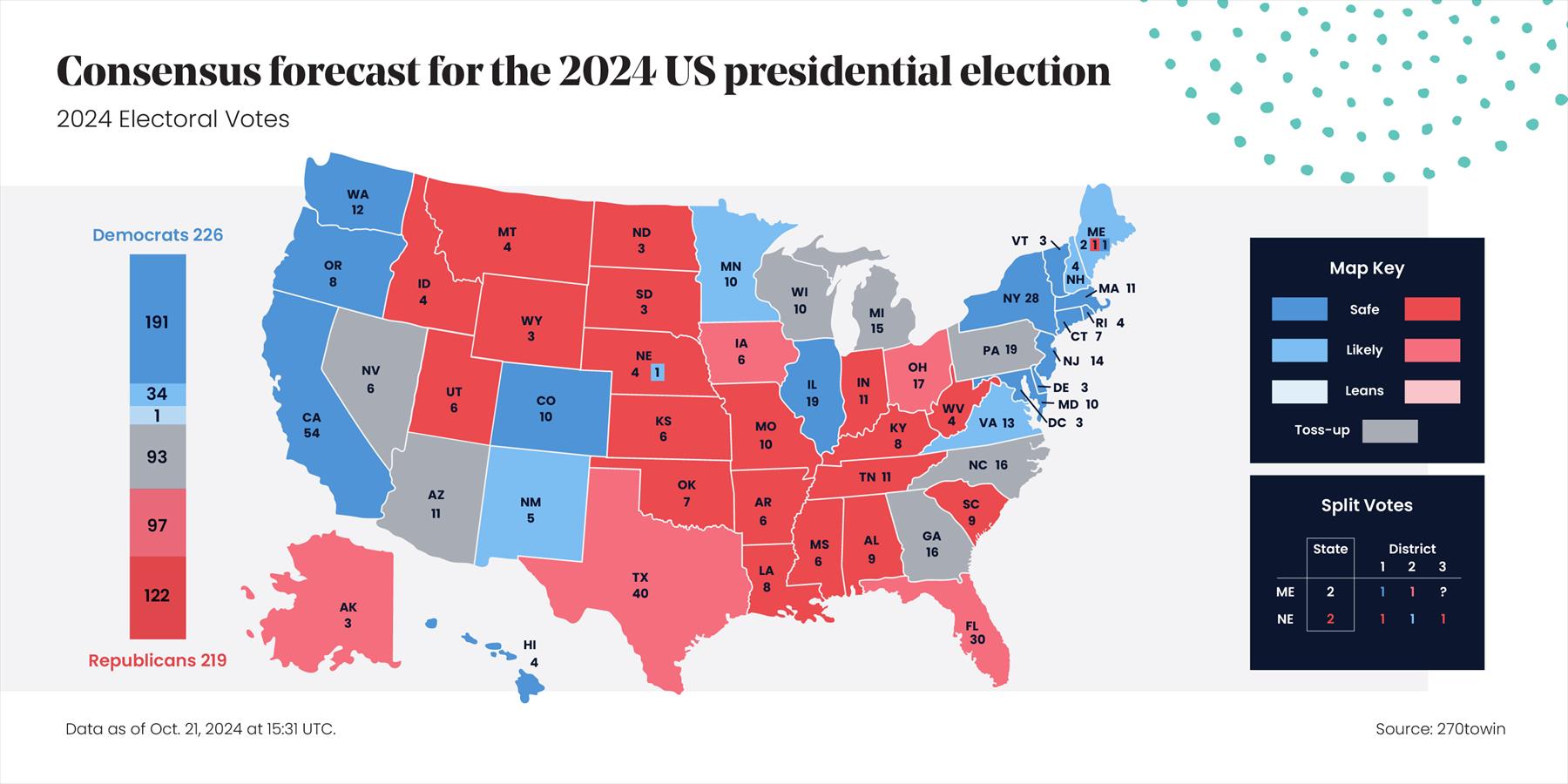
The Last Word
“We need to answer to the people’s criticism. That is how I will take responsibility for the loss of the election.”
– Shigeru Ishiba, Prime Minister of Japan, as he responds to the results of the election over the weekend.
The information contained is correct as at the date of the article. The information contained does not constitute investment advice and is not intended to state, indicate or imply that current or past results are indicative of future results or expectations. Where the opinions of third parties are offered, these may not necessarily reflect those of St. James’s Place.
Source: London Stock Exchange Group plc and its group undertakings (collectively, the “LSE Group”). ©LSE Group 2024. FTSE Russell is a trading name of certain of the LSE Group companies.
“FTSE Russell®” is a trademark of the relevant LSE Group companies and is used by any other LSE Group company under license. All rights in the FTSE Russell indexes or data vest in the relevant LSE Group company which owns the index or the data. Neither LSE Group nor its licensors accept any liability for any errors or omissions in the indexes or data and no party may rely on any indexes or data contained in this communication. No further distribution of data from the LSE Group is permitted without the relevant LSE Group company’s express written consent. The LSE Group does not promote, sponsor or endorse the content of this communication.
© S&P Dow Jones LLC 2024; all rights reserved.
Source: MSCI. MSCI makes no express or implied warranties or representations and shall have no liability whatsoever with respect to any MSCI data contained herein. The MSCI data may not be further redistributed or used as a basis for other indices or any securities or financial products. This report is not approved, endorsed, reviewed or produced by MSCI. None of the MSCI data is intended to constitute investment advice or a recommendation to make (or refrain from making) any kind of investment decision and may not be relied on as such.
SJP approved 28/10/2024
WeeklyWatch – Decisions depend on pending Budget

22nd October 2024
Stock Take
Big shifts in the upcoming weeks?
Investors and the UK general public wait with anticipation of the announcement of the current Labour government’s first Budget at the end of the week. And across the pond, voters are preparing to go to the polls, as the presidential election takes place in just two weeks’ time. The upcoming weeks are hugely significant for both nations and investors worldwide as they face great uncertainty until both events have taken place. Having said this, equity markets in both countries rose last week.
The ONS reveals UK inflation figures
There was a 1.27% rise for the FTSE 100 on the back of the news that there was a continued fall in inflation in September. The Office of National Statistics (ONS) revealed that headline CPI was only 1.7% in the previous month, compared to the 2.2% recorded in August – distinctly below the Bank of England’s 2.0% target. Significantly, it also marked the first time the CPI was below 2.0% since 2021.
The ONS cited the biggest contributor to the falling inflation figure as transport, including motor fuel and air fares.
In a similar trend, core inflation, which doesn’t include energy, food, alcohol and tobacco, was at 3.2% over the same period, down from 3.6%.
Assuming little before the Budget
The ONS’s data backs up the prediction that the Bank of England will make further reductions to interest rates at their next Monetary Policy Committee meeting on 7th November. But as the Budget announcement gets ever closer, investors are holding back on making too many assumptions regarding another interest rate cut.
The Budget isn’t being announced until next week, but we can expect tough measures with the warnings that have already been issued or hinted at by the government. Several tax rises have been at the forefront of discussion and have fed wide speculation.
One of these is a predicted increase in National Insurance contributions from employers. St. James’s Place Divisional Director of Retirement & Holistic Planning, Claire Trott, commented:
“It has been reported that a 2% raise in the rate could bring in nearly £17bn to the Treasury which would go a long way to address the fiscal challenges. However, the impact that it will have on businesses that are highly dependent on workers, such as the service industry, would mean that the hardest hit industries will reconsider future staffing levels or even pay rises come the new year.”
The polls are tightly contested – what does this mean for the US?
We’re fast approaching the start of November, and all eyes are focused on one thing and one thing only: the presidential election. Polls are close between the two candidates; however, recent betting odds suggest that there’s been a shift in favour towards Trump. With roughly two weeks to go, the race is very tight, and much can still happen until the votes are in.
But it’s not just the presidential election that’s set to shape the nation. In the Senate and Congress, there are many seats up for grabs. Who controls the houses of Congress will have a direct effect on the ability of the presidential candidate to get their policies through.
Although there is much uncertainty surrounding the US election, their equities have continued to advance, with the S&P 500 finishing the week up 1.2% which was, in part, thanks to strong company results.
Reviving efforts in place for the EU
A second straight interest cut was delivered by the European Central Bank at their policy meeting last week, where the key deposit rate was reduced by 0.25 percentage points to 3.25%.
These actions came on the back of an equivalent move in the previous month. The Bank has now cut rates for a third time from their peak levels. The latest cut came as a result of the downgraded inflation figure from September when it was reduced to 1.7%, more than half a percentage point below August’s recorded levels.
The continent has been engaged in an ongoing struggle with economic stagnation in a number of economies, with Germany being the largest economy in this group. By reducing interest rates, borrowing money will be cheaper and will boost higher levels of spending, consequently encouraging economic growth.
The lower inflation figures alongside the economic slowdown meant that it was widely expected that there would be a rate cut, meaning there wasn’t a dramatic reaction from the markets. Additionally, the MSCI Europe ex UK index increased by 0.2% as the week went on.
A quick word about China
The nation’s central bank announced further support measures and, as a result, Chinese shares lifted.
Wealth Check
Inflation impact vs pension payments
Inflation is now just under 2.0%; however, consumer prices are still very high, and a large number of households are having to keep a close eye on their finances. The Scottish Widows Retirement Report 2023 stated that the number of people reducing their pensions or savings contributions has increased from the previous 2023 figures to 13%.1
The Senior Propositions Manager at St James’s Place, Tony Clark, said:
“We’re not out of the woods yet, but if you’re looking at where you could make savings, pausing your pension should be one of your last resorts. You could lower your contribution, or look for other smaller economies you could make, before pressing pause on your pension completely.”
Know the facts, don’t be hasty, evaluate the options
Pausing payments into your pensions can be tempting, especially as pension contributions aren’t compulsory in the UK – and depending on your stage in life, you could be decades away from accessing your savings. When you start to feel a financial pinch and meeting everyday household costs becomes difficult, one of your short-term options may be to halt your pension payments. But before you do this, it’s important that you’re aware of the facts.
Reducing or stopping your pension payments may make meeting short-term needs more attainable; however, this decision can have a significant impact on your standard of living in years to come, particularly when your other options are far fewer.
Firstly, you won’t benefit from the tax relief that the government pays on those contributions. The current relief is 20% for basic rate taxpayers, 40% for higher and 45% for additional taxpayers.* Additionally, you may also risk missing out on the top-up payments that a lot of employers add to employee pension plans.
Secondly, the money you put towards a pension benefits from the power of compounding. This snowball effect takes place when any growth in investments held in your pension goes on to generate its own growth. By stopping your contributions abruptly and completely, the value of your pension won’t just be affected by the loss of the money paid in, but it will potentially lose any compounding growth from money that could have been paid in. Ultimately, you could be losing out a lot more than you realise.
By seeking out financial advice with Wellesley, we can advise and help you plan for every stage of your financial journey. Get in touch with us today.
The value of an investment with St. James’s Place will be directly linked to the performance of the funds you select and the value can therefore go down as well as up. You may get back less than you invested.
The levels and bases of taxation, and reliefs from taxation, can change at any time. The value of any tax relief is generally dependent on individual circumstances.
*This is on the basis that any tax relief over the basic rate is claimed via your annual tax return.
Source:
12023 Retirement Report, Scottish Widows, June 2023. (The survey included general questions on pensions and retirement planning and was carried out online by YouGov Plc across a total of 5,072 adults aged 18+, weighted to be representative of the UK population.)
The Last Word
“Unless you put Britain on a stable economic and financial path, we’re not going to be able to get that investment in. And that will mean some difficult decisions, including on taxation.”
– Rachel Reeves, UK Chancellor, as she gives further indication that the Budget will include a number of tax rises.
The information contained is correct as at the date of the article. The information contained does not constitute investment advice and is not intended to state, indicate or imply that current or past results are indicative of future results or expectations. Where the opinions of third parties are offered, these may not necessarily reflect those of St. James’s Place.
Source: London Stock Exchange Group plc and its group undertakings (collectively, the “LSE Group”). ©LSE Group 2024. FTSE Russell is a trading name of certain of the LSE Group companies.
“FTSE Russell®” is a trademark of the relevant LSE Group companies and is used by any other LSE Group company under license. All rights in the FTSE Russell indexes or data vest in the relevant LSE Group company which owns the index or the data. Neither LSE Group nor its licensors accept any liability for any errors or omissions in the indexes or data and no party may rely on any indexes or data contained in this communication. No further distribution of data from the LSE Group is permitted without the relevant LSE Group company’s express written consent. The LSE Group does not promote, sponsor or endorse the content of this communication.
© S&P Dow Jones LLC 2024; all rights reserved.
Source: MSCI. MSCI makes no express or implied warranties or representations and shall have no liability whatsoever with respect to any MSCI data contained herein. The MSCI data may not be further redistributed or used as a basis for other indices or any securities or financial products. This report is not approved, endorsed, reviewed or produced by MSCI. None of the MSCI data is intended to constitute investment advice or a recommendation to make (or refrain from making) any kind of investment decision and may not be relied on as such.
SJP approved 21/10/2024