WeeklyWatch – Market readiness amid Iran conflict

3rd March 2026
Stock Take
The ripple effect of the Iran strikes
The weekend saw another escalation in the conflict across the Middle East, where coordinated strikes were conducted by the US and Israel against Iran. As a result, uncertainty across the global markets has risen sharply. Investors weren’t completely unprepared; they’d anticipated a strong possibility of actions like these following the pre-emptive strikes that targeted Iran’s nuclear facilities last summer. In addition, the well-publicised deployment of US military resources to the region already had many suspecting it was a case of ‘when, not if’ the US would act.
Since the weekend, the conflict has extended beyond Iran – retaliatory strikes by the regime across the region have increased concern about how far the conflict may spread.
From an economic perspective, Iran has significant influence over the global economy, due to its effective control over the Strait of Hormuz. The narrow waterway allows for the passage of approximately 20% of the world’s oil and 90% of the oil being delivered to Asian markets. Last night, the Iranians closed the waterway.
The Chief Economist at St. James’s Place, Hetal Mehta, highlighted that there may be some impact on petrol prices and eventually on UK inflation if oil prices increase for more than a few days. Giving a worst-case illustration: if oil prices rise to over $120 a barrel, there could be an increase in inflation from 3% to over 4%. Mehta says:
“For every 1% increase in inflation, consumer spending would be affected and in turn this could take 0.2% to 0.3% off UK growth.”
But she also indicates that a rapid change in domestic energy prices will come too late to have an impact on the Office for Budget Responsibility’s forecasts, which are due to be published today alongside the Chancellor’s Spring Statement.
Anticipated market movement
Yesterday (2nd March) saw global markets react fairly predictably. The stock markets are lower, and ‘safe haven’ assets like government bonds, gold and the US dollar have risen. The price of oil increased by over 10%, but it drifted back as the day progressed; it remains higher than at the end of last week. A modest increase in production to help stabilise the market has been agreed on by OPEC (an organisation enabling the cooperation of leading oil-producing and oil-dependent countries).
Concern among economists may grow if the disruption continues, as it could result in higher oil prices and consequently create higher inflation, which would impact global GDP.
A case of watch and see?
St. James’s Place Director of Investment Research, Joe Wiggins, says that it’s easier to be disciplined when the markets are going up. But in the current situation of stress and uncertainty is when investors need to be most disciplined. Wiggins’ advice to investors puts forward five questions to ask whenever there’s a shock to the market:
- Do I have confidence in predicting the outcome of the current situation?
- Can I reliably anticipate the financial market implications?
- Are any of these potential market impacts likely to be material over my investment horizon?
- Is my portfolio appropriately diversified for a range of possible outcomes?
- Have my investment objectives changed in any way?
For long-term investors, the answers to these questions are most likely to be a strong “no”. Recent events are the very reason why investors should avoid the temptation to change up their approach.
Wiggins also cites a study that analysed the New York Times’ coverage of different topics dating back 160 years and what impact this had on future stock market returns.1 It revealed that the topic that was the strongest predictor of higher stock market returns over the next 1 to 36 months was ‘war’.
This may seem unexpected; however, the explanation is as simple as it is sensible. The knee-jerk reaction for some investors and traders in this environment would be to sell if they get unnerved by short-term uncertainty. However, lower prices make valuations more attractive and push up future expected returns – this is the reward for investors who chose to maintain the course or take opportunities to purchase when prices were lower. Wiggins adds:
“That’s by no means a prediction of what will happen, but it reflects that our gut reaction to such events [is] often wrong”.
The Director of Portfolio Management at St. James’s Place, Robin Ellis, reinforced Wiggins’ statement and emphasised the significance of diversification, discipline and a long-term mindset. Ellis states that preparation plays a key role: ensuring that portfolios are diversified before periods of market volatility is more important than reactive moves taken during times of crisis. Market events like this create high levels of uncertainty, evolve quickly and cause market fluctuations. It may be tempting to try to predict how events will unfold, but this can destroy value over the long term. Seeing past the noise, staying invested and allowing returns to compound over the long term is generally the best strategy when it comes to building long-term wealth.
Source
1Hirshleifer, D, Mai, D.Y., and Pukthuanthong, K. (2023). War Discourse and Disaster Premia: 160 Years of Evidence from Stock and Bond Markets, NBER. Available at: www.nber.org/papers/w31204 (Accessed: 03/03/2026).
Wealth Check
Chancellor pushed to scrap salary sacrifice pension cap
Ahead of today’s Spring Statement, St. James’s Place – along with several other major pension and wealth management companies – gave their support to the campaign urging Chancellor Rachel Reeves to reverse her plan to cap the tax relief on salary sacrifice pension arrangements.
In last year’s Autumn Budget, Reeves stated that from April 2029, the amount of salary sacrifice pension contributions exempt from national insurance contributions (NICs) for employees and employers would be capped at £2,000 per year.
However, many experts, including pension ministers, are concerned that limiting the NIC tax relief will have a negative long-term impact on pension saving. The issue has been raised that the UK population doesn’t pay enough into retirement savings. The cost of living continues to make it more challenging for people to put money into retirement contributions, and it’s believed that the new rule will make it even more difficult for people to save. Additionally, critics have weighed in on the conversation, stating that the changes pose a risk to the nation’s confidence in saving into a pension.
With a pension salary sacrifice scheme, an employee’s contract is amended to reduce their salary in exchange for increased contributions made by the employer into a pension. The result is relief on income tax for the employee, as well as savings on NICs for both the employee and employer.
St. James’s Place has played an active role in supporting the reversal of the raid on salary sacrifice.
The campaign came about following analysis carried out by the Office for Budget Responsibility (OBR), which suggested that the impact of the salary sacrifice cap would affect more people than expected, not just those in higher tax rate bands.
The measure is estimated to bring in £4.7 billion in revenue for the government in the 2029/30 tax year, according to the OBR.2
A “highly uncertain” behavioural response has been cited by the OBR as a possible response if the cap on tax-free contributions to a pension via salary sacrifice is introduced. This could extend beyond the 4.3 million people estimated to be affected by the measure.
NOTE: Chancellor Rachel Reeves delivered her Spring Statement earlier today. There will be future updates and insights on what it means for your personal finances.
Calls for improvement to the insurance market by the FCA
At the heart of the Financial Conduct Authority’s strategic market plans is to improve insurance claims handling and increase consumer access to cover.
In the latest report on the insurance sector, the UK’s financial regulator stated that they want to help consumers navigate the insurance market more easily. They’ve called on insurers to discover ways to improve access to products and services, and shown that some of the most vulnerable people in society don’t have access to insurance.
The levels and bases of taxation and reliefs from taxation can change at any time. Tax relief is dependent on individual circumstances.
Source
2Office for Budget Responsibility (February 2026).
In the Picture
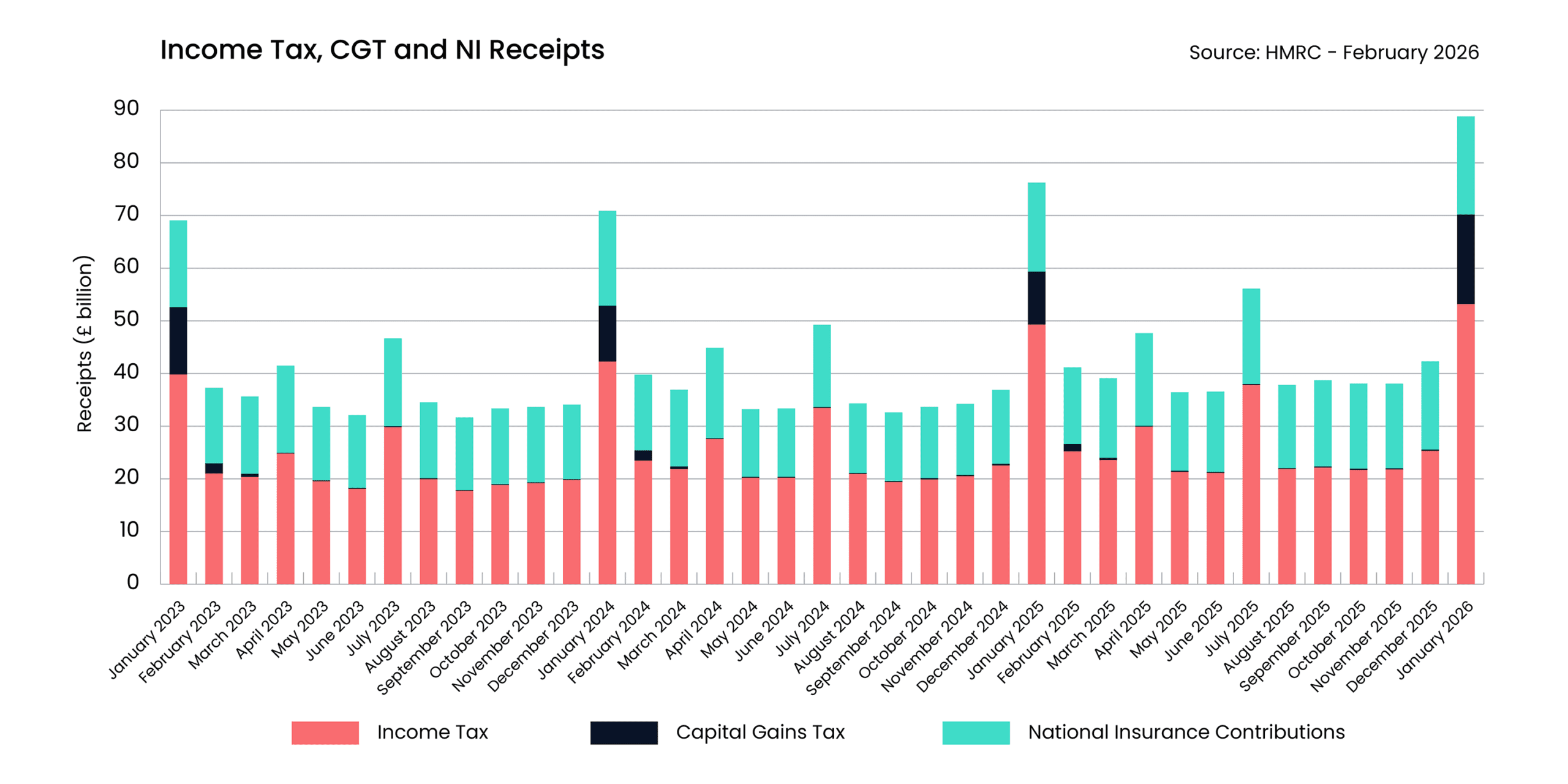
Record high tax take in January due to self-assessment payments
During January, we saw one of the highest volumes of monthly tax receipts, which was all down to self-assessment payments hitting new highs.
As illustrated in the chart below, January usually records increased receipts as 31st January is the self-assessment deadline – and this year was no different. Payments from income tax, capital gains tax (CGT) and national insurance (NI) reached £88.8 billion – way up from the £76.3 billion recorded in January 2025.
As income tax thresholds are frozen until at least 2031, receipts are expected to increase in the years ahead. The freezing of thresholds acts as a stealth tax, putting more workers into higher income tax bands as wages go up, ultimately increasing the overall tax take for the government.
Times of high inflation, like the ones experienced over the last few years, have also contributed to rising receipts. Inflation usually increases salaries, generates higher income tax revenues and increases the nominal value of assets, which in turn leads to larger CGT liabilities when gains are realised.
The value of an investment with St. James’s Place will be directly linked to the performance of the funds selected and may fall as well as rise. You may get back less than the amount invested.
Past performance is not indicative of future performance.
The information contained is correct as at the date of the article. The information contained does not constitute investment advice and is not intended to state, indicate or imply that current or past results are indicative of future results or expectations. Where the opinions of third parties are offered, these may not necessarily reflect those of St. James’s Place.
Source: London Stock Exchange Group plc and its group undertakings (collectively, the “LSE Group”). ©LSE Group 2026. FTSE Russell is a trading name of certain of the LSE Group companies.
“FTSE Russell®” is a trademark of the relevant LSE Group companies and is used by any other LSE Group company under license. All rights in the FTSE Russell indexes or data vest in the relevant LSE Group company which owns the index or the data. Neither LSE Group nor its licensors accept any liability for any errors or omissions in the indexes or data and no party may rely on any indexes or data contained in this communication. No further distribution of data from the LSE Group is permitted without the relevant LSE Group company’s express written consent. The LSE Group does not promote, sponsor or endorse the content of this communication.
© S&P Dow Jones LLC 2026; all rights reserved
Source: MSCI. Certain information contained herein, including without limitation text, data, graphs, charts (collectively, the “Information”) is the copyrighted, trade secret, trademarked and/or proprietary property of MSCI Inc. or its subsidiaries (collectively, “MSCI”), or MSCI’s licensors, direct or indirect suppliers or any third party involved in making or compiling any Information (collectively, with MSCI, the “Information Providers”), is provided for informational purposes only, and may not be modified, reverse-engineered, reproduced, resold or redisseminated in whole or in part, without prior written consent.
Source: Bloomberg. BLOOMBERG®” and the Bloomberg indices listed herein (the “Indices”) are service marks of Bloomberg Finance L.P. and its affiliates, including Bloomberg Index Services Limited (“BISL”), the administrator of the Indices (collectively, “Bloomberg”) and have been licensed for use for certain purposes by the distributor hereof (the “Licensee”). Bloomberg is not affiliated with Licensee, and Bloomberg does not approve, endorse, review, or recommend the financial products named herein (the “Products”). Bloomberg does not guarantee the timeliness, accuracy, or completeness of any data or information relating to the Products.
SJP Approved 02/03/2026
WeeklyWatch – Tariff ruling triggers trade reaction

24th February 2026
Key Takeaways
• The US Supreme Court rules on the “Liberation Day” tariffs, giving way to more trade and market uncertainty
• Bank rate-cut expectations weigh on UK market performance
• BrewDog – the reasons why retail investors will end up empty-handed
Stock Take
Tariff two-step and trade uncertainty
On Friday, the US Supreme Court ruled President Trump’s “Liberation Day” tariffs illegal. The resulting market activity led to a twin-speed US market in a week that had remained fairly subdued up until that point. The S&P 500 and Nasdaq finished the week over 1% higher – the latter delivered its first positive weekly returns since January.
There was a rise in trade and tariff-sensitive companies once the Court had made its ruling, giving a boost to retailers and luxury manufacturers. Tech shares also rose. The Equity Strategist at St. James’s Place, Carlota Estragues Lopez, said:
“The Court’s decision to reject Trump’s tariffs comes at a time when investors were already pricing in a higher risk premium for US assets because of concerns over the level of AI spending. This latest move further dampened sentiment towards US equities and saw the US dollar fall back into weaker territory.”
Despite the decision, tariffs aren’t completely off the agenda for the US administration, which doesn’t erase uncertainty for investors. The president’s response was to impose a blanket 10% global tariff; this was increased to 15% over the weekend. The latest tariffs will expire in 150 days unless Congress decides to renew them. The Chief Economist at St. James’s Place, Hetal Mehta, said:
“Tariffs are still a very core part of the way Trump wants to operate. It is also about attempting to keep the effective tariff rate steady.”
The Court didn’t provide any insight into what will happen with the $150 billion+ in tariff revenues that have already been collected. If tariff “lawfare” continues to be used as a method by Trump, trade clarity will continue to elude investors – and likely create more adverse sentiment for companies and markets. However, as Mehta adds:
“It’s worth remembering that even with the 15% tariffs there are a number of exemptions. For example, the UK with an existing 10% tariff rate with the US probably won’t see this go to 15%”.
With tariff news taking centre stage, it overshadowed data news that revealed the fourth quarter 2025 economic growth (GDP) to be 1.4% in comparison to the quarter before – way off the expected 2.8% figure. The prime suspect: the six-week federal government shutdown and the resulting decrease in government spending. Once this had been factored in, the overall performance revealed a steadier track.
Rate cuts on the cards for the UK
Recent UK data showed poor performance for job numbers and growth, but it wasn’t all doom and gloom. The FTSE 100 finished the week over 2% stronger and the index drew close to its all-time high. The fact that shares are showing a positive response to bad news may seem counterintuitive, but often the relationship between the health of the economy and stock market returns isn’t particularly positive. This is largely due to economic data releases being based on historic events, while stock markets reflect future expectations.
Now that UK unemployment is at a near five-year high, and taking into account anaemic economic growth across the last quarter of 2025 and headline inflation falling, predictions are leaning towards a March rate cut by the Bank of England.
The FTSE 100 is made up of companies with major operations beyond the UK, which is another catalyst for the index. There’s better demand in the US, Asia and parts of Europe compared to the UK, and this is unlikely to change for the rest of the year. Although this is positive for bigger UK companies, smaller companies – which are more reliant on the domestic market – don’t feel the benefit. It explains why UK small caps are underperforming, even though they have relatively low valuations.
Where did it all go wrong for BrewDog?
Big craft beer business, BrewDog, have confirmed that they’re exploring selling off the business following continuous losses. If any transaction takes place, it’s likely that the 200,000+ retail shareholders – some subscribing through the initial ‘Equity for Punks’ investment scheme in 2009 – will probably be left with nothing.
Although it’s not a listed company, the high-profile and brand presence of BrewDog across international breweries, bars and hotels makes their journey an interesting yet sobering story. Possibly its biggest culprit was an investment made by private equity firm TSG Partners in exchange for a 22.3% stake in the company.
While the deal valued BrewDog at £1 billion, it also made TSG Partners a preferred shareholder, ranking them ahead of the equity punks. TSG Partners were promised a return worth much more than their initial investment in the event that BrewDog was sold or listed on the stock market.
In 2021, BrewDog was valued at around £2 billion, but it hasn’t been profitable since 2019. Not only did this reflect company-specific concerns, but also the industry trends that weren’t working in favour of the company. Beer sales have decreased due to consumers spending less on nights out or reducing their alcohol consumption. Additionally, more competition has resulted in more ‘edgy’ beer options in both pubs and supermarkets. Furthermore, negative publicity concerning the management style has been damaging to the brand’s image. Together, it’s had a significant impact on BrewDog’s value, but it hasn’t impacted their financial obligation to TSG. To conclude, BrewDog now owes more to TSG than they’re currently worth, therefore eradicating any value for retail investors.
One of the big problems for BrewDog’s retail investors is that there is no formalised way of buying or selling shares – even more so when the company’s conditions deteriorated. If you’ll pardon the pun, a holding in the company was ‘illiquid’. Retail investors have no way of cutting their losses.
Wealth Check
Investment scams claim thousands of victims
Last year, investment scams caught thousands of people out, according to the latest data from the Financial Ombudsman Service (FOS), the independent dispute resolution service.1
Around 31,300 complaints were received by the ombudsman service from consumers concerning fraud and scams in 2025, and online investment scams were the largest source of the complaints.
Approximately 20,000 complaints came as a result of people making authorised payments as part of a scam; the figure includes authorised push payment scams. These scams usually involve criminals manipulating victims to send them money directly from their bank account or using their debit or credit card. Out of these complaints, over half related to online investment scams.
Online investment scams usually have origins on social media and tend to promote high-return opportunities and deliver fast and guaranteed profits.
Other types of fraud and scam cases that were seen by FOS last year included employment scams and unrecognised bank transactions.
Four tips to evade scams:
- “It sounds too good to be true” – the likelihood of this is probably true. Red flags to look out for include “risk-free” claims, guaranteed returns or bonuses for quick investing.
- Don’t click the links in an unsolicited message. Scammers usually target victims through emails, social media and messaging apps.
- Be aware of pressure tactics. Scammers push an urgent agenda to try to get victims to act quickly in transferring money or making an investment.
- Never share your personal information, ID documents, bank login details, card information or passcodes.
Source
1Financial Ombudsman Service (19 February 2026). Financial Ombudsman Service warns people to be on high alert for online investment and employment scams. Available at: www.financial-ombudsman.org.uk/news/financial-ombudsman-service-warns-people-high-alert-online-investment-employment-scams (Accessed 23 February 2026).
In the Picture
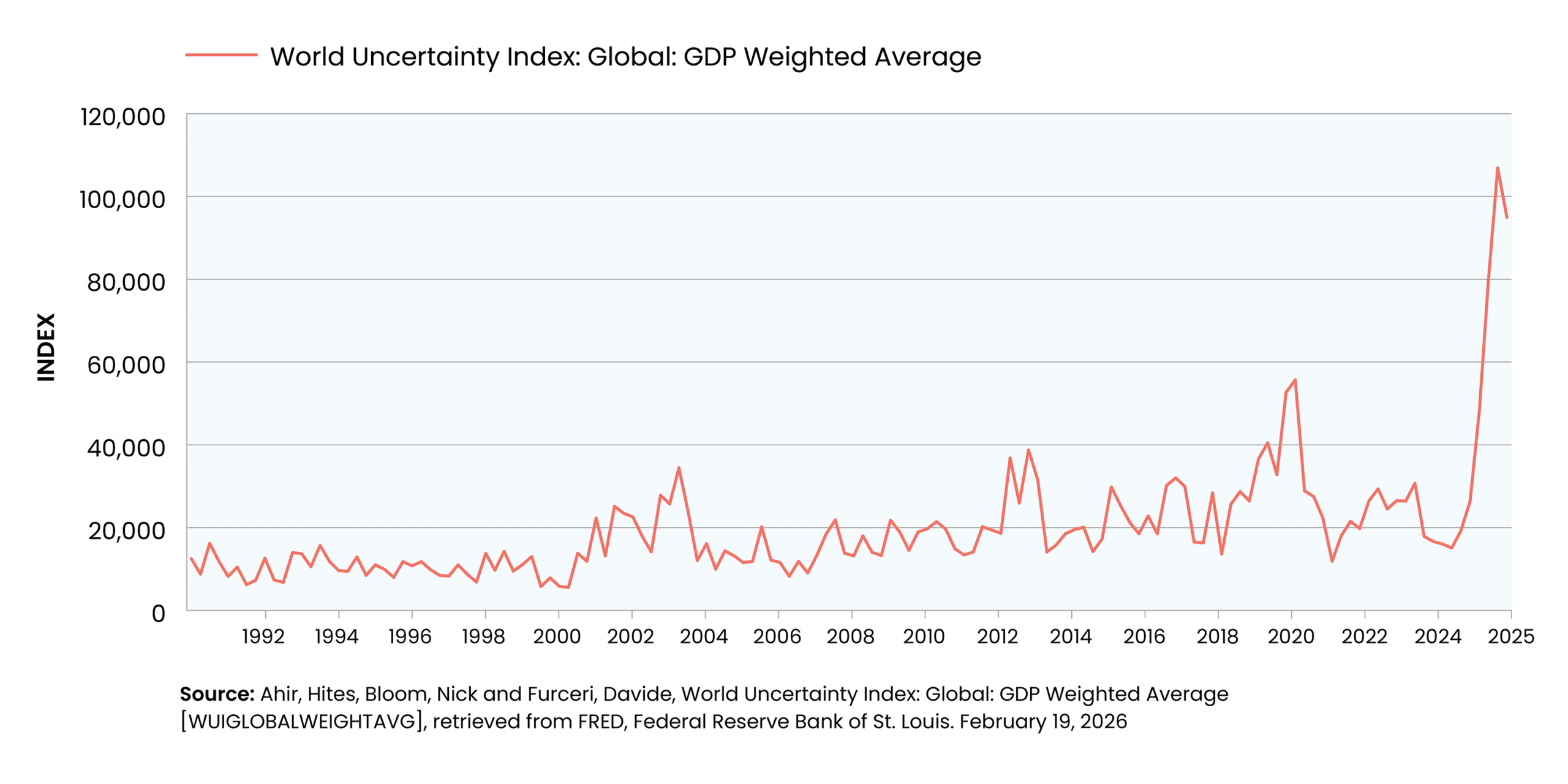
What the World Uncertainty Index reveals about today’s market resilience
The chart below shows the World Uncertainty Index (WUI) and that uncertainty is higher than at any point in its monitored history. But despite these figures, stock markets are at near all-time highs. So, why the disconnect between the two?
The WUI was developed by economists at the International Monetary Fund (IMF) and uses a simple calculation methodology to measure uncertainty. It works by counting the frequency of the words like “uncertain” or “uncertainty” in quarterly country reports that are published by the Economist Intelligence Unit.
But when it comes to explaining the high stock markets, the IMF considers several factors. Inflation and interest rates are getting lower and there is adaptability in the private sector. Tariff impact has been less than first feared and the financial backdrop (as it currently stands) is supportive.
The value of an investment with St. James’s Place will be directly linked to the performance of the funds selected and may fall as well as rise. You may get back less than the amount invested.
Past performance is not indicative of future performance.
The information contained is correct as at the date of the article. The information contained does not constitute investment advice and is not intended to state, indicate or imply that current or past results are indicative of future results or expectations. Where the opinions of third parties are offered, these may not necessarily reflect those of St. James’s Place.
Source: London Stock Exchange Group plc and its group undertakings (collectively, the “LSE Group”). ©LSE Group 2026. FTSE Russell is a trading name of certain of the LSE Group companies.
“FTSE Russell®” is a trademark of the relevant LSE Group companies and is used by any other LSE Group company under license. All rights in the FTSE Russell indexes or data vest in the relevant LSE Group company which owns the index or the data. Neither LSE Group nor its licensors accept any liability for any errors or omissions in the indexes or data and no party may rely on any indexes or data contained in this communication. No further distribution of data from the LSE Group is permitted without the relevant LSE Group company’s express written consent. The LSE Group does not promote, sponsor or endorse the content of this communication.
© S&P Dow Jones LLC 2026; all rights reserved
Source: MSCI. Certain information contained herein, including without limitation text, data, graphs, charts (collectively, the “Information”) is the copyrighted, trade secret, trademarked and/or proprietary property of MSCI Inc. or its subsidiaries (collectively, “MSCI”), or MSCI’s licensors, direct or indirect suppliers or any third party involved in making or compiling any Information (collectively, with MSCI, the “Information Providers”), is provided for informational purposes only, and may not be modified, reverse-engineered, reproduced, resold or redisseminated in whole or in part, without prior written consent.
Source: Bloomberg. BLOOMBERG®” and the Bloomberg indices listed herein (the “Indices”) are service marks of Bloomberg Finance L.P. and its affiliates, including Bloomberg Index Services Limited (“BISL”), the administrator of the Indices (collectively, “Bloomberg”) and have been licensed for use for certain purposes by the distributor hereof (the “Licensee”). Bloomberg is not affiliated with Licensee, and Bloomberg does not approve, endorse, review, or recommend the financial products named herein (the “Products”). Bloomberg does not guarantee the timeliness, accuracy, or completeness of any data or information relating to the Products.
SJP Approved 23/02/2026
WeeklyWatch – AI’s disruptive domino effect

17th February 2026
Stock Take
AI disruption rages on
The AI domino effect is giving way to a new line of thinking: which industries will AI disrupt and make irreparably less profitable? This follows the wave of sell-offs happening across a variety of sectors in just the last few weeks.
Last week, affected areas included insurance brokers and wealth management firms, with publishing companies and the software sector being the victims two weeks ago.
How it’s panned out so far: a new AI tool is released that is able to replicate or improve the function or value added associated with a specific industry or sector. An immediate sell-off follows, with many companies seeing double-digit percentage corrections.
What this does is show up some of the issues associated with short-term investing. As it stands, no one knows what new AI tools will be released in the next month – and certainly not for the rest of the year. Even beyond that, it’s impossible to predict what the impact of the tools will be. The consequence: large swings in share prices.
The volatility across specific sectors has also reinforced the importance of diversification. The Investment Research Director at St. James’s Place, Joe Wiggins, says:
“The rapid progress of AI technology is creating significant uncertainty as markets attempt to understand who the winners and losers will be. At this stage, we are seeing focused bouts of short-term speculation, rather than anything more fundamentally driven. Given the pace of change, this uncertainty is likely to persist, making prudent diversification more important than ever for the long-term investor.”
Struggles for technology and 100-year bonds
In the second half of last week, there was a noticeable fall in technology stocks, with big names like Apple, Amazon and Alphabet suffering declines of 5% or more.
The technology sector faces pressure from two sides:
1. Investor concerns regarding the high levels of investment involved with the AI arms race.
2. Concerns that entire sectors could be at risk of being superseded by AI completely.
Volatility caused by AI has meant that US equities have struggled. By the end of Friday, the S&P 500 was at the level it began the year and the Nasdaq was down.
However, this didn’t prevent Alphabet from launching a multi-billion-dollar 100-year bond as part of their funding for AI development. They’re not the first company to create such a long-term bond, but it’s rare. In the 1990s, JCPenney issued century bonds, but 23 years later, they went bankrupt. Ford and Motorola also launched ‘century bonds’, and there’s at least one case, from the 1800s, where the Canadian Pacific Corporation offered a 1,000-year bond!¹
For perspective, Google is only 27 years old.
The Senior Fixed Income Analyst at St. James’s Place, Ian Entwisle, commented on the Google bond issuance:
“Demand for this bond appears to have been solid rather than exceptional, as it is not currently trading at a notable premium. It is nevertheless the kind of bond that is attractive to insurance/pension/asset and liability management (ALM) type of investors who are looking for attractive cashflows over a very long-time horizon.”
Progress across Asia
Since Prime Minister Sanae Takaichi’s recent victory in the general election, Japanese stocks have continued to climb. Her emphasis on greater economic stimulus was well-received by investors.
The South Korean index, the Kospi, has also been enjoying strong performance, having doubled over the past year. Last week, the index finished around 4% up. Previously low valuations have aided the Korean market, as have the strength of its semiconductor businesses and the wider boost in sentiment across emerging markets.
Strong performance in the Asian markets, plus ongoing volatility in the US, has resulted in Asian markets having their best start compared to US equities since at least 2000.
For the rest of the world, a mixed bag
Strong US payroll data was released for January on Wednesday. Employment rose by 130,000 jobs month-on-month, which is the strongest reading since December 2024 – and roughly double what was expected. However, the devil’s in the detail… Job gains weren’t evenly spread, with healthcare jobs being the main reason for the positive figures. In other sectors, the challenges may remain.
On home soil, the Office for National Statistics said that the UK economy saw a 0.1% growth in the final quarter of 2025. Even though this was a little below estimates, economists weren’t alarmed. The reality is that the British economy, which is home to an ageing population and low productivity growth, is unlikely to return to high growth anytime soon.
Over the week, the FTSE 100 hit a new record high; after retreating slightly, it still ended the week higher. The possibility of an interest rate cut next month is being priced in by investors, and corporate takeover and defence spending also provided support.
¹Investopedia (2024). Why Do Companies Issue 100-Year Bonds? Available at: www.investopedia.com/ask/answers/06/100yearbond.asp (Accessed 13/02/2026).
Wealth Check
Making Tax Digital (MTD) – the implementation
There is only a matter of weeks left for hundreds of thousands of landlords and sole traders to get ready for huge changes to the tax system coming into place on 6th April.
Described as the biggest shake-up in tax returns since self-assessment was launched more than 30 years ago, the introduction of Making Tax Digital (MTD) is about to make big waves.
Landlords and sole traders who earn more than £50,000 from property income and self-employment will need to keep digital records and submit tax records to HMRC five times a year. They’ll need to use new HMRC-compatible accounting software to manage their taxes, and submission dates for taxes and paying due tax won’t change.
HMRC are encouraging landlords and sole traders to get prepared now, ahead of the introduction of MTD. Failure to follow the MTD rules will incur penalties, with every submission deadline missed getting one penalty point. If four penalty points are incurred, a £200 fine will be issued. There will also be financial costs for late tax payments; these can range from 3% of the amount owed up to 10%.
The MTD roll-out will be a staged process. Traders and landlords with an income of more than £30,000 must comply with MTD from 6th April 2027. For those earning above £20,000, it will come into force in April 2028.
Sole traders, landlords and agents can find guidance on the new way of reporting via this link.
The levels and bases of taxation and reliefs from taxation can change at any time. Tax relief is dependent on individual circumstances.
In the Picture
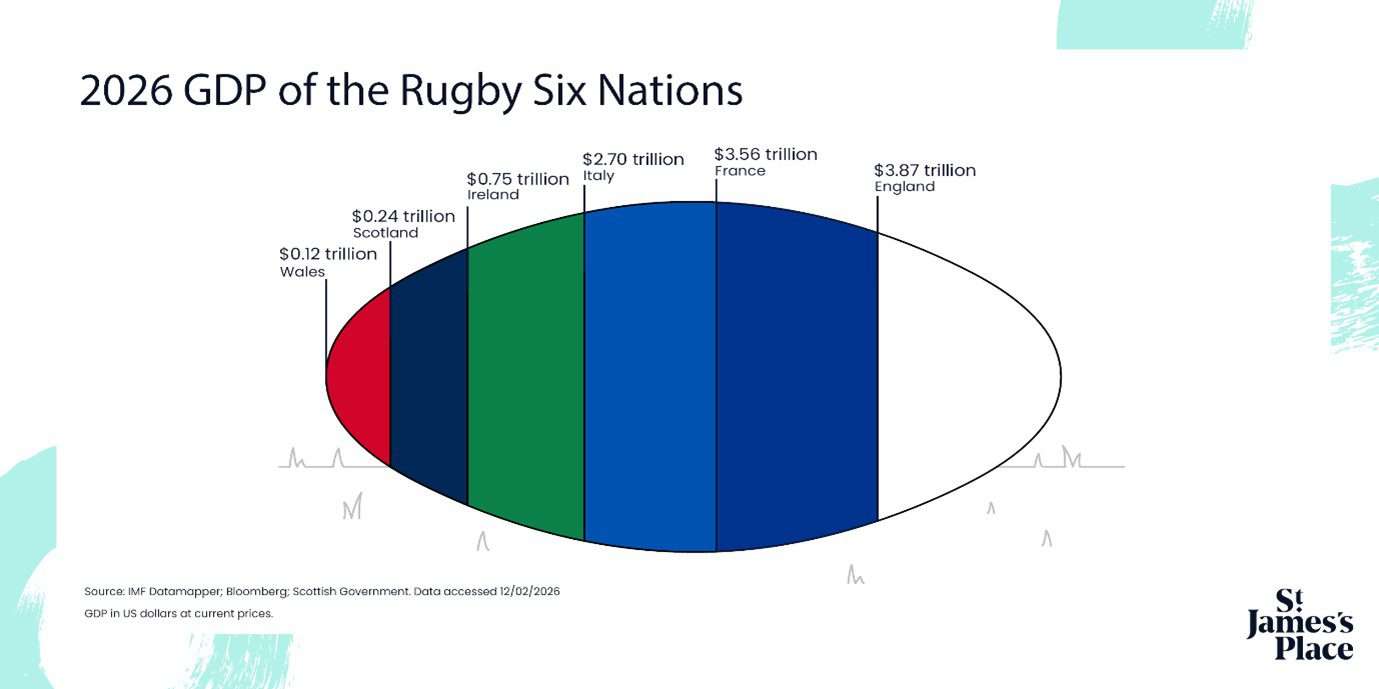
The Six Nations rugby tournament is well underway and there’s an intense battle on the pitch to claim sporting glory. Even though France are currently topping the table, and England being dominated by Scotland at the weekend, England leads when it comes to GDP. The chart shows the competing nations of the tournament have a combined economy of over $11 trillion. Here are their respective sizes:
The value of an investment with St. James’s Place will be directly linked to the performance of the funds selected and may fall as well as rise. You may get back less than the amount invested.
Past performance is not indicative of future performance.
The information contained is correct as at the date of the article. The information contained does not constitute investment advice and is not intended to state, indicate or imply that current or past results are indicative of future results or expectations. Where the opinions of third parties are offered, these may not necessarily reflect those of St. James’s Place.
Source: London Stock Exchange Group plc and its group undertakings (collectively, the “LSE Group”). ©LSE Group 2026. FTSE Russell is a trading name of certain of the LSE Group companies.
“FTSE Russell®” is a trademark of the relevant LSE Group companies and is used by any other LSE Group company under license. All rights in the FTSE Russell indexes or data vest in the relevant LSE Group company which owns the index or the data. Neither LSE Group nor its licensors accept any liability for any errors or omissions in the indexes or data and no party may rely on any indexes or data contained in this communication. No further distribution of data from the LSE Group is permitted without the relevant LSE Group company’s express written consent. The LSE Group does not promote, sponsor or endorse the content of this communication.
© S&P Dow Jones LLC 2026; all rights reserved
Source: MSCI. Certain information contained herein, including without limitation text, data, graphs, charts (collectively, the “Information”) is the copyrighted, trade secret, trademarked and/or proprietary property of MSCI Inc. or its subsidiaries (collectively, “MSCI”), or MSCI’s licensors, direct or indirect suppliers or any third party involved in making or compiling any Information (collectively, with MSCI, the “Information Providers”), is provided for informational purposes only, and may not be modified, reverse-engineered, reproduced, resold or redisseminated in whole or in part, without prior written consent.
Source: Bloomberg. BLOOMBERG®” and the Bloomberg indices listed herein (the “Indices”) are service marks of Bloomberg Finance L.P. and its affiliates, including Bloomberg Index Services Limited (“BISL”), the administrator of the Indices (collectively, “Bloomberg”) and have been licensed for use for certain purposes by the distributor hereof (the “Licensee”). Bloomberg is not affiliated with Licensee, and Bloomberg does not approve, endorse, review, or recommend the financial products named herein (the “Products”). Bloomberg does not guarantee the timeliness, accuracy, or completeness of any data or information relating to the Products.
SJP Approved 16/02/2026
WeeklyWatch – The numbers aren’t on AI’s side
10th February 2026
Key Takeaways
- As AI optimism declined, tech stocks struggled
- Interest rates for the UK and EU remained flat
- It was a landslide victory for Sanae Takaichi in the Japanese election
Stock Take
The AI sugar rush leaves enthusiasm slump
Sweet euphoria was felt by the Seattle Seahawks fans after the team claimed victory in the Super Bowl at the weekend – but the same couldn’t be said for investors, as AI fears resulted in equities being dragged down.
Up until now, AI had been a good opportunity for investors, with anticipation over its disruptive potential boosting tech stocks to historic highs. But in recent weeks, this thrill has faded.
Investors are now concerned with the significantly high level of investment that’s being spent in the unfolding AI arms race. An example includes Amazon: in the past, the company’s plans to spend $200 billion on AI infrastructure might have been warmly welcomed by markets, but instead, it contributed to a significant drop in its share price last week. The Equity Strategist at St. James’s Place, Carlota Estragues Lopez, asks the question: “Is the AI sugar rush over?”
Investor uneasiness is combining with already stretched US valuations to create some sharp swings. There was a 1.2% drop for the S&P 500 on Thursday – although it rebounded on Friday after people bought into the dip, which helped recover some of the losses.
Although big names like Amazon and Microsoft take up headlines, they’re not the only organisations that are feeling the pinch. Estragues Lopez notes:
“It’s not just return on investment that worries investors, but also the risk of narrow market leadership that struggles to broaden beyond a handful of mega-cap names. Software companies, once viewed as prime AI beneficiaries, are increasingly seen as vulnerable to AI disruption. The MSCI World Software Index, a gauge for developed market software companies, is down 21% year to date, with nearly all constituents in negative territory, including several in Europe.”
As well as software, new AI models have created new challenges in the legal and publishing worlds – several companies in these sectors have also dropped.
What’s ironic is that, so far, US results have remained fairly strong, with profit margins reaching their highest levels since 2009. Estragues Lopez adds:
“I would say that this is not a reason to panic. Recent equity market volatility was caused by uncertainty, which is one of the primary reasons that our asset allocation views are over the medium-term – to protect clients against this short-term uncertainty. Our asset allocation views lean towards areas that have a balanced sector exposure in both growth and value sectors (UK, Japan, Europe) and away from regions that are heavily concentrated in technology which makes them more vulnerable to large sentiment swings like the ones we have seen this week (US).”
European central banks hold rates steady
Moving away from the US, the European Central Bank (ECB) and the Bank of England (BoE) both voted to keep interest rates level. The ECB kept their interest rates at 2%. After inflation fell to 1.7% (below the 2% target), there was some hope for an interest rate cut in January. The bank decided, however, that the risks to growth and inflation were broadly balanced. It’s now widely expected that rates will be kept at the current level over the next few months.
There was, in fact, a bigger surprise from the BoE. It was expected that interest rates would be held this month, but it was a closer decision than first thought. When it comes to interest rate decisions, nine members of the Monetary Policy (MPC) – headed by BoE Governor Andrew Bailey – cast their vote. The latest vote ended 5–4 and Bailey cast the deciding vote.
Across the UK, politics took an invasive step into investing with the ongoing fallout of Peter Mandelson and his appearance in the Epstein files. Mandelson’s appointment as US ambassador by Keir Starmer has incurred more questions for Number 10. As a result, the fixed income market became unsettled and gilt yields rose.
Victorious Takaichi
In Asia, Takaichi’s call for a snap Japanese election paid off as she won in a landslide victory in the elections and gained a majority in the Japanese parliament.
Takaichi is popular with the voters and went to the polls trying to garner support for her plans for increased spending, particularly in the defence sector. With a fresh mandate, and a majority in the house, she’s now in a position to take more assertive action.
The Head of Asia and Middle East Investment Advisory and Comms at St. James’s Place, Martin Hennecke, noted that Takaichi’s landslide victory boosted equities while the yen weakened, but he warned:
“There is a possibility that inflation will rise as a result of supportive monetary policies as well, presenting a dilemma for the country’s savers to re-allocate cash holdings to other asset classes or face a rising risk of purchasing power loss through persistent negative real interest rates.
“Global investors might want to watch this carefully if not learn from it, as former Fed Chair and Treasury Secretary Janet Yellen warned last month about the preconditions for ‘fiscal dominance’ (i.e. the size of the debt prompting central banks to keep rates low to minimise debt servicing costs) strengthening in the United States, too.”
Wealth Check
Impact of pension shake-up on workers
Last year’s Autumn Budget saw the government take aim at pensions – and now a government watchdog has warned that upcoming changes could impact more workers than previously thought. The Office for Budget Responsibility (OBR) has assessed the forthcoming cap on pensions via salary sacrifice and suggests that the impact of these measures could go beyond higher earners.
The upcoming changes will see employee pension contributions made via salary sacrifice and above £2,000 a year become subject to employer and employee national insurance contributions (NICs) from the 2029/30 tax year.
A previous policy paper from HMRC indicated that less than half (44%) of employees using salary sacrifice would be impacted by the change. The remaining 56% (4.3 million people) wouldn’t exceed the £2,000 contribution threshold.¹
However, the recent OBR findings indicate that millions more could be impacted, depending on how employers react to the new cap, citing a “highly uncertain” behavioural response to the measures.² This could include switching everyone to a different pension set-up.
Among the possible responses, the OBR considered a potential change to relief at source (RAS) schemes as an alternative. This involves taking pension contributions out of employees’ net pay, not their gross pay. The pension provider will claim basic rate tax relief of 20% for the pension; however, higher rate and additional rate taxpayers must pay income tax and reclaim the additional tax relief from HMRC themselves. NICs are payable on contributions made through these schemes.
Should employers choose to shift entirely from salary sacrifice to RAS schemes, it could result in employers lowering salaries in exchange for higher employer pension contributions. If salary sacrifice is abandoned, it would eliminate NIC savings for all employees, including those not meeting the threshold.
It’s also believed by the OBR that employers may pass on a lot of the additional NIC costs to employees by lowering their wages. This could therefore impact those paying in less than £2,000 a year through salary sacrifice schemes.
The levels and bases of taxation, and reliefs from taxation, can change at any time. The value of any tax relief depends on individual circumstances.
Sources
¹ HMRC – December 2025
² OBR – February 2026
The value of an investment with St. James’s Place will be directly linked to the performance of the funds selected and may fall as well as rise. You may get back less than the amount invested.
Past performance is not indicative of future performance.
The information contained is correct as at the date of the article. The information contained does not constitute investment advice and is not intended to state, indicate or imply that current or past results are indicative of future results or expectations. Where the opinions of third parties are offered, these may not necessarily reflect those of St. James’s Place.
Source: London Stock Exchange Group plc and its group undertakings (collectively, the “LSE Group”). ©LSE Group 2026. FTSE Russell is a trading name of certain of the LSE Group companies.
“FTSE Russell®” is a trademark of the relevant LSE Group companies and is used by any other LSE Group company under license. All rights in the FTSE Russell indexes or data vest in the relevant LSE Group company which owns the index or the data. Neither LSE Group nor its licensors accept any liability for any errors or omissions in the indexes or data and no party may rely on any indexes or data contained in this communication. No further distribution of data from the LSE Group is permitted without the relevant LSE Group company’s express written consent. The LSE Group does not promote, sponsor or endorse the content of this communication.
© S&P Dow Jones LLC 2026; all rights reserved
Source: MSCI. Certain information contained herein, including without limitation text, data, graphs, charts (collectively, the “Information”) is the copyrighted, trade secret, trademarked and/or proprietary property of MSCI Inc. or its subsidiaries (collectively, “MSCI”), or MSCI’s licensors, direct or indirect suppliers or any third party involved in making or compiling any Information (collectively, with MSCI, the “Information Providers”), is provided for informational purposes only, and may not be modified, reverse-engineered, reproduced, resold or redisseminated in whole or in part, without prior written consent.
Source: Bloomberg. BLOOMBERG®” and the Bloomberg indices listed herein (the “Indices”) are service marks of Bloomberg Finance L.P. and its affiliates, including Bloomberg Index Services Limited (“BISL”), the administrator of the Indices (collectively, “Bloomberg”) and have been licensed for use for certain purposes by the distributor hereof (the “Licensee”). Bloomberg is not affiliated with Licensee, and Bloomberg does not approve, endorse, review, or recommend the financial products named herein (the “Products”). Bloomberg does not guarantee the timeliness, accuracy, or completeness of any data or information relating to the Products.
SJP Approved 09/02/2026
WeeklyWatch – Investors’ eyes on Japanese elections

3ʳᵈ February 2026
January Round-up
• Markets were bracketed by the US forcing a regime change in Venezuela and growing expectations that President Trump might use force against Iran.
• Many major markets and assets had positive returns, and Asia and Europe outpaced the US in local currency terms.
• The tensions and tariff threats over Greenland faded.
• The new nominee for the position of Fed chair was welcomed by most analysts.
• Gold and silver saw dramatic falls on the final trading day of the month, but both still ended the period in positive territory.
Stock Take
Japanese election fever creates higher bond yields
Hype surrounding Japan’s upcoming election on 8ᵗʰ February may have been overshadowed following speculation about the Fed chair nominee and Trump’s falling out with allies over Greenland, but these election results could have implications for global markets.
Some investors see similarities between the Japanese Prime Minister Sanae Takaichi’s and former UK Prime Minister Liz Truss’ stimulus packages. While Truss advocated for unfunded tax cuts, Takaichi is promoting an extensive stimulus package. If voters approve of Takaichi’s policies, then there is a fear among investors that the Japanese economy could face higher inflationary pressures, which would put more pressure on Japanese bonds and the yen.
With long periods of low interest rates, Japan is one of the world’s largest creditors. The nation’s borrowing relative to its wealth (debt to GDP) is over 200% – more than double that of the UK. The higher inflation could push Japanese bondholders to demand higher yields, as compensation for the extra inflationary risks that come with a large stimulus package on top of increased government borrowing.
As for the yen, if it weakens, traders fear that the Bank of Japan (BoJ) will have to step in to support the currency through the selling of US Treasuries. This has led to speculation regarding a US–Japanese intervention coming into place to support the yen. If the BoJ sell off some of their US Treasury holdings, US bond prices could decrease and push US bond yields higher. As it stands, this intervention hasn’t come into effect.
Favourable Fed for markets
Despite this upcoming pivotal moment in Japan, the US once again stole the headlines. Many commentators felt highly optimistic following the nomination of a new Fed chair, Kevin Warsh, a previous (and the youngest ever) Fed governor. They commended his anti-inflation credentials – at a crucial time as US inflation is closer to 3% than the 2% target.
If confirmed, Warsh will be responsible for overseeing Fed action regarding interest rates after May, when the current chair, Jerome Powell, will finish his tenure. The resulting assumption that near-term rate cuts will be less likely weakened stock markets. The Equity Strategist at St. James’s Place, Carlota Estragues Lopez, said:
“US equity markets reacted negatively to Kevin Warsh’s nomination as the next Fed chair. Investors view his policies as less supportive of interest rate cuts, extrapolating his hawkish attitudes in the past.”
The Chief Economist at St. James’s Place, Hetal Mehta, added:
“We know President Trump wants interest rates to come down, but whichever way Warsh decides is best for interest rates, it’s unlikely he’s going to swing the whole FOMC (the Fed committee which sets interest rates) in his direction near term.”
She also noted:
“There is still quite a process before Warsh gets confirmed. This is probably not going to happen very quickly, given everything else that is going on politically in the US.”
Throughout his second presidential term, Trump has been critical of the Fed. He’s favoured lower interest rates and a weaker dollar, which could result in higher inflation. Assuming that Warsh will be confirmed as the new Fed chair, he could face challenges to the Fed’s independence. As it stands, the White House are seeking to remove one Fed governor, and Powell is under criminal investigation.
Record fall for gold and silver as January ends
The final day of trading in January was a dramatic one for silver and gold. The price of silver fell 31% in dollar terms by market close; during the day, it had been even weaker. This was the metal’s largest intra-day peak-to-trough fall in history. It was a similar case for the gold price, though in a smaller way, falling by 11% to just over $4,700 per troy ounce. This was another record breaker, being the largest one-day fall for the metal since 1980. But for the month overall, the metals rose – gold by 9% and silver by 17% (in dollar terms).
Some analysts suspect that the catalyst for the selling off of gold and silver was linked to the announcement of the new Fed chair, who is expected to prioritise lowering inflation.
It would mean less likelihood of near-term cuts for US interest rates, with continuing dollar weakness becoming less of a certainty. Precious metals have been benefiting from the wide expectation that the dollar will keep weakening – known as the ‘debasement trade’; these gave up ground with investors closing positions and taking profits.
The Fixed Income Strategist at St. James’s Place, Greg Venizelos, noted:
“With Warsh as a credible candidate, the debasement trade has gone into reverse. It was a strong session for the dollar on Friday.”
However, some analysts have highlighted that supports for gold are still in place. These include central bank buying as part of asset diversification, geopolitical uncertainty and higher volatility.
Wealth Check
Will there be more time to pay inheritance tax?
The government have been urged by a House of Lords committee to extend the inheritance tax (IHT) payment deadline on pension assets and for estates containing qualifying agricultural and business property.
The Economic Affairs Committee are proposing to extend the current deadline of six months to one year. It’s hoped that this will give grieving families more time to understand and sort out the significant complexities that come with paying IHT on these assets.
Such complexities include where an individual had many unused pensions, which could be difficult and time-consuming to find, and the increased reliance on professional advisers to sort out these assets, adding costs and risks for executors.
This recommendation arrives as pensions are facing a significant change in tax treatment. From April 2027, the majority of unused funds and death benefits will be included as part of the deceased’s estate and therefore fall under IHT.
Valuations for farmers and business owners may need to cover assets like shops and rental businesses, which makes things even more complicated! Specialist valuation demand will rise, increasing costs and causing more delays.
Late IHT payments are subject to interest charges at the Bank of England’s base rate plus four percentage points. Currently, this would equate to 7.75%.
Top tip:
Poor or no records can increase an IHT bill. HMRC allow certain regular gifts to remain outside of IHT, but only if they’re regular, made from surplus income and don’t reduce your standard of living.
If you’ve made any financial gifts, make a record of them and store it safely. This makes it easier for executors to find and verify exactly what was gifted. You can use form IHT403 to make a log of gifts and transfers you make during your lifetime, and this will then be completed once you pass away.
Lifetime ISA retiring elements
The retirement element of the lifetime ISA (LISA) looks like it will come to an end.
The government are currently creating a replacement LISA, which will only be for first-time buyers, with the 25% bonus paid at the time of property purchase, according to reports.
Under the new bonus structure, exit fees will be removed – a 25% withdrawal penalty under current rules, which applies if the tool is used for purposes other than purchasing a first home or retiring when you turn 60.
LISA rules currently allow individuals to contribute up to £4,000 each tax year and receive a 25% bonus from the government – up to £1,000 annually.
The levels and bases of taxation and reliefs from taxation can change at any time. The value of any tax relief depends on individual circumstances.
Please note that Lifetime ISAs are not available through St. James’s Place.
In the Picture
Worries concerning Japanese inflationary challenges and government spending plans have pushed up Japanese government bond yields over the last few years. Their debt-to-GDP ratio is already over 200%. Could more expensive borrowing become more of a head scratcher for the nation’s leaders?
If Prime Minister Sanae Takaichi is re-elected after next weekend’s general election, there’s increased investor concern that her proposed stimulus package could have negative results when it comes to inflation pressures. The Japanese equivalent of ‘Trussonomics’?

The value of an investment with St. James’s Place will be directly linked to the performance of the funds selected and may fall as well as rise. You may get back less than the amount invested.
Past performance is not indicative of future performance.
The information contained is correct as at the date of the article. The information contained does not constitute investment advice and is not intended to state, indicate or imply that current or past results are indicative of future results or expectations. Where the opinions of third parties are offered, these may not necessarily reflect those of St. James’s Place.
Source: London Stock Exchange Group plc and its group undertakings (collectively, the “LSE Group”). ©LSE Group 2026. FTSE Russell is a trading name of certain of the LSE Group companies.
“FTSE Russell®” is a trademark of the relevant LSE Group companies and is used by any other LSE Group company under license. All rights in the FTSE Russell indexes or data vest in the relevant LSE Group company which owns the index or the data. Neither LSE Group nor its licensors accept any liability for any errors or omissions in the indexes or data and no party may rely on any indexes or data contained in this communication. No further distribution of data from the LSE Group is permitted without the relevant LSE Group company’s express written consent. The LSE Group does not promote, sponsor or endorse the content of this communication.
© S&P Dow Jones LLC 2026; all rights reserved
Source: MSCI. Certain information contained herein, including without limitation text, data, graphs, charts (collectively, the “Information”) is the copyrighted, trade secret, trademarked and/or proprietary property of MSCI Inc. or its subsidiaries (collectively, “MSCI”), or MSCI’s licensors, direct or indirect suppliers or any third party involved in making or compiling any Information (collectively, with MSCI, the “Information Providers”), is provided for informational purposes only, and may not be modified, reverse-engineered, reproduced, resold or redisseminated in whole or in part, without prior written consent.
Source: Bloomberg. BLOOMBERG®” and the Bloomberg indices listed herein (the “Indices”) are service marks of Bloomberg Finance L.P. and its affiliates, including Bloomberg Index Services Limited (“BISL”), the administrator of the Indices (collectively, “Bloomberg”) and have been licensed for use for certain purposes by the distributor hereof (the “Licensee”). Bloomberg is not affiliated with Licensee, and Bloomberg does not approve, endorse, review, or recommend the financial products named herein (the “Products”). Bloomberg does not guarantee the timeliness, accuracy, or completeness of any data or information relating to the Products.
SJP Approved 02/02/2026
WeeklyWatch – Geopolitics take a swing at markets

27th January 2026
Stock Take
Are shake-ups the norm for markets now?
While Davos was at the centre of geopolitical ruptures and there was a brief threat of more tariffs, little had changed for the market by the end of last week.
The week began with a predictable play of events. President Trump’s tariff threats triggered investors into selling European shares and US stock futures (due to Monday being a US public holiday). But by Wednesday, some of these fears had subsided following Trump’s announcement of a vague framework deal concerning Greenland. Consequently, the markets were able to rebound in the middle of the week, with key indices on both sides of the Atlantic finishing the week off their lows. One significant casualty during the week was the dollar, suffering its steepest weekly decline since May 2025 against a variety of other currencies.
Since last year’s Liberation Day tariffs, investors have been more aware of the US possibly using tariffs in negotiations. The mid-week market rebound was seen as a reward for those who perceived this as a “Trump always chickens out” (TACO) opportunity. Even though investors faced uncertainty during the week, the VIX “fear index”, which is an indicator of US market sentiment, concluded the period at 16 – well under the 20 mark that’s usually an indicator of a stable market.
So why did markets recover so quickly during the week? Well, possibly because they’re already discounting the impact of geopolitical turmoil. What they do instead is to focus on the economic and corporate fundamentals as they’re easier to assess.
As the Fixed Income Strategist at St James’s Place, Greg Venizelos, put it:
“US administration policy has become so erratic domestically and internationally that investors may as well stay the course rather than try to react to each pronouncement by the President of the United States. Portfolio diversification and resilience is what will get portfolios through the next few years.”
This kind of approach offers a backdrop that’s more supportive. Data revealed during the week showed that the US economy grew at an annual rate of 4.4% in the last quarter of 2025 – a little ahead of expectations. Consumer and employment readings are showing to be benign.
Although the readings were encouraging, the core personal consumption expenditures (PCE) price index – the latest inflation measure favoured by the Federal Reserve (Fed) – reveals why inflation is still an issue.
On an annual basis, the November reading of 2.8% remains well above the Fed’s 2% target, meaning any upcoming interest-rate cuts are not a done deal!
Glinting gold
It was the strongest weekly return for the precious metal since 2008. Gold finished the period just below $5,000 per troy ounce – the price has doubled in the past 18 months. It’s benefiting from both the uncertainty in the geopolitical backdrop and the inflationary concerns mentioned above. The “debasement trade”, where investors perceive gold as a counter to unsustainable levels of government borrowings, is further boosting the price.
Poland’s central bank made an announcement during the week that they plan to purchase up to 150 tonnes of gold – adding to the 550 tonnes the nation already owns. Central banks don’t always report their gold purchases, but this is the largest one recently declared. No timescale was given to complete the transaction, but the bank’s Governor, Adam Glapiński, has stated that gold is “the only safe investment for state reserves [during] difficult times of global turmoil and search for a new financial order”.
Five times three for China
2025 was the third year in a row that China have achieved the government-mandated 5% annual economic growth rate. In the second half of the year, between quarters three and four, momentum slowed from an annual rate of 4.8% to 4.5%. Even though they faced additional US tariffs, China successfully managed to divert their exports elsewhere, reflecting the strength of their exporting prowess – reports show a 2025 trade surplus of $1.2 trillion.
The Chinese government haven’t set the annual growth target for this year, but reports currently suggest that China will set a range between 4.5% and 5%. This will be against an International Monetary Fund global growth projection of 3.3%.
However, if protectionism is taken up by more countries as part of their trade policy, then China – with their reliance on exports – are left increasingly vulnerable. As a result, numerous analysts expect the authorities to encourage a pivot to domestic consumption. But headwinds to achieving this include property market weakness as well as a weak job market.
UK navigate uncertainty
When it comes to data for the UK, there were some rather mixed results. It was another month of falling payrolls within the private sector and moderating wage growth, which increased at a sub-4% level for the first time in about three years. Which begs the question, is there now room for a rate cut?
The Chief Economist at St. James’s Place, Hetal Mehta, commented:
“As ever with the UK, the data is mixed. While wage growth has slowed, business sentiment data has picked up quite strongly, and we also had better than expected December retail sales. I think the Bank of England is likely to remain cautious on interest rate cuts, but with more of an easing bias, given the UK’s backdrop of subdued growth.”
Wealth Check
Deadline approaching for Self Assessment
There are only a few days left to file online Self Assessment tax returns and settle any tax due – failure to do so before the deadline of 31st January will result in a late-filing penalty from HMRC. And anyone who fails to pay any owed tax by the deadline will also receive a penalty.
HMRC reported that in early January, 5.65 million people still needed to submit their Self Assessment tax return. In contrast, 6.36 million people had made their submissions by then.1
The initial penalty for late tax returns is £100; this increases to £10 per day after three months. If the return still hasn’t been filed after 6 or 12 months, further charges of up to 5% are added.
If owed tax isn’t paid by 30 days after the 31st January deadline, a penalty of 5% of the unpaid tax is issued. If the tax remains unpaid, then a further 5% penalty will be levied at 6 months and a further 5% at 12 months – all in addition to interest accrued on unpaid tax.
The self-employed, people in business partnerships, individuals who need to pay capital gains tax on assets sold and those who have untaxed income, for example foreign income or from renting out a property, are the ones who usually need to complete a tax return.
How best to avoid the fines
If you need to submit an online tax return to HMRC, it’s advisable to set up a calendar reminder for the middle of January to make sure the return is filed and the balance is settled before the deadline. Paper returns must be submitted to HMRC by 31st October.
The value of an investment with St. James’s Place will be directly linked to the performance of the funds selected and may fall as well as rise. You may get back less than the amount invested.
Past performance is not indicative of future performance.
The information contained is correct as at the date of the article. The information contained does not constitute investment advice and is not intended to state, indicate or imply that current or past results are indicative of future results or expectations. Where the opinions of third parties are offered, these may not necessarily reflect those of St. James’s Place.
Source: London Stock Exchange Group plc and its group undertakings (collectively, the “LSE Group”). ©LSE Group 2026. FTSE Russell is a trading name of certain of the LSE Group companies.
“FTSE Russell®” is a trademark of the relevant LSE Group companies and is used by any other LSE Group company under license. All rights in the FTSE Russell indexes or data vest in the relevant LSE Group company which owns the index or the data. Neither LSE Group nor its licensors accept any liability for any errors or omissions in the indexes or data and no party may rely on any indexes or data contained in this communication. No further distribution of data from the LSE Group is permitted without the relevant LSE Group company’s express written consent. The LSE Group does not promote, sponsor or endorse the content of this communication.
© S&P Dow Jones LLC 2026; all rights reserved
Source: MSCI. Certain information contained herein, including without limitation text, data, graphs, charts (collectively, the “Information”) is the copyrighted, trade secret, trademarked and/or proprietary property of MSCI Inc. or its subsidiaries (collectively, “MSCI”), or MSCI’s licensors, direct or indirect suppliers or any third party involved in making or compiling any Information (collectively, with MSCI, the “Information Providers”), is provided for informational purposes only, and may not be modified, reverse-engineered, reproduced, resold or redisseminated in whole or in part, without prior written consent.
Source: Bloomberg. BLOOMBERG®” and the Bloomberg indices listed herein (the “Indices”) are service marks of Bloomberg Finance L.P. and its affiliates, including Bloomberg Index Services Limited (“BISL”), the administrator of the Indices (collectively, “Bloomberg”) and have been licensed for use for certain purposes by the distributor hereof (the “Licensee”). Bloomberg is not affiliated with Licensee, and Bloomberg does not approve, endorse, review, or recommend the financial products named herein (the “Products”). Bloomberg does not guarantee the timeliness, accuracy, or completeness of any data or information relating to the Products.
SJP Approved 26/01/2026
WeeklyWatch – Are markets sailing into troubled waters?

20th January 2026
Stock Take
Fast-flowing news unsettles markets
Unfolding news over the weekend once again demonstrated how quickly events can turn. One of the biggest headlines was President Trump threatening further tariffs, this time on countries that oppose his wish to purchase Greenland.
News started to emerge of a possible trade war and, unsurprisingly, European markets were down on Monday morning as a result, with the US outlook also looking negative.
Prior to this, the markets seemed to be holding up well going into the new year, despite facing several possible headwinds.
In addition to ongoing arguments regarding Greenland, news outlets were reporting on the continued volatility in Venezuela and the currency collapse, as well as mass protests in Iran. And that wasn’t all – further tensions continued in the Far East concerning China’s claims around Taiwan.
Over in the US, it’s also far from a happy picture. Federal Reserve Chair Jerome Powell has been put under investigation, a move perceived by many as an attempt to weaken the central bank’s power and ability to make decisions over interest rate policy.
Despite the volatility in the Fed, US equities reached record highs early last week, falling slightly as the week progressed. US Treasury bonds concluded the week near to where they started. On top of this, the FTSE 100 ventured further into record territory as the week went on. On the whole, since the big sell-off in April 2025, volatility has stayed amazingly low across the world.
Faith in the market
When it comes to explaining the market performance up until last Friday, it’s relatively simple: large, institutional investment houses didn’t anticipate that the rumbling tensions would end up causing actual geopolitical shocks.
Overall, the global markets indicated that investors believed that events would blow over or a compromise would be reached, like in the past.
The Fixed Income Strategist at St. James’s Place, Greg Venizelos, said:
“I think a lot of the market just didn’t believe a lot of what’s being talked about was going to happen. For example, if China were to invade Taiwan, that would obviously be really big. But talking to others around the industry, no one thinks China would be prepared to take such a risk for some time.”
Addressing the US situation, he notes:
“There is a general expectation that the November midterm elections will see the Democrats take control of the House. That should moderate the current administration’s actions somewhat. I think that is giving markets comfort.”
A surprise for UK GDP
It was relatively good news for our shores last week. The Office for National Statistics (ONS) announced that there was a 0.3% growth in UK GDP in November – above the 0.1% forecast.
Increased economic output was the reason cited by the ONS for the increase. The figures were supported by the return to production from Jaguar Land Rover that month, following the cyber-attack that meant they had to go offline for September and a large part of October. UK equities were helped by this, but as the FTSE 100 has been on an upward trend for a period of time, it seems unlikely that Jaguar Land Rover was the only influence.
Investors who have been looking to diversify their portfolio outside of US tech companies have helped UK shares over the last few months. The FTSE 100 is an index dominated by banks and mining companies and therefore acts as a great diversifier. Unsurprisingly, the index’s top 10 best-performing companies last year and in the year-to-date consist of mining, financials or defence.
Snap election on the horizon for Japan?
Reports have begun to circulate that the Japanese Prime Minister, Sanae Takaichi, is thinking about initiating a snap election, which could take place as early as February. Takaichi leads the current coalition government, but only with a tiny majority in the Japanese House of Representatives. Despite this, she’s polling very well. She’ll be hoping that personal popularity will turn into more votes and more seats for her party.
The Head of Asia and Middle East Investment Advisory and Comms at St. James’s Place, Martin Hennecke, gave his own warning:
“Takaichi still appears to have a high approval rating compared to a relatively fragmented opposition. That said, investors might want to pay more attention to economic and businesses’ fundamentals than political developments. The room to manoeuvre for whoever is in charge will be constrained by a combination of significant economic, demographic and sovereign debt challenges to deal with.”
Japanese shares have started well this year – building positively on strong returns in 2025. But Japanese government bond yields have been consistently rallying and are nearly double where they were at the start of 2025, which means the government will face increased interest payments in the future.
Wealth Check
More homes facing the mansion tax?
Homes that currently cost £1.5 million or more could be in line to be hit with the new mansion tax as the government looks to expand the scope of their revaluation efforts.
It was confirmed by the government’s Valuation Office Agency that they were beginning a review of homes in England believed to be worth £1.5 million or more, to ensure valuations were accurate and didn’t exceed the £2 million mansion tax threshold.
This latest set of reviews will be the largest revaluation of homes for more than three decades and could cover up to 200,000 properties that had been previously valued at up to £5 million. Critics have warned that broadening the valuation criteria is likely to draw more homes into the mansion tax threshold.
The tax was announced in the 2025 Autumn Budget, with plans to put it into force in April 2028, when the levy will be charged in bands according to the value of homes. As an example: a house that’s worth between £2 million and £2.5 million will face an annual council tax surcharge of £2,500. This will rise to a maximum of £7,500 for properties worth over £5 million.
Overall, the mansion tax is expected to generate around £400 million for the government in the tax year 2029/30, according to the Office for Budget Responsibility.1
Last week, the Scottish government revealed a similar plan – they’re looking to apply a mansion tax on houses worth over £1 million as part of their own Budget.
Economic trouble reduces financial ambition
Economic pressures and uncertainty are becoming big influences in putting households off long-term financial planning.
This is according to St. James’s Place’s Real Life Advice Report 2025, carried out by Opinium to find out how attitudes to money, financial advice and the future had changed over time. Opinium surveyed 8,000 UK adults nationwide between 22nd July and 5th August 2025 and refreshed shorter surveys of a further 2,050 UK adults between 28th November and 6th December 2025. Quantitative data is taken from these surveys. Quotas and post-weighting were applied to both samples to make the datasets representative of the UK adult population. In the final chapter of the 2025 Real Life Advice Report, it identifies that the number of adults that have no financial ambitions for the following year rose from approximately one in ten (13%) to one in five (21%) between July and December 2025.
One of the most significant factors for this is the focus on day-to-day spending as a result of the increase in the cost of living, which makes it more challenging for households to put long-term financial planning into place.
The Chief Executive Officer at St James’s Place Wealth Management, James Rainbow, said:
“This widening ‘ambition gap’ speaks to a deeper challenge: when financial pressure becomes the norm, confidence in the future erodes, making long-term planning feel less possible for many households.”
The levels and bases of taxation, and reliefs from taxation, can change at any time. The value of any tax relief depends on individual circumstances.
Source
1Office for Budget Responsibility – November 2025
In the Picture
It’s a two-way system when it comes to market volatility. For investors who have chosen to hold onto Venezuelan government bonds, or recent buyers, they have been able to benefit from the surgical strike conducted by the US.

The value of an investment with St. James’s Place will be directly linked to the performance of the funds selected and may fall as well as rise. You may get back less than the amount invested.
Past performance is not indicative of future performance.
Please note it is not possible to invest directly into a financial Index and the figures shown do not take into account any charges applicable to the appropriate investment wrapper or any relevant tax charges.
The information contained is correct as at the date of the article. The information contained does not constitute investment advice and is not intended to state, indicate or imply that current or past results are indicative of future results or expectations. Where the opinions of third parties are offered, these may not necessarily reflect those of St. James’s Place.
Source: London Stock Exchange Group plc and its group undertakings (collectively, the “LSE Group”). ©LSE Group 2026. FTSE Russell is a trading name of certain of the LSE Group companies.
“FTSE Russell®” is a trademark of the relevant LSE Group companies and is used by any other LSE Group company under license. All rights in the FTSE Russell indexes or data vest in the relevant LSE Group company which owns the index or the data. Neither LSE Group nor its licensors accept any liability for any errors or omissions in the indexes or data and no party may rely on any indexes or data contained in this communication. No further distribution of data from the LSE Group is permitted without the relevant LSE Group company’s express written consent. The LSE Group does not promote, sponsor or endorse the content of this communication.
© S&P Dow Jones LLC 2026; all rights reserved
Source: MSCI. Certain information contained herein, including without limitation text, data, graphs, charts (collectively, the “Information”) is the copyrighted, trade secret, trademarked and/or proprietary property of MSCI Inc. or its subsidiaries (collectively, “MSCI”), or MSCI’s licensors, direct or indirect suppliers or any third party involved in making or compiling any Information (collectively, with MSCI, the “Information Providers”), is provided for informational purposes only, and may not be modified, reverse-engineered, reproduced, resold or redisseminated in whole or in part, without prior written consent.
Source: Bloomberg. BLOOMBERG® and the Bloomberg indices listed herein (the “Indices”) are service marks of Bloomberg Finance L.P. and its affiliates, including Bloomberg Index Services Limited (“BISL”), the administrator of the Indices (collectively, “Bloomberg”) and have been licensed for use for certain purposes by the distributor hereof (the “Licensee”). Bloomberg is not affiliated with Licensee, and Bloomberg does not approve, endorse, review, or recommend the financial products named herein (the “Products”). Bloomberg does not guarantee the timeliness, accuracy, or completeness of any data or information relating to the Products.
SJP Approved 19/01/2026
WeeklyWatch – Investors tentatively stepping into 2026

13th January 2026
Stock Take
What’s in store for 2026?
Not even two weeks into the new year, and investors are already navigating numerous potential market-moving events. The US’s intervention in Venezuela has initiated multiple financial market responses. And if that shock wasn’t enough, news over the weekend broke that Fed Chair Jerome Powell is under criminal investigation.
These events are certainly a reminder that unexpected events and market volatility will be almost inevitable in 2026. Let’s take a close look at some of the areas that investors will be keeping an eye on as the months unfold…
Hawk or dove approach for a new Fed chair?
At the end of May this year, Powell’s term as chair of the US central bank (the Fed) comes to an end. As a result, investors will be watching closely to see whether the newly appointed chair will adopt a ‘hawkish’ approach (favouring keeping interest rates higher for longer) or a ‘dovish’ one (lower interest rates). Whoever is appointed, they will be a key component in market sentiment in the upcoming months.
The ‘dual mandate’ set by the Fed aims to create the best conditions for maximum domestic employment that’s compatible with their 2% inflation target. Trying to keep this in balance has been dubbed one of the most difficult jobs in finance. The shortlist of candidates to replace Powell was completed before Christmas, and President Trump will make the final decision. When it comes to Fed policy, Trump hasn’t held back in his criticism, believing that decisions to cut interest rates should be made faster.
The choice to select someone potentially vulnerable to undue pressure could get a bad reception from investors and be perceived as an erosion of the Fed’s independence. And the news that Powell is now under criminal investigation, in relation to the US$2.5 billion renovations to the Federal Reserve Building, may contribute to growing concerns. A possible consequence could include investors demanding higher yields on US government bonds in order to compensate for the higher perceived risks.
Peace in Ukraine but without the dividend?
When Russia invaded Ukraine back in 2022, it brought an end to Europe’s decades-long ‘peace dividend’. For several years, numerous European members of the North Atlantic Treaty Organisation (NATO) failed to meet their 2% of economic output (GDP) for annual defence commitment. But against the backdrop of bigger regional tensions, member states have agreed to up their defence expenditure to 5% of GDP by 2035.
Even though this is a massive commitment, it could underpin the European defence sector and further areas if put in place. Moving to high-volume, low-expense systems – valuable against mass drone attacks – and increasingly digitised battlefields could bring more support to the order books.
However, with many governments already struggling with high levels of debt that are proving challenging to ease, a move like this will likely increase fiscal and political pressures across the continent.
The Venezuela intervention and tumbling oil prices
Oil markets saw a brief spike after the US strike in Venezuela, but then the price slumped to levels not seen since the height of the pandemic in January 2021. The current figure lies below US$60/bbl, while Trump has expressed a preference for a US$50/bbl level. For investors, they’re presented with a ‘glass half empty, glass half full’ situation. The pessimistic outlook sees the current relative oil price weakness as an indication of slowing consumer demand, weaker economic growth (GDP) expectations and global oil oversupply. On the other hand, the optimistic outlook will argue that the price is just right – not too high that it’ll push inflation higher and not too low to suggest a downward spiral in the outlook for the global economy.
When it comes to oil, there are conflicting forces. The OPEC+ group of oil producers, as well as the US, are producing high amounts, but demand is lacklustre. The growth that’s been recorded in China, Japan and the eurozone is expected to slow down in 2026 – China in particular. It’s the world’s second-largest oil consumer and has been the main booster of global oil demand for years. However, weak domestic consumer confidence has influenced demand. Additionally, there are upcoming structural changes, including the rise of electric vehicles (EVs), which make up half of new car sales across the nation.
For optimistic thinkers, they look to the broad positive benefits of lower oil prices, including its ability to reduce inflation and aid central banks in lowering their interest rates. The benefits go beyond cheaper utility and motoring bills for consumers and businesses, as businesses also benefit from improved profit margins without having to increase prices.
Lots of emerging market (EM) economies are big importers of oil and are more specific beneficiaries of lower oil prices. Government finances are boosted as less government revenue is spent importing oil. Furthermore, it relieves the cost of energy subsidies, undertaken by lots of EMs in Asia, Latin America and the Middle East (which includes top oil producers such as Saudi Arabia and Iran) to provide cheap energy.
China – what’s going on?
Last year, China’s stock markets saw a big rise, and even outperformed the US. However, its annual economic growth (GDP) potentially undershot its annual target of ‘around’ 5%. China’s 2026–2031 Five-Year Plan also comes into play this year and will lay out the next stage of the nation’s economic and social development – technology and innovation are expected to be the main focus.
Trade tensions between China and the US didn’t stop the former’s annual trade surplus (the balance between exports and imports) from rising to over US$1 trillion for the first time in 2025, while non-US exports filled the space from lower US demand. On the domestic side, there’s still not much sign of recovery in residential property prices (a major store of household wealth, affecting key areas like consumer spending). This continued to weaken in 2025 – the fourth year in a row. When combined with unsold housing inventory plus a weak jobs market, this heavily impacts consumer confidence and expenditure.
Investor sentiment could be Investor sentiment could be supportive on signs that China’s investment in AI will be influential in real-world applications for services and the industrial sector – even if Chinese economic growth remains below 5% over the year.
The next stage of AI
Global AI spending to date has been estimated at US$1.6 trillion – most of which has been spent on infrastructure. In 2025, a further US$375 billion is expected to have been spent. 2026 could be the year when investors start to ask AI companies and operators to “show me the money”. Even though OpenAI have said that profits aren’t expected to be seen until 2029, the company plans to invest over US$1 trillion over the next few years.
Long-term, this mismatch doesn’t seem sustainable and could result in lower valuations for the whole sector. Only a handful of tech companies account for between 35% and 40% of the US S&P 500, meaning that any weaknesses across AI-heavy companies could spark a broader market correction.
For investors in 2026, they may become more selective. The AI companies that can charge meaningful subscriptions and show a credible path to profitability are more likely to be rewarded. But AI companies that are reliant on never-ending funding rounds and have unrealistic projections will fade out.
Gridlock ahead of US midterms?
November 2026 could be a significant month for the US financial markets when the midterm elections take place. These elections grant the electorate the chance to vote on who controls Congress – think of it as the people’s response to the politician’s question: “How are we doing?”
It’s also gained a reputation for being known as the ‘midterm curse’, as the president’s party nearly always loses seats during these elections; this has been the case in 20 out of 22 midterms dating back to 1938. It’s likely the Republicans will be put on the defensive – assuming they lose control of either the House or the Senate. It would make things more challenging for Trump – his poll ratings are at a historic low as he endeavours to go ahead with his legislative programme, which includes tax cuts and deregulation across the environmental, crypto and technology sectors.
It may sound strange, but a stalemate like this can sometimes provide a positive backdrop for markets. Legislative logjams mean that the markets have one less thing to be concerned with, so they can devote more time to corporate activity. The benchmark S&P 500 has delivered double-digit returns in the 12 months following the midterm elections since 1950.
Missed the boat on gold buying?
During 2025, gold prices rose by a whopping 65%; it’s therefore not surprising that the price would increase again following the news of the US’s intervention in Venezuela. However, gold’s haven status during high geopolitical tensions is just one reason that underpins support for the precious metal. High levels of government borrowings in several developed economies, led by the US, add a bigger boost. The results: the possibility of increased inflationary pressures and weaker currencies.
Gold is a finite resource and has been shown to be an effective foil against currency debasement, yet it remains free of any default risk. The US dollar’s weakness against other key currencies throughout 2025 has probably had a helpful impact by reducing the cost of gold for non-US buyers. Additional high levels of gold purchases by central banks have further supported this, having significantly increased gold purchases since 2022.
Even though gold has enjoyed a great run, this may not be the case in 2026. If the US dollar strengthens and there’s an easing in geopolitical tensions, there could be some very different outcomes.
Wealth Check
A happy new year for pubs
Chancellor Rachel Reeves is set to back down on increases to businesses rates, following widespread worry that further increases will put many of them at risk of bankruptcy.
During her 2025 Autumn Budget, Reeves announced that business rate relief that was brought in during the pandemic would fall from 40% to 0% in April 2026, following a large-scale revaluation of pub premises, which saw large increases in rateable values.
But pushback from pub landlords and industry groups has forced the government to make another U-turn. They’re now believed to be considering many measures, which includes changing the methodology that calculates business rates or increasing the discount for pubs.
For businesses struggling in the hospitality sector, this eases the financial pressure somewhat. But it serves as another example where a decision that was announced in last year’s Budget has been reversed.
Another significant example of this was when a £1 million allowance on qualifying assets for agricultural property and business property was announced in the 2024 Budget. Following subsequent pressure from the farming community, the threshold was raised to £2.5 million in December. Further government U-turns include reinstating winter fuel payments and increasing National Insurance.
This latest announcement could cause further governmental headaches as other businesses within the hospitality sector (hotels, entertainment venues, etc.) are calling for similar changes to their billing situations.
In the Picture
Could the FTSE 100 be an investment sweet spot? In comparison to other indexes, it offers lower-priced exposure to a variety of in-demand sectors outside of AI.
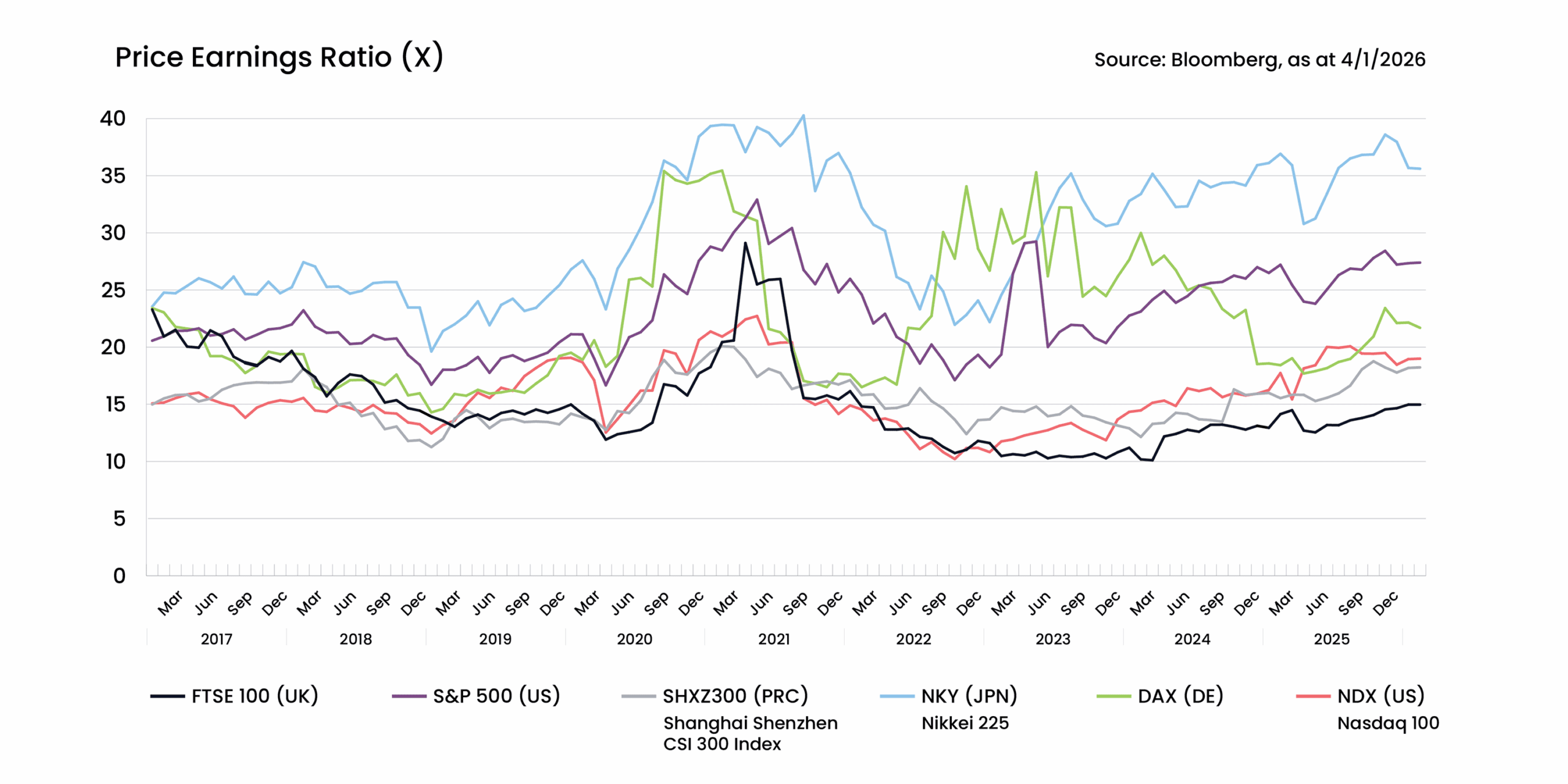
The value of an investment with St. James’s Place will be directly linked to the performance of the funds selected and may fall as well as rise. You may get back less than the amount invested.
Past performance is not indicative of future performance.
Please note it is not possible to invest directly into a financial Index and the figures shown do not take into account any charges applicable to the appropriate investment wrapper or any relevant tax charges.
The information contained is correct as at the date of the article. The information contained does not constitute investment advice and is not intended to state, indicate or imply that current or past results are indicative of future results or expectations. Where the opinions of third parties are offered, these may not necessarily reflect those of St. James’s Place.
Source: London Stock Exchange Group plc and its group undertakings (collectively, the “LSE Group”). ©LSE Group 2026. FTSE Russell is a trading name of certain of the LSE Group companies.
“FTSE Russell®” is a trade mark of the relevant LSE Group companies and is used by any other LSE Group company under license. All rights in the FTSE Russell indexes or data vest in the relevant LSE Group company which owns the index or the data. Neither LSE Group nor its licensors accept any liability for any errors or omissions in the indexes or data and no party may rely on any indexes or data contained in this communication. No further distribution of data from the LSE Group is permitted without the relevant LSE Group company’s express written consent. The LSE Group does not promote, sponsor or endorse the content of this communication.
© S&P Dow Jones LLC 2026; all rights reserved
Source: MSCI. Certain information contained herein, including without limitation text, data, graphs, charts (collectively, the “Information”) is the copyrighted, trade secret, trademarked and/or proprietary property of MSCI Inc. or its subsidiaries (collectively, “MSCI”), or MSCI’s licensors, direct or indirect suppliers or any third party involved in making or compiling any Information (collectively, with MSCI, the “Information Providers”), is provided for informational purposes only, and may not be modified, reverse-engineered, reproduced, resold or redisseminated in whole or in part, without prior written consent.
Source: Bloomberg. BLOOMBERG®” and the Bloomberg indices listed herein (the “Indices”) are service marks of Bloomberg Finance L.P. and its affiliates, including Bloomberg Index Services Limited (“BISL”), the administrator of the Indices (collectively, “Bloomberg”) and have been licensed for use for certain purposes by the distributor hereof (the “Licensee”). Bloomberg is not affiliated with Licensee, and Bloomberg does not approve, endorse, review, or recommend the financial products named herein (the “Products”). Bloomberg does not guarantee the timeliness, accuracy, or completeness of any data or information relating to the Products.
SJP Approved 12/01/2026
WeeklyWatch – Investing in 2025: the round-up

16th December 2025
Stock Take
The economic movements of 2025
2025 has been quite the year for investors! There’ve been periods of volatility, but towards the end, markets made some impressive gains. The usual groups – AI, inflation and interest rate cuts – steered investor sentiment both in the US and on a broader global scale. In the final edition of WeeklyWatch for this year, we’re taking a look back at some of the standout moments in each month.
We’ll be taking a break over the Christmas period. WeeklyWatch will return on Tuesday 13th January 2026.
January
The big tech favourite and AI company Nvidia experienced a 17% fall on 27th January, registering a near US$600 billion drop in value. This mirrored investor fear towards the threat from DeepSeek, a Chinese AI start-up. The subsequent Nvidia sell-off secured a historic moment as the worst single-day loss in dollar terms for a listed company.
In spite of the negativity, global markets ended the month higher. However, the AI shakeout resulted in the US lagging behind other regions.
February
Shaping a new economic landscape? At the start of February, US President Donald Trump announced tariffs on imports from Canada, Mexico and China. After last-minute negotiations, the 25% proposed tariffs on Canadian and Mexican goods were suspended for 30 days.
US shares fell, with investors redirecting their focus to less risky assets like US Treasuries, whose prices increased.
March
Europe, the US and the UK’s inflation data (February) revealed declines compared to January. Fears continued over a possible trade war, but the European Central Bank (ECB) still cut their interest rates by 0.25% percentage points to 2.5% as a way of addressing the region’s weak growth outlook.
Over in the UK, the March Spring Statement reinforced priorities put forward in the 2024 Autumn Budget. Key areas included:
- Investing in defence
- Fixing public services
- Accelerating economic growth
April
The term ‘Liberation Day’ frequently made our headlines following more US tariff announcements on 2nd April. A wide range of reciprocal tariffs was announced on a long list of countries. This included the European Union (taxed at 20%), and a global tariff rate of 10% was placed on countries not affected by reciprocal tariffs.
For financial markets, this marked a spell of volatility. There was a sharp drop in shares, but they soon recovered following Trump’s announcement of a 90-day suspension on reciprocal countries that didn’t retaliate, allowing for a recovery of initial losses for the stock markets. Additionally, bond yields dropped before concluding the month with little change. The US dollar ended April lower.
On 1st April in the UK, the stamp duty holiday ended when temporary increases to stamp duty thresholds came to an end. First-time buyers saw a fall in the threshold as to when they begin paying stamp duty, dropping from £425,000 to £300,000.
At the end of the tax year – 5th April – the government said that unspent pensions would be included in estates for Inheritance Tax purposes from April 2027.
May
May became a good month for market recovery. The S&P 500 in the US generated its best monthly returns in 18 months. First quarter earnings in the US were supported by outsized returns from the ‘Magnificent 7’, plus an ease in trade tensions and more positive economic data played their role.
Moody’s Ratings had previously had the US sovereign credit rating at a perfect Aaa, but they decided to downgrade it to Aa1 – in step with other major rating agencies. The decision was influenced by the persistently high US budget deficits and the associated debt servicing costs.
In the UK, even though there was a temporary spike in inflation, the Bank of England (BoE) opted to reduce interest rates by 0.25% percentage points to 4.25%. There was also a boost in retail sales due to the UK’s maximum daytime temperatures being the highest on record.
June
There was a rise in US shares, and some major indices reached record highs. AI continued to boost investor sentiment (Nvidia’s first quarter sales rising almost 70% year-on-year) and negotiations were underway to stave off triggering the tariffs.
Oil prices spiked following Israel’s attack on Iranian nuclear facilities and then faded. The increased geopolitical tensions also contributed to a rise in bond prices and the US dollar weakened further to a multi-year low against the pound.
July
Finalising trade deals went a long way in calming investor sentiment as the 90-day US tariff extensions concluded. The S&P 500 and Nasdaq were boosted by AI-related enthusiasm and reached new highs.
The US President made comments about potential US government interference with the US central bank’s (Fed) independence that caused concern. The Fed chair, Jerome Powell, gave little sign of the possibility of a pending US interest rate cut, which resulted in some investors feeling unnerved.
August
Nvidia reclaimed the spotlight as leading AI firm Nvidia emerged as the world’s most valuable public company. This was a notable achievement amid analysts’ concerns surrounding the profitability of AI projects and considering the high levels of investment into AI and demanding sector valuations.
The month also saw the BoE break ranks with the Fed and make a 0.25% interest rate cut, even though UK inflation was way above the 2% target. August also saw emerging markets outperform developed markets. An easing in tariff tensions supported returns in China and commodity exporters in Latin America, which was helped along by a weaker US dollar.
September
US markets continued to grow thanks to increased optimism around AI. The Fed’s decision to cut interest rates early in September and increased hopes of another by the end of the year also played its role in boosting the markets.
Across Europe, the outlook was more challenging. Fears regarding the long-term sustainability of government finances resulted in a spike in UK yields. At one stage, the yield on UK 30-year gilts hit a 27-year high before a slight easing (it remains relatively high). Additionally, Fitch downgraded French government debt to A+.
October
The beginning of October saw a flurry of political instability. The French Prime Minister, Sébastien Lecornu, surprised many when he resigned on Monday 6th October after less than a month in charge. As a result, French government 10-year bond yields increased to 3.58% – the highest in nine months – and French equities fell.
Volatility also re-emerged in the US when a partial government shutdown began, which would run into November. Shutdowns often make the headlines, but their impact on the stock markets is usually very limited. For example, the S&P 500 reached record highs towards the end of the month.
For the first time in history, gold broke the £3,000 per ounce mark. It began 2025 below £2,100, but persistent geopolitical uncertainty led investors to look for perceived ‘safe havens’, which resulted in prices going up.
November
UK Chancellor Rachel Reeves scheduled the Autumn Budget for as late as possible. As the day came closer, gilts and UK equities reacted to the rumours and leaks as to what she could reveal. The only certainty was that taxes would be increased.
Budget day ended up being rather eventful. An hour before the Chancellor delivered the Budget, the Office of Budget Responsibility (OBR) accidentally released their forecasts. Thankfully, as the OBR figures were better than expected, the markets remained calm (even though many of the expected tax rises came to pass). This slight reassurance of better fiscal headroom provided some comfort to gilt markets.
On 12th November, after 43 days, the longest ever US government lockdown ended.
December
The end of the year saw the anticipated US interest rate cut come to pass. This quarter point cut was the third in a row, and interest rates are now at a three-year low between 3.5% and 3.75%. Inflationary pressures remain in place, and there are increased concerns surrounding the latest employment data that the Fed are now focused on tackling. After the cut, Powell said that interest rates were “now within a broad range of estimates of its neutral value”.
Figures published by the Office for National Statistics revealed that the British economy shrank by 0.1% in October. Analysts’ expectations had been geared towards a modest rise, but it reinforces hopes that the BoE will cut interest rates by 0.25% percentage points on 18th December.
In the Picture
The Fed decided to cut interest rates last week, and they’re now at their lowest level for three years. Fed chair Jerome Powell suggested that future cuts will only happen if there’s a material deterioration in the labour market.

The information contained is correct as at the date of the article. The information contained does not constitute investment advice and is not intended to state, indicate or imply that current or past results are indicative of future results or expectations. Where the opinions of third parties are offered, these may not necessarily reflect those of St. James’s Place.
Source: London Stock Exchange Group plc and its group undertakings (collectively, the “LSE Group”). ©LSE Group 2025. FTSE Russell is a trading name of certain of the LSE Group companies.
“FTSE Russell®” is a trademark of the relevant LSE Group companies and is used by any other LSE Group company under license. All rights in the FTSE Russell indexes or data vest in the relevant LSE Group company which owns the index or the data. Neither LSE Group nor its licensors accept any liability for any errors or omissions in the indexes or data and no party may rely on any indexes or data contained in this communication. No further distribution of data from the LSE Group is permitted without the relevant LSE Group company’s express written consent. The LSE Group does not promote, sponsor or endorse the content of this communication.
© S&P Dow Jones LLC 2025; all rights reserved.
Source: MSCI. MSCI makes no express or implied warranties or representations and shall have no liability whatsoever with respect to any MSCI data contained herein. The MSCI data may not be further redistributed or used as a basis for other indices or any securities or financial products. This report is not approved, endorsed, reviewed or produced by MSCI. None of the MSCI data is intended to constitute investment advice or a recommendation to make (or refrain from making) any kind of investment decision and may not be relied on as such.
SJP Approved 15/12/2025
WeeklyWatch – Are Japanese interest rates climbing?

9th December 2025
Stock Take
Sell-off initiated after BoJ governor comments
Needless to say, the governor of the Bank of Japan (BoJ) carries a lot of influence. And when he speaks, markets move. Kazuo Ueda’s latest comments hinted at a possible further rise for Japanese interest rates which resulted in an increase in bond yields (and a fall in their prices) in the US and UK, and a decline in global stock markets.
So why does the notion of higher Japanese interest rates rattle the global markets? Let’s take a closer look.
Negative Japanese interest rates – investors are a fan
Japan’s economy is the fourth largest in the world but has battled with low domestic consumer confidence and weak demand for several years. The result: falling prices, also known as deflation. Cutting interest rates was the BoJ’s solution to reverse this, with the hope that domestic consumers would spend more on goods and services rather than watch their savings lose more value.
The low, sometimes negative, interest rate environment was an advantage to overseas investors, who began to borrow yen and convert it into US dollars or euros. They then purchased higher yielding assets overseas, like US Treasuries, which delivered returns of 3% to 4%, as well as shares.
This relatively low-risk investing strategy is called yen carry trade. One way to compare it is using a cheap Japanese mortgage to buy a more expensive rental yield property in the UK or US – this has been popular among international investors.
An unwinding in carry trade in 2024
In early 2024, the BoJ raised their interest rates for the first time in 17 years. In August of the same year, a more substantial hike followed, leading to a double-digit percentage sell-off for the Nikkei index. With higher interest rates, overseas investors needed to rapidly pay off their now more expensive yen loans which they did by selling some carry trade investments, meaning that these prices fell. Additionally, the higher rates boosted the value of the yen which made it more challenging for Japanese exporters as products were more expensive overseas.
The Head of Asia and Middle East Investment Advisory at St. James’s Place, Martin Hennecke, said:
“The sharp rise in the yields of Japanese government bonds (JGBs) in a relatively short period of time serves as a reminder of the risk of using leverage when investing, with the yen being one of the most popular carry trade currencies.
“Any advice on the use of leveraged strategies can be conflicted as it often results in large amounts invested. This in turn can often backfire badly in an adverse scenario. Investors enticed into this type of strategy by high future return projections based on ‘historical evidence’ should tread very carefully. Financial markets can be more unpredictable than we would like to think.”
No historical repeats, but familiar patterns
At the beginning of the week, after realising the possibility of higher Japanese interest rates, global bond and share markets sold off. 10-year JGB yields now sit at their highest level since mid-2008. Japanese investors who’ve invested in US bonds are facing the temptation to sell their US Treasuries and repatriate funds to purchase JGBs.
Why is this important? Japanese investors are the largest buyers of US Treasuries. If fewer purchases are made, there’s a fall in price for US Treasuries, and yields rise to compensate. For the US federal government, this isn’t good news… They’re forced to pay a higher interest rate on the debt that is regularly re-financed. Their figures forecast that these interest payments will be $1.2 trillion in 2025 on the national debt, which is $37.6 trillion. Both sides have agreed that this option is unsustainable, but the rises continue.
Summarising global market activity
The BoJ comments created rather a weak beginning to the week, but despite this, US stock markets ended the period higher – the S&P 500 was less than 1% below its record closing high. And the remaining S&P 493 were outperformed by the tech-centred Magnificent 7.
Investor sentiment towards AI remains upbeat, and hopes are fuelled by the expectation of a 0.25% interest rate cut tomorrow (10th December) from the US central bank, with potentially more to come in 2026. This will come as positive news for interest-rate-sensitive sectors and smaller companies as they often have higher levels of debt.
With the prospect of lower interest rates on the horizon, there was an easing on the US dollar. As a result, this makes gold (which is priced in dollars) cheaper for buyers using alternative currencies like the euro or yen. By the end of the week, gold had closed around 4% below its recent record high.
Across Europe, shares ended higher. And in Asia, there was a rallying for Japanese shares after a weak Monday, finishing almost 1% up. Additionally, shares also increased in China, where sentiment is underpinned by tech and AI themes.
Wealth Check
The gift that keeps on…taking
A freedom of information request has revealed that hefty Inheritance Tax (IHT) bills are becoming a reality for thousands of households in the UK, after falling foul of the seven-year rule on gifting.
More than 14,000 families are being asked to pay tax by HMRC after receiving gifts from relatives who have passed away within seven years of leaving their assets. The bills range in amount – some families are facing payments of millions of pounds.
Gifts that are over the £3,000 annual gift allowance become part of the person’s estate, meaning the recipient can become liable to pay IHT on them. IHT levied on gifts is charged on a sliding scale and is dependent on when the person passed away. If the person passed away more than seven years after issuing the gift, then no IHT needs to be paid.
As it stands, people can leave an estate worth up to £325,000 without recipients needing to pay IHT – known as the nil-rate band. This increases to £500,000 if a property is left to a direct descendent and the estate is valued at less than £2 million.
In April 2027, pension pots will become part of a person’s estate and therefore susceptible to IHT. Thus, more estates are likely to be pushed over the tax thresholds, meaning that more families and individuals will face IHT bills.
In recent years, HMRC have noticed more gross IHT receipts, with inflation pushing up asset prices. Between April and October of 2025, IHT receipts totalled £5.14 billion, an increase of £3.8 billion compared with the same period last year.1
Do you have any questions about IHT and how it could affect you and your loved ones? Our expert advisers are able to evaluate your finances and help you plan the best way forward to help mitigate these costs.
The levels and bases of taxation, and reliefs from taxation, can change at any time. The value of any tax relief depends on individual circumstances.
Source
1HMRC tax receipts and National Insurance contributions for the UK (monthly bulletin) – gov.uk
In the Picture
For monthly stock market returns, December usually delivers some of the best! With the new year approaching, investor sentiment tends to be more upbeat or ‘bullish’. And with many market participants away on holiday, trading volumes are lower. What this means is that fewer purchases are required to deliver a positive effect on performance.
Over in the US, technical moves like selling underperforming shares for tax purposes and reinvesting proceeds also contribute to this upbeat yearly conclusion.
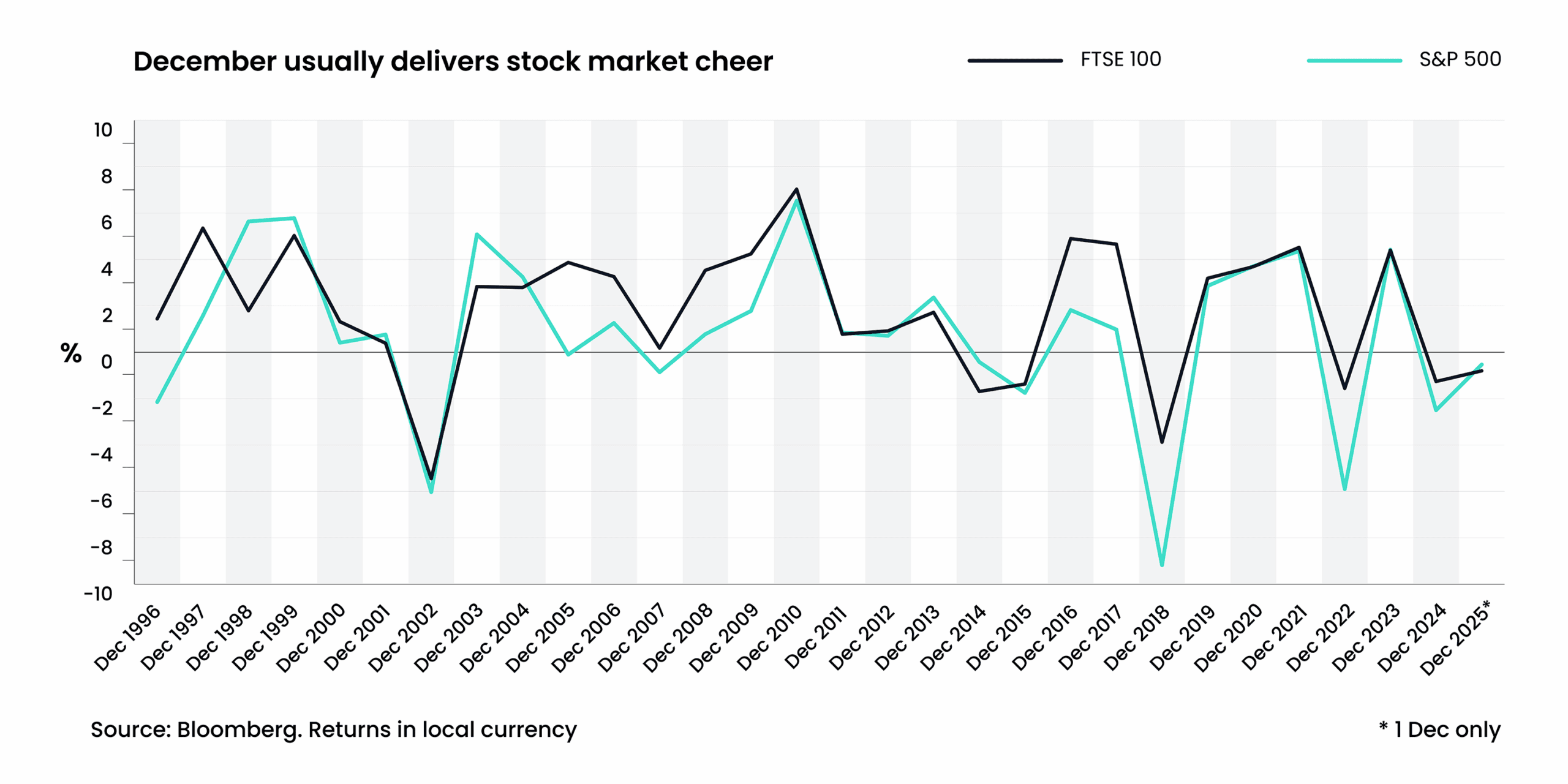
The information contained is correct as at the date of the article. The information contained does not constitute investment advice and is not intended to state, indicate or imply that current or past results are indicative of future results or expectations. Where the opinions of third parties are offered, these may not necessarily reflect those of St. James’s Place.
Source: London Stock Exchange Group plc and its group undertakings (collectively, the “LSE Group”). ©LSE Group 2025. FTSE Russell is a trading name of certain of the LSE Group companies.
“FTSE Russell®” is a trademark of the relevant LSE Group companies and is used by any other LSE Group company under license. All rights in the FTSE Russell indexes or data vest in the relevant LSE Group company which owns the index or the data. Neither LSE Group nor its licensors accept any liability for any errors or omissions in the indexes or data and no party may rely on any indexes or data contained in this communication. No further distribution of data from the LSE Group is permitted without the relevant LSE Group company’s express written consent. The LSE Group does not promote, sponsor or endorse the content of this communication.
© S&P Dow Jones LLC 2025; all rights reserved.
Source: MSCI. MSCI makes no express or implied warranties or representations and shall have no liability whatsoever with respect to any MSCI data contained herein. The MSCI data may not be further redistributed or used as a basis for other indices or any securities or financial products. This report is not approved, endorsed, reviewed or produced by MSCI. None of the MSCI data is intended to constitute investment advice or a recommendation to make (or refrain from making) any kind of investment decision and may not be relied on as such.
SJP Approved 08/12/2025