WeeklyWatch – First Fed rate chop of 2025

23rd September 2025
Stock Take
Rate cuts and risk management in the US
Last week, the Federal Reserve cut interest rates for the first time this year. In a widely expected move, the US central bank opted to lower its key lending rate by 0.25% – a move often referred to as dovish.
The US equity market index, the S&P 500, as well as the tech-focused Nasdaq Composite index both hit record highs at the end of the week – boosted in part by expectations of two further rate cuts before the year ends.
The Fed operates under a dual mandate: to maintain price stability (i.e. target an inflation rate of 2%), while also, unusually, safeguarding maximum employment. This differs from many other central banks, such as the Bank of England, which typically focus solely on price stability.
Juggling employment and inflation is challenging given the Fed only has one tool (interest rates) to control both responsibilities, meaning it’s often forced to prioritise. At present, the Fed faces slowing job growth, while inflation remains above its 2% target and higher than a year ago.
The Fed called its rate decision a ‘risk-management cut’. Investors have taken this to mean that supporting the job market is now the priority, even if inflation stays high. Fed chair Jerome Powell pointed to tariffs and tighter immigration policies as key pressures on employment. The recent downward revision to annual job creation figures, alongside weaker-than-expected employment data, featured in the central bank’s calculations to cut interest rates.
Greg Venizelos, Fixed Income Strategist at St. James’s Place, emphasised this risk-management stance:
“Post-Covid, the Fed was late to raise interest rates. Remember when they described inflation as being ‘transitory’ during the pandemic? What we are seeing now is the US central bank being more proactive regarding possible problems in its jobs market. Even so, they are cutting rates as economic growth forecasts for the global (and US) economies are being raised. US equity valuations have also been increasing.”
The underlying concern is that a weakening jobs market could undermine consumer confidence and consumption, threatening the broader economy. The Fed now faces a conundrum: while cutting rates may support employment, it may cause reputational damage if inflation remains high and the job market fails to rebound.
The UK holds steady
In contrast to the Fed, the Bank of England (BoE) chose to hold interest rates last week. At 3.8%, UK inflation remains persistently above the UK central bank’s 2% target, driven in large part by the food and housing rental market sectors, as well as wage growth. Even so, it maintained its guidance that future rate cuts will be ‘gradual and careful’. Notably – unlike the US – the BoE has already lowered rates four times since last November.
Despite domestic inflation remaining above target, weakness in the domestic job market is a growing concern. Similarly to the US, there are risks that job market conditions could deteriorate further.
The BoE also announced a slowdown in its programme of bond (also known as gilt) sales, reducing the annual target from £100 billion to £70 billion. This process, known as quantitative tightening (QT), is the reverse of quantitative easing. Easing the pace of QT is expected to deliver several benefits, including greater support for gilt prices. Since bond prices and yields move in opposite directions, many analysts expect this adjustment to help reduce some of the upward pressure on bond yields and the cost of servicing the government’s debt.
Global markets react to Fed cut
The US smaller companies Russell 2000 index and Dow Jones joined the S&P 500 and Nasdaq 100 in hitting record highs during the week following the Fed’s rate cut. A range of other assets also rose – including gold, silver and the US dollar. US 10-year bond yields edged higher (with prices falling), while oil prices also fell. Meanwhile, upbeat news around AI continued to make headlines, helping US mega-cap technology shares outperform the broader S&P 500.
In Europe, performance was more varied. The MSCI Europe ex UK benchmark posted modest gains, while the UK’s FTSE 100 and several other European indices retreated. The pound also slipped against the US dollar.
Asian emerging markets mostly rallied, but mainland Chinese equities fell after disappointing data on retail sales and industrial output. Japanese markets also ended the week in the red.
Wealth Check
UK house prices have surged over the last 20 years, but will the boom last? Many still expect values to keep climbing. Watch Alex Loydon of St. James’s Place and Karen Ward of JP Morgan Asset Management discuss whether those expectations are realistic here.
In the Picture
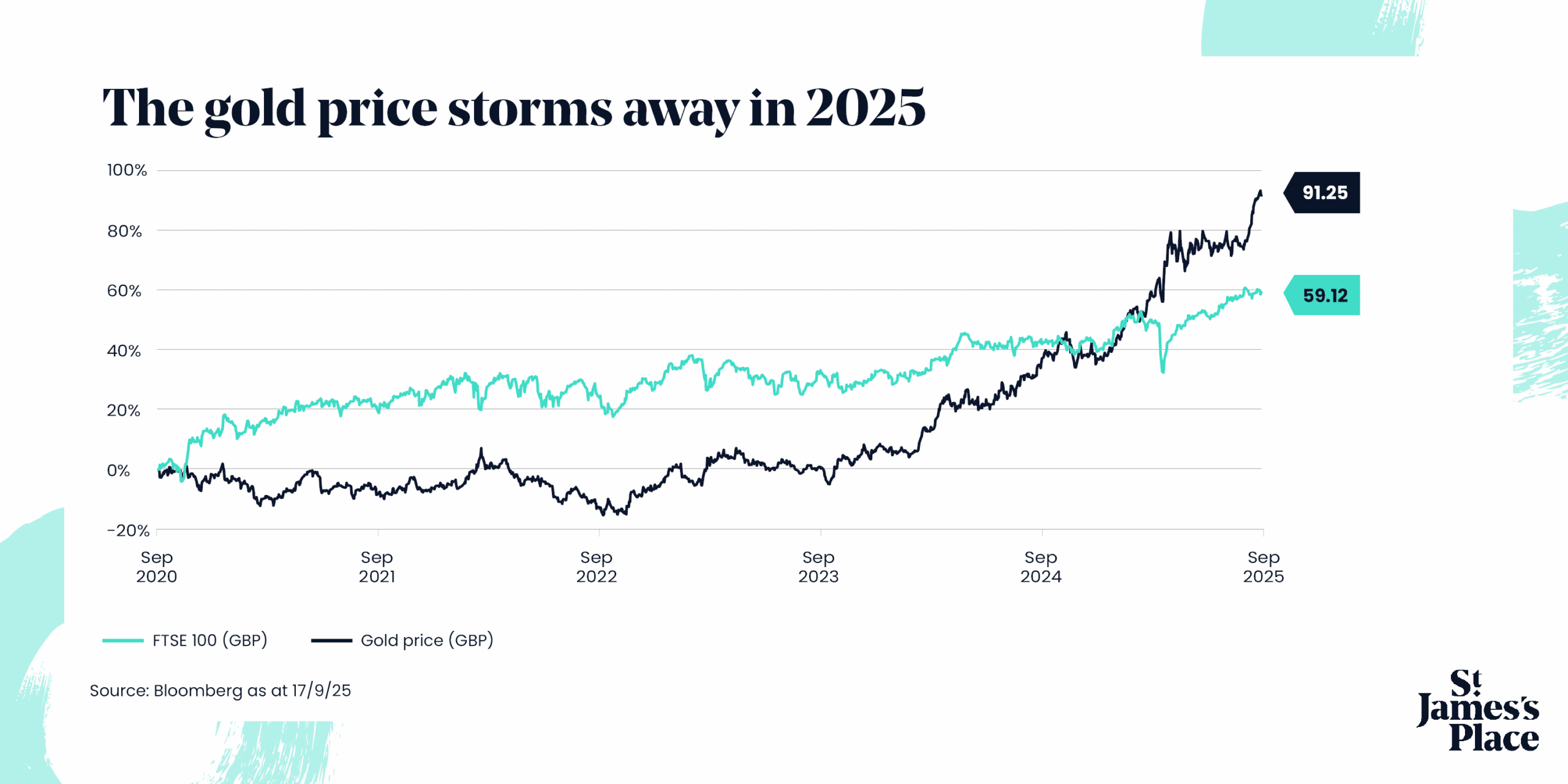
Gold is shining bright against the current market backdrop. Because it doesn’t pay interest, it often becomes more attractive when interest rates drop – reducing the opportunity cost of holding it versus other assets. At the same time, the weaker US dollar since the start of the year has made gold more affordable for international buyers. Global trade tensions are also playing a role in this ‘flight to safety’ as investors seek safe-haven assets.
The value of an investment with St. James’s Place will be directly linked to the performance of the funds selected and may fall as well as rise. You may get back less than the amount invested.
Past performance is not indicative of future performance.
The information contained is correct as at the date of the article. The information contained does not constitute investment advice and is not intended to state, indicate or imply that current or past results are indicative of future results or expectations. Where the opinions of third parties are offered, these may not necessarily reflect those of St. James’s Place.
Source: London Stock Exchange Group plc and its group undertakings (collectively, the “LSE Group”). ©LSE Group 2025. FTSE Russell is a trading name of certain of the LSE Group companies.
“FTSE Russell®” is a trademark of the relevant LSE Group companies and is used by any other LSE Group company under license. All rights in the FTSE Russell indexes or data vest in the relevant LSE Group company which owns the index or the data. Neither LSE Group nor its licensors accept any liability for any errors or omissions in the indexes or data and no party may rely on any indexes or data contained in this communication. No further distribution of data from the LSE Group is permitted without the relevant LSE Group company’s express written consent. The LSE Group does not promote, sponsor or endorse the content of this communication.
© S&P Dow Jones LLC 2025; all rights reserved
Source: MSCI. Certain information contained herein, including without limitation text, data, graphs, charts (collectively, the “Information”) is the copyrighted, trade secret, trademarked and/or proprietary property of MSCI Inc. or its subsidiaries (collectively, “MSCI”), or MSCI’s licensors, direct or indirect suppliers or any third party involved in making or compiling any Information (collectively, with MSCI, the “Information Providers”), is provided for informational purposes only, and may not be modified, reverse-engineered, reproduced, resold or redisseminated in whole or in part, without prior written consent.
Source: Bloomberg. BLOOMBERG®” and the Bloomberg indices listed herein (the “Indices”) are service marks of Bloomberg Finance L.P. and its affiliates, including Bloomberg Index Services Limited (“BISL”), the administrator of the Indices (collectively, “Bloomberg”) and have been licensed for use for certain purposes by the distributor hereof (the “Licensee”). Bloomberg is not affiliated with Licensee, and Bloomberg does not approve, endorse, review, or recommend the financial products named herein (the “Products”). Bloomberg does not guarantee the timeliness, accuracy, or completeness of any data or information relating to the Products.
SJP Approved 22/09/2025
WeeklyWatch – Reality check for US jobs data

16th September 2025
Stock Take
Payroll plot twist in the US
The statistics show a slowdown in US hiring – but is it all bad news?
Last week, the US Bureau of Labor Statistics revealed it overstated job creation by 911,000 in the 12 months to March 2025. Weekly payroll growth during that period was therefore less than half the original report.
Although these revised figures were from earlier this year, they were echoed by early September data showing jobless claims jumped to their highest weekly level since October 2021. While, overall, unemployment remains low, these signs point to US hiring losing momentum. Investors, however, appeared to shrug off the news, viewing it as ‘bad news is good news’ – helping to cement expectations of an imminent US rate cut this week, with more possibly to follow.
Rate-cut rally
Indeed, stock markets in the US had a good week ahead of the Federal Reserve’s September meeting today and tomorrow (16th and 17th), where a 0.25% rate cut is widely expected. Strong Q1 order growth at software company Oracle, driven by demand for cloud-computing services, boosted investor sentiment around the AI boom.
Back across the pond, European stock markets also rose, buoyed by hopes for the potential US rate cut. The ECB, as anticipated, held interest rates steady at its recent meeting. In Asia, both Chinese and Japanese markets rose. Gold glimmered – finishing the week just shy of an all-time high, while the US dollar index eased.
Debt déjà vu for France
On Friday, credit rating agency Fitch downgraded France’s government debt, effectively signalling the country is becoming less creditworthy. Domestic fixed income (known as OATS) now carry an A+ rating, with a stable outlook. This decision was partly a response to a deteriorating political backdrop, with the minority government struggling to implement spending cuts and rein in the deficit.
Earlier in the week, President Emmanuel Macron appointed Sébastien Lecornu as prime minister – the fifth in less than two years. To govern effectively, Lecornu will need backing from the socialists and other groups in the National Assembly. His predecessor, François Bayrou, lost a no-confidence vote after lawmakers rejected his proposals to reduce public spending.
Occurring soon after UK 30-year bond yields rose to near three-decade highs, last week’s developments may be a sign the market’s patience is weakening towards indebted developed economies such as France and the UK. Both are trying to maintain generous welfare and pension systems while also funding energy transition efforts and higher defence spending, all against a backdrop of a weak economic growth outlook, according to Hetal Mehta, Chief Economist at SJP. She observed:
“One of the key underlying problems is the weakness of productivity. France didn’t undergo the turmoil and painful reforms the periphery went through back in 2011–13. This is now becoming a much bigger problem as debt continues to accumulate.
“It is not unusual for many economies to be faced with high debt levels, but it is the pace of that debt accumulation that matters. The deficit in France is set to remain among the largest in the G7. The only exception is the US.”
As the eurozone’s second-largest economy, any sustained loss of investor confidence in France could push domestic bond yields higher and have the same effect elsewhere in the bloc. Persistently rising yields could set up a standoff between investors – convinced an eventual correction is inevitable – and a government determined to avoid a default as well as the humiliation of a bailout and severe repayment conditions by the European Central Bank (ECB).
Lecornu doesn’t have much time to find a solution. A critical hurdle is the 2026 budget, with a draft due on 13th October. Mehta noted that the short-lived Bayrou government had targeted ambitious reductions in spending. Commenting on what happens now, she says:
“The new Lecornu government will need to have discussions with opposition parties to get a budget passed. It seems more likely the adjustment will be dialled down to be consistent with EU fiscal rules.”
In the absence of progress on cuts, France’s Ministry of Finance is projecting a 2026 budget deficit of 6.1% of GDP, way above the EU’s 3% limit. Bond markets are not yet pricing in a repeat of the sovereign debt crisis. Although 10-year OAT yields rose after Bayrou’s resignation, they remain below levels seen earlier this month and under their 12-month peak.
A useful gauge of relative risks is the difference between French 10-year yields, and the equivalent 10-year yields for German Bunds. Greg Venizelos, SJP’s Fixed Income Strategist, noted that:
“Fixed income markets do not appear unduly concerned about French debt because of the domestic political backdrop.”
He also reminded investors the ECB has an extensive toolkit to counter any potential runaway in French yields.
“The back-up facilities put in place after both the European sovereign debt crisis, which began in September 2009, as well as Italian fiscal stress provide ample room to cushion solvency concerns. This would of course come with conditions of fiscal discipline, but probably not much harsher than what the French parliament might be able to agree to.”
Wealth Check
Five pension myths: busted
As Pension Awareness Week returns for its 11th year, attention is once again on the vital role pensions play in ensuring well-being in retirement. Yet many people are unaware of how to make the most of the pension savings options available to them.
Here are some of the most common misconceptions…
“I’ve already paid £60,000 into my pensions, so I can’t pay in more.”
The £60,000 annual allowance applies to most people for tax-relieved pension contributions. However, the ‘carry forward’ rules let you use unused allowances from the previous three tax years, meaning you may be able to pay in more.
“I’m not working, so I can’t get pension tax relief.”
Not true. Even non-earners, including children, can benefit from some pension tax relief. Anyone earning under £3,600 a year can contribute up to £2,880 annually, with 20% tax relief topping this up to £3,600.
“Pensions are subject to Inheritance Tax (IHT).”
For now, most pensions can still be passed on free of IHT. Although the government does intend to make pensions liable for this tax, it hasn’t happened yet; pensions will fall within the value of a person’s estate for IHT purposes from 6 April 2027.
“My State Pension and auto-enrolment pension are enough for retirement.”
Assuming you qualify for the full State Pension, a single person will still need to build up a pension pot worth £540,000 to £800,000 to achieve a comfortable retirement, according to Pensions UK.1 It’s therefore unlikely the State Pension plus a workplace pension where you’re saving the minimum will be enough.
“It’s too late to boost my pension now.”
It’s a myth! It’s never too late to give your pension a boost and enjoy a bigger nest egg in later life. For example, contributing an extra £200 a month from age 50 until retiring at 65 could add around £48,200 to your pension pot, assuming 4.5% annual growth after charges.
Source:
1How to estimate likely retirement living standards – 2025 Pensions UK
The value of an investment with St. James’s Place will be directly linked to the performance of the funds selected and may fall as well as rise. You may get back less than the amount invested.
Past performance is not indicative of future performance.
The information contained is correct as at the date of the article. The information contained does not constitute investment advice and is not intended to state, indicate or imply that current or past results are indicative of future results or expectations. Where the opinions of third parties are offered, these may not necessarily reflect those of St. James’s Place.
Source: London Stock Exchange Group plc and its group undertakings (collectively, the “LSE Group”). ©LSE Group 2025. FTSE Russell is a trading name of certain of the LSE Group companies.
“FTSE Russell®” is a trademark of the relevant LSE Group companies and is used by any other LSE Group company under license. All rights in the FTSE Russell indexes or data vest in the relevant LSE Group company which owns the index or the data. Neither LSE Group nor its licensors accept any liability for any errors or omissions in the indexes or data and no party may rely on any indexes or data contained in this communication. No further distribution of data from the LSE Group is permitted without the relevant LSE Group company’s express written consent. The LSE Group does not promote, sponsor or endorse the content of this communication.
© S&P Dow Jones LLC 2025; all rights reserved
Source: MSCI. Certain information contained herein, including without limitation text, data, graphs, charts (collectively, the “Information”) is the copyrighted, trade secret, trademarked and/or proprietary property of MSCI Inc. or its subsidiaries (collectively, “MSCI”), or MSCI’s licensors, direct or indirect suppliers or any third party involved in making or compiling any Information (collectively, with MSCI, the “Information Providers”), is provided for informational purposes only, and may not be modified, reverse-engineered, reproduced, resold or redisseminated in whole or in part, without prior written consent.
Source: Bloomberg. BLOOMBERG®” and the Bloomberg indices listed herein (the “Indices”) are service marks of Bloomberg Finance L.P. and its affiliates, including Bloomberg Index Services Limited (“BISL”), the administrator of the Indices (collectively, “Bloomberg”) and have been licensed for use for certain purposes by the distributor hereof (the “Licensee”). Bloomberg is not affiliated with Licensee, and Bloomberg does not approve, endorse, review, or recommend the financial products named herein (the “Products”). Bloomberg does not guarantee the timeliness, accuracy, or completeness of any data or information relating to the Products.
SJP Approved 15/09/2025
WeeklyWatch – Bonds back in the spotlight

9th September 2025
Stock Take
Bonds break into the headlines
UK investors received quite the shock last week when trading screens flashed danger red and there was a strong sense of alarm concerning a crash in the bond markets. It even resulted in a former Conservative chancellor bringing up the notion that the UK could need a bailout from the International Monetary Fund.
The yields, or interest rate, on 30-year gilts rose to a 27-year high of 5.72% after the sell-off in UK government bonds (gilts). Additionally, the pound recorded its steepest one-day decline since the start of summer against the US dollar and euro.
But as the week went on, fears began to calm. Despite this, the selling off of UK bonds impacted other markets and served as a reminder of continuous, uncomfortable problems for developed economies, not only the UK. These are issues that can’t be easily resolved.
As well as tax revenue, the UK government raises money to cover expenses by issuing gilts. When gilt yields rise, it costs the government more to service its debt. The 10-year gilt yield is used as a reference point for bank lending rates and mortgages, and now stands as the highest among the G7 group of industrialised economies.
30-year gilts are used by investors as an indicative tool with which to estimate their long-term market expectations when it comes growth, inflation and economic management. Them spiking to a level not seen since 1998 is a signal that investors’ perception of the UK’s economic prospects has broken down.
Growing concern
Under both the Conservative and Labour governments, borrowing has escalated. With a rapidly ageing population, the NHS faces a far bigger demand, and social care costs have increased. In addition, the inflation-protected ‘triple lock’ State Pension also contributes to the financial burden. Plus, a volatile geopolitical situation and increasing defence spending are also piling on the pressure.
UK productivity has been an issue for a long time, having barely grown for over a decade, falling behind big competitors like the US and Germany. Moreover, business investment is the lowest among its peers. Existing concerns are continuing to be fuelled by the government’s business strategy and further challenges in the form of higher tariffs and rising levels of unemployment.
Eyes turn to the upcoming Budget
Investors are focused on what Chancellor Rachel Reeves will have to say, as it’s been announced that the Autumn Budget will be revealed on 26th November. Reeves’ limited options have got them intrigued as she’s already ruled out increasing VAT, national insurance (NI) or income tax.
The Governor of the Bank of England, Andrew Bailey, responded to the bond market fluctuations, identifying that the government raises the majority of its borrowings by issuing ‘short-term’ debt (gilts with a lifespan of 5–10 years). While he said the rise in the 30-year yield was unwelcome, it was “not that significant” for borrowing costs.
He also drew attention to the fact that many of the UK’s issues are happening elsewhere. This week’s ‘In the Picture’ chart reveals that long-term bond yields in Germany and the US have been on an upward trend as well.
The Fixed Income Strategist at St. James’s Place, Greg Venizelos, highlighted that higher Japanese government bond yields may encourage Japanese buyers of overseas bonds (including gilts) to hold back from buying foreign bonds and even consider selling down some holdings and repatriate funds. He said:
“If you remove a key buyer (Japan) from the market, inevitably there’s less demand. Yields creep up on that basis.”
Concluding the market news
After a US national holiday, a lot of the domestic stock markets concluded the week higher – a positive sign in light of the unimpressive US data that revealed that fewer jobs were created in August than predicted. Analysts widely presume that the negative backdrop has made an interest rate cut by the US central bank later this month almost certain. And another two cuts are also likely before the end of 2025.
After a challenging week last week, the FTSE 100 made a slight recovery, ending the week higher, alongside the pound. Across Europe, shares didn’t change much over the course of the week. However, in China, a strong multi-week rally saw their shares ease. Gold increased to a new high whereas oil prices softened.
As the week concluded, global bond prices recovered some ground lost in the week as investors digested the disappointing US jobs report. But the 30-year gilt is higher than it was at the beginning of 2025, or twelve months ago. If there’s a continuous rise in yields, there are still options for the Bank of England, including as the ‘buyer of last resort’. If inflation was to decrease, confidence in government policy was to increase and the economic data improved, investor sentiment would be boosted.
Wealth Check
The Autumn Budget is on its way – what’s in store?
The Autumn Budget will be revealed on 26th November – made official by the UK government last week. It’s taking place notably later in the year, which allows for more time to speculate what tax hikes may be implemented.
There’s a huge fiscal black hole to resolve, but due to election pledges not to raise income tax, it’s left the chancellor with a challenging budgetary tightrope to navigate. So, what are some of the changes we might expect?
- Increased income tax, NI or VAT – This would betray one of Labour’s key manifesto promises. Although it would be an unpopular choice, increasing income tax, say of 1p in the pound, could raise much-needed revenue.
- Reducing spending on public services – This may include making cuts to the bloated welfare bill and encouraging more people to get back into work. Many believe this is now becoming a real possibility, much to the disapproval of some.
- ISAs – This could involve cutting the savings limit for cash ISAs.
- Pensions – These could be impacted by the limiting of the 25% tax-free lump sum that savers currently take from their pension from the age of 55. Another option could be to reduce the level of tax relief on pension contributions which could also be used as a way to raise funds.
- Capital Gains Tax (CGT) – These were increased in the last Budget and may see further increases in the upcoming one. Additionally, the CGT allowance may be reduced even more; it currently stands at £3,000 so any changes will appear harsh.
- Increasing Inheritance Tax (IHT) – Limiting the benefits of tax-free gifting and freezing thresholds are both options.
- Wholesale reform of property rates – This is believed to have been discussed. CGT may be levied on the sale of high-value homes, and a national property tax could replace council tax.
In the Picture
Jumps in UK bond prices may have grabbed headlines, but the UK are not alone in their increased borrowing costs. Most developed countries are facing a similar issue and having to endure more expensive long-term borrowing.

The value of an investment with St. James’s Place will be directly linked to the performance of the funds selected and may fall as well as rise. You may get back less than the amount invested.
Past performance is not indicative of future performance.
The information contained is correct as at the date of the article. The information contained does not constitute investment advice and is not intended to state, indicate or imply that current or past results are indicative of future results or expectations. Where the opinions of third parties are offered, these may not necessarily reflect those of St. James’s Place.
Source: London Stock Exchange Group plc and its group undertakings (collectively, the “LSE Group”). ©LSE Group 2025. FTSE Russell is a trading name of certain of the LSE Group companies.
“FTSE Russell®” is a trademark of the relevant LSE Group companies and is used by any other LSE Group company under license. All rights in the FTSE Russell indexes or data vest in the relevant LSE Group company which owns the index or the data. Neither LSE Group nor its licensors accept any liability for any errors or omissions in the indexes or data and no party may rely on any indexes or data contained in this communication. No further distribution of data from the LSE Group is permitted without the relevant LSE Group company’s express written consent. The LSE Group does not promote, sponsor or endorse the content of this communication.
© S&P Dow Jones LLC 2025; all rights reserved.
Source: MSCI. MSCI makes no express or implied warranties or representations and shall have no liability whatsoever with respect to any MSCI data contained herein. The MSCI data may not be further redistributed or used as a basis for other indices or any securities or financial products. This report is not approved, endorsed, reviewed or produced by MSCI. None of the MSCI data is intended to constitute investment advice or a recommendation to make (or refrain from making) any kind of investment decision and may not be relied on as such.
SJP Approved 08/09/2025
WeeklyWatch – Deficit woe dominates Europe

2nd September 2025
Stock Take
French markets shaken by political volatility
Political uncertainty resurfaced in France once again, when Prime Minister François Bayrou announced a snap vote of confidence, which will take place on 8th September. The impact on the markets? Well, it’s certainly rocked the boat.
Bayrou is currently fighting to pass nearly €44 billion in budget cuts which will go towards tackling the deficit that hit 5.8% of French GDP in 2024. But because Bayrou’s party holds a minority position, he requires the support of another party in order for the budget to pass. Opposition parties from both the left and right have voiced their disapproval of the plans, making it more unlikely that Bayrou will rally the support he needs.
Commenting on his reasoning behind calling the snap vote of confidence, Bayrou said:
“Yes, it’s risky, but it’s even riskier not to do anything.”
If Bayrou loses the vote, French President Emmanuel Macron will have quite the political headache. It could result in another parliamentary election – and Macron already surprised many when he initiated a snap election just last year. Macron’s party lost numerous seats which has, in part, contributed to the issues currently being faced.
The resulting political volatility and announcement meant that French markets fell. There was an immediate drop for the CAC 40 (a benchmark for the French stock market), which finished the week almost 3% down.
During the same time frame, yields on 10-year bonds rose. Consequently, the gap between French 10-year bonds and their German counterparts widened to its largest level since the snap election in 2024. It’s now comparable to the gap between Italian and German bonds.
As the fixed income narrative continues to develop, the Fixed Income Strategist at St. James’s Place, Greg Venizelos, stated:
“This has been going on since Macron started the ball rolling in 2024. There is an argument that most of the risk has been priced in. The worst-case scenario is that they declare elections and then they’ll need to go through the process of building a new government a few weeks down the line. They can still vote an emergency budget in the Parliament, where basically they roll the 2025 budget forward for a year.”
UK banking faces more troubles
While he may be struggling for support from fellow French parties, Bayrou would certainly have a sympathetic ear from Chancellor Rachel Reeves when it comes to deficit difficulties.
She faces challenging decisions as she tries to reduce a £40 billion black hole in public finances. Over the last few weeks, rumours have arisen regarding possible rises in taxes that are widely believed to be under serious consideration.
On Friday, the Institute for Public Policy Research (IPPR) requested that the government introduce a new tax on windfall profits on banks. According to them, a tax like this could raise up to £8 billion a year for the Chancellor.
Numerous high street banks, including Lloyds and NatWest, ended Friday down more than 2% after the proposal was put forward.
Unfortunately, this created a bit of a domino effect. The FTSE 100 was subsequently knocked by 1% over the week, which was only four days as a result of the bank holiday, although this is down from the historic highs it reached on Friday 22nd August.
10-year highs for Chinese shares
Turning our attentions to the east, Chinese markets have been enjoying a strong period of growth and are now trading at levels previously seen after a period of growth last decade. In 2025, the Shanghai SE Composite (SSE) index is up over 36%.
Chinese shares did not have a good year in 2015. The SSE index fell from a high of over 5,000 points in June to under 3,000 in August when a stock market bubble burst. Last week, the index broke the 3,800 mark for the first time.
The Head of Asia and Middle East Investment Advisory and Comms at St. James’s Place, Martin Hennecke, explains the revival:
“China’s rally has been supported by a combination of factors, including highly discounted equity valuations to start with. There has also been strong performance in many sectors extending beyond electric vehicle and AI to high-tech manufacturing, new drug development and other areas that have been less in the spotlight. As well as this, government support measures have been rolled out, covering consumption, further property easing and anti-price-war measures.
“Perhaps one of the most telling statistics to gauge China’s modern manufacturing might is that, according to preliminary data from the International Federation of Robotics released last month, the country’s 2024 market share of global industrial robot installations increased to 54%.”
Even though Chinese markets’ performance has been impressive, it’s worth bearing in mind the international context of its growth: the S&P 500, NASDAQ and FTSE 100 are all trading at or near record highs.
AI containment?
A lot of global growth has been as a result of high expectations on AI – and few, if any, companies can claim they’ve benefited from this confidence more than chip maker Nvidia.
The expectation on Nvidia is so high that its shares fell by 3% in the previous week after their quarterly results were released, even though revenue surpassed expectations.
Nvidia stated that they didn’t make any sales of their H20 chips in China over the most recent quarter because of the ongoing trade war. But reports suggest that there are a number of Chinese companies developing their own alternatives.
The news of this came less than two weeks after Sam Altman, OpenAI founder, said that investor excitement surrounding AI was too much, even though it’s the most important thing to happen in many years. It’s comments like this which have led people to believe that we’re currently in an AI bubble.
Wealth Check
Landlord tax rises – are they coming?
We’re edging closer to the Autumn Budget and leaks and suspicions surrounding proposals to fill the increasing fiscal black hole have increased. In the previous week, reports speculated that Chancellor Rachel Reeves was considering charging landlords national insurance (NI) on rental income – an act that could possibly raise £2 billion per year.
Reeves’ challenge
Reeves has a tricky path to tread as she plans the upcoming Budget. Her challenge: to balance economic growth and fill the £40 billion hole in the public purse.
And if that doesn’t seem like a difficult enough prospect, Labour’s election promises included not increasing rates on VAT, income tax or employee NI contributions.
As it stands, earnings from pensions, savings and property are widely exempt from NI. Employers and self-employed people pay NI of 8%. According to the Office for National Statistics, if an NI levy is introduced on rental income for landlords, it could impact more than two million homeowners.
Last month, reports said that Reeves was seeking to significantly extend Capital Gains Tax (CGT) in order to raise funds. The proposals that are being discussed could result in CGT levied on the profits made from the sale of a principal home where it’s worth £1.5 million or in excess of. At the moment, those selling their principal home don’t pay any CGT on profit made. If this is introduced, it could replace stamp duty.
Also contributing to the unease are the rumours of a potential reduction in the annual gifting allowance, where people can pass money on to loved ones tax-free.
The levels and bases of taxation, and reliefs from taxation, can change at any time. The value of any tax relief depends on individual circumstances.
In the Picture
It’s been a strong year for Chinese equities, having reached levels last seen in 2015. Their performance has been boosted by a number of factors, including government support, attractive values and strong performance by multiple companies across several industries.
Please note it is not possible to invest directly into the Shanghai Composite Index and the figures shown do not take into account any charges applicable to the appropriate investment wrapper or any relevant tax charges.

The information contained is correct as at the date of the article. The information contained does not constitute investment advice and is not intended to state, indicate or imply that current or past results are indicative of future results or expectations. Where the opinions of third parties are offered, these may not necessarily reflect those of St. James’s Place.
Source: London Stock Exchange Group plc and its group undertakings (collectively, the “LSE Group”). ©LSE Group 2025. FTSE Russell is a trading name of certain of the LSE Group companies.
“FTSE Russell®” is a trademark of the relevant LSE Group companies and is used by any other LSE Group company under license. All rights in the FTSE Russell indexes or data vest in the relevant LSE Group company which owns the index or the data. Neither LSE Group nor its licensors accept any liability for any errors or omissions in the indexes or data and no party may rely on any indexes or data contained in this communication. No further distribution of data from the LSE Group is permitted without the relevant LSE Group company’s express written consent. The LSE Group does not promote, sponsor or endorse the content of this communication.
© S&P Dow Jones LLC 2025; all rights reserved.
Source: MSCI. MSCI makes no express or implied warranties or representations and shall have no liability whatsoever with respect to any MSCI data contained herein. The MSCI data may not be further redistributed or used as a basis for other indices or any securities or financial products. This report is not approved, endorsed, reviewed or produced by MSCI. None of the MSCI data is intended to constitute investment advice or a recommendation to make (or refrain from making) any kind of investment decision and may not be relied on as such.
SJP Approved 01/09/2025
WeeklyWatch – US saddle up for possible lower interest rates

27th August 2025
Stock Take
The pressure’s riding high for the Fed
President Trump has been demanding that the Federal Reserve (Fed) cut interest rates for months, and now he may actually get his wish. On Friday, the chair of the US central bank, Jerome Powell, made a speech that strongly indicated interest rates would be cut in September – the first since January.
Following this news, the US markets rallied – a positive sign after a lacklustre week. There was an increase of more than 800 points (1.9%) for the Dow Jones Industrial index, which is its first record high of the year. The broader-based S&P 500 performed its best since May, gaining 1.5%.
Additionally, share prices also closed higher in Europe and the UK. There was also a rise in bond prices (and yields, which move in the opposite direction, fell), and there was an increase in the price of oil and gold. However, the prospect of lower interest rates on dollar deposits meant that the dollar weakened.
The good, the bad and the ugly for investors
So why exactly are investors expecting US interest rates to fall? The interest rate changes at the Fed are decided on by a committee led by Powell, and they have two main responsibilities:
- Achieve maximum employment
- Keep inflation steady and low, with a target of 2%
If they’re able to achieve both, then interest rates remain in a sweet spot – not too high, not too low.
Most investors are supportive of a possible September interest cut, but Powell gave cautious reasoning in his speech. He highlighted how possible economic risks could influence both parts of his mandate – in particular the domestic jobs market and US employment figures.
The latest figures reveal a notable slowdown in job creation, with increasing numbers for people applying for jobless benefits – the number of those collecting unemployment benefits is at a near-four-year high. This has led numerous analysts to believe that the Fed will cut rates at their next meeting in September, with Powell’s words supporting this viewpoint.
Unfortunately, the inflation outlook has got worse. Core inflation (with the volatile food and energy prices stripped out) increased to an annual rate of 3.1% in July – far above market expectations. The latest release of the Fed’s preferred inflation indicator, when focused on personal consumption expenditures, was 2.6%. Both figures are significantly above the 2% target.
And it doesn’t look like this will end anytime soon… Inflationary pressures look like they will increase. As costs on imports increase due to higher tariffs, the signs are that these will be increasingly passed on to US consumers. This marks quite the change from earlier in 2025, when companies absorbed the additional costs at a detriment to their profits. Supply of labour will likely also be affected as the US government seek to crack down on illegal immigration.
Walking a fine line
With the inflationary backdrop looking bleaker, it seems odd that the Fed is hinting at a potential interest rate cut. What it shows is that the Fed has a difficult dual mandate to balance: full employment and steady inflation. Interest rates are their only tool to manage both issues, and at times like now, a choice has to be made on which to prioritise.
So, why in his speech did Powell choose to focus on employment rather than inflation? He noted that there’s an “unusual situation” in the labour market. The outlook could deteriorate quite rapidly and be seen in higher layoffs and unemployment.
Smaller companies rope bigger gains while tech stumbles
Lower interest rates usually indicate positive news for the economy and the stock markets as borrowing costs decrease for companies and consumers, who are able to spend more.
The prospect of lower interest rates led to more than 400 companies in the S&P 500 rallying on Friday. The most significant rises came from areas and sectors seen as prime beneficiaries of lower rates – like the smaller company Russell 2000. Higher levels of borrowing are more common in smaller companies than larger ones. Smaller companies are also more dependent on borrowings as a way of growing their business and, as a result, will gain from a lower debt burden. Another key beneficiary is the financial sector, including banks.
The real estate (property), energy and materials (commodities) companies-led sector returns in the S&P 500. However, two sectors lagged: tech and communication services – but both these sectors are high value and have been performing strongly as of late.
The buck just got bucked
Contrasting with the stock market performance was the weakening of the US dollar as the possibility of lower interest rates was put forward. Bond yields fell and prices increased. Risks of a weaker currency means that imports get more expensive, which fuels inflation further. On a more positive note, exports become a more attractive option, helping support businesses and bringing some balance to trade.
30 days in the market feels like 100 on the range
Lowering interest rates comes with risks. Before Powell made his speech, the Fixed Income Strategist at St. James’s Place, Greg Venizelos, commented:
“[Future effects of the tariffs] will be more disruptive than perhaps the markets think. Both inflationary and negative for growth.”
He goes on to warn of:
“… A certain exuberance, if not complacency, in markets.”
The Fed are due to meet on 17th September and announce their latest decision regarding interest rates. Currently, market data shows that there’s a 75% chance that they’ll decide to make a cut. But there are still reasons as to why the Fed may decide against cutting interest rates, even if it’s widely expected by investors. They include stubborn inflation readings (frequently described as ‘sticky’), a strong jobs report that indicates that the economy is performing well without the impact of further rate cuts, or a geopolitical shake-up that will result in an oil price increase. Any of these factors could give the Fed reason to stop and think, leading to a reversal of some of the moves that have been noticed in the markets.
Wealth Check
How can you reduce your Inheritance Tax bill?
Needless to say, death is an uncomfortable topic to discuss – and then you add finances into the conversation…
It’s therefore not surprising that a large number of people put their estate planning and Inheritance Tax (IHT) to the bottom of the priority list.
But regardless of the discomfort you may feel when it comes to death and taxes, there’s one thing we can all agree on: no one wants to pay more tax than they need to.
That’s where we can help! Here are three ways in which you can mitigate your IHT bill and can leave your loved ones more.
Begin giving money
In each tax year, you’re allowed to give up to £3,000 tax free – this is called your annual gifting exemption. And if you haven’t used your £3,000 gifting exemption from the previous tax year, you’re able to combine two years and give £6,000.
You can make as many small gifts worth up to £250 per person as you like – this is your small gifts exemption – with the proviso that you haven’t made other gifts to the same person. Once again, these exemptions apply for every tax year.
Moreover, if your child is getting married, you can gift £5,000 to them, £2,500 to a grandchild or great-grandchild and £1,000 to anyone else.
But you must remember, if you die before the seven years have passed and a gift is above your available IHT exemption, it becomes chargeable to IHT and tax may need to be paid. Fortunately, the rate of tax that applies to the gift over the allowance tapers off after three years, and this ranges from 40% to 0% (known as taper relief). If you’re considering making a larger gift, start your giving sooner rather than later to avoid the IHT seven-year rule.
Spare income? Turn it into gifts
Higher earners may wish to make more regular gifts from their disposable income. In tax terms, the ‘normal expenditure out of income exemption’. If you’ve got more income than you need to live on, gifting money more regularly is a good option.
You’ll need to prove to HMRC that you’re able to afford the payments and maintain a comfortable standard of living if you want it to help mitigate your eventual IHT bill.
You must ensure that you keep a record of the gifts you give; let your loved ones know where it is or give them a copy. If HMRC investigate the payments, this will help, whether it’s before or after you pass away.
Life assurance – sort it and write it in trust
An IHT-friendly option could also be to take out a life-assurance policy where the sum assured will cover your predicted IHT bill. This allows your family to be able to use the funds to cover the tax bill.
However, in order to enable this, the policy must be written in trust. The payout will then fall outside your estate for IHT purposes. Any premiums you pay into the policy are considered as a lifetime gift and can be covered under the ‘expenditure out of normal income’ rule or under your annual gifting exemption.
The levels and bases of taxation, and reliefs from taxation, can change at any time. The value of any tax relief generally depends on individual circumstances.
In the Picture
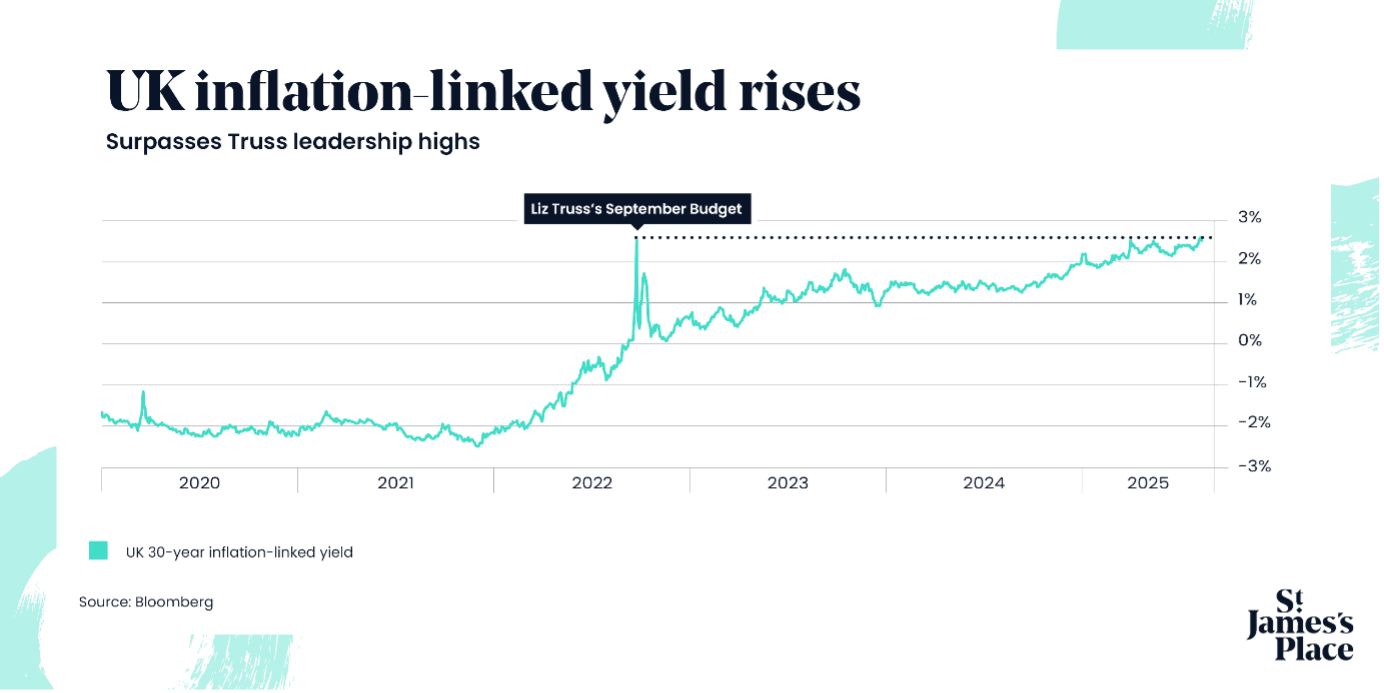
Weak growth, growing concerns surrounding inflation and interest rates as well as a general pessimistic outlook have all contributed to a rise in UK government bond yields over the last few years. In August alone, yields reached prices which were last seen under Liz Truss’ leadership – but this time with fewer headlines.
Increasingly expensive debt is quite the headache for the current government, as more money will need to be sourced to pay it down.
The information contained is correct as at the date of the article. The information contained does not constitute investment advice and is not intended to state, indicate or imply that current or past results are indicative of future results or expectations. Where the opinions of third parties are offered, these may not necessarily reflect those of St. James’s Place.
Source: London Stock Exchange Group plc and its group undertakings (collectively, the “LSE Group”). ©LSE Group 2025. FTSE Russell is a trading name of certain of the LSE Group companies.
“FTSE Russell®” is a trademark of the relevant LSE Group companies and is used by any other LSE Group company under license. All rights in the FTSE Russell indexes or data vest in the relevant LSE Group company which owns the index or the data. Neither LSE Group nor its licensors accept any liability for any errors or omissions in the indexes or data and no party may rely on any indexes or data contained in this communication. No further distribution of data from the LSE Group is permitted without the relevant LSE Group company’s express written consent. The LSE Group does not promote, sponsor or endorse the content of this communication.
© S&P Dow Jones LLC 2025; all rights reserved.
Source: MSCI. MSCI makes no express or implied warranties or representations and shall have no liability whatsoever with respect to any MSCI data contained herein. The MSCI data may not be further redistributed or used as a basis for other indices or any securities or financial products. This report is not approved, endorsed, reviewed or produced by MSCI. None of the MSCI data is intended to constitute investment advice or a recommendation to make (or refrain from making) any kind of investment decision and may not be relied on as such.
SJP Approved 26/08/2025
WeeklyWatch – How will markets react to Ukraine peace talks?

19th August 2025
Stock Take
Is peace in Ukraine on the horizon?
Yesterday, talks continued in Washington – between President Trump and President Zelenskyy this time as they looked to try and end the war in Ukraine. They came off the back of the weekend talks between President Trump and President Putin, focused on agreeing a ceasefire.
While the outcome remains uncertain, the markets have responded in a mixed fashion. After Friday’s Alaska meeting, there was a slight decrease in oil prices. It was a quiet start to the week for European equities, whereas Asian markets concluded the week higher.
Since the start of the conflict in 2022, the markets have faced significant impact. And looking ahead, the picture could alter again. So what can investors expect?
Market highs and lows
One of the most immediate effects of the invasion was the soaring cost of energy, which had a huge impact on businesses and consumers. This also caused a rise in inflation, which was already high due to countries applying fiscal stimulus measures as a response to the Covid pandemic. To begin with, markets sold off – particularly in Europe, where fears of a prolonged recession were heightened. This was reflective of the geographical proximity to Russia and the long-standing trade links existing between them. There was a fall of almost 4% for the Stoxx 600 and the tech-heavy Nasdaq fell by 3.2%. There was a sharp drop in US Treasury yields (which move in the opposite direction to prices) due to investors seeking safety in US government debt.
The Russo–Ukraine conflict is the largest seen in Europe since WWII and has also been the most costly – in terms of lives and expenditure – and has had a huge influence on the markets. The defence sector growth has increased, and there have been record profits for the big five oil companies (BP, Shell, Chevron, ExxonMobile and TotalEnergies). Campaigning and investigation organisation Global Witness published a report in February this year, which stated that the world’s largest oil companies had made profits of $380 billion since the start of the war in 2022.
Fast forward 41 months, and the world seems to have settled into a ‘new normal’ wherein global volatility has come to be widely expected.
Equities
Following the invasion, global equities were sold off, which was particularly prevalent across Europe. This was due to the fact that Europe was very dependent on cheap Russian gas to power households and businesses. For Germany, the ‘industrial powerhouse’ of Europe, there was an initial fall of 5% for the DAX 40 index. The index already faced struggles such as an ageing population and issues with infrastructure; the Ukraine conflict only piled more pressure on an economy that was stagnating.
Recovery was noticeable towards the end of 2022, and since then, global equity markets have, for the most part, been on an upwards trajectory, as noted by Will Hargreaves, Multi-Asset Analyst at St. James’s Place. He states:
“The real shock for markets came at the start of the conflict, with energy prices spiking violently in the early months of the invasion due to supply fears. However, they then trended downwards as global demand for Russian supplies was re-routed.
“Following the invasion, global equities sank to the lowest point in October 2022. However, they’ve been on an upwards trajectory since. Long-term growth is good and equities have delivered – albeit there are variations in performance.”
He adds:
“Developed markets have continued to outpace emerging markets quite substantially. In terms of geographical regions, Japanese equities outperformed all other areas in local currency terms. The US followed, while the UK just outperformed Europe over this time.”
Record highs have been reached by both the S&P 500 and the FTSE100 this year. In July, for the first time in its 41-year history, the FTSE100 passed the 9,000 mark.
Yesterday, Japanese and Taiwanese shares concluded at record highs. There’s been a boost to Japanese shares on the back of a bullish corporate outlook, a calmer assessment of the tariff backdrop and the continuing weakness of the yen. For domestic automakers, exports have been helped by this. Additionally, investors in Taiwan have been encouraged by this outlook as it relates to the tech sector and a more positive tariff assessment.
Energy
The global energy sector was impacted significantly by the invasion. There was a quick and steep spike in the price of oil, natural gas and coal – a near 300% price rise for natural gas and approximately 30% price increase in the cost of Brent crude oil which reached $139 per barrel.
As a result, market volatility became widespread with energy prices reaching their peak in August 2022; these gradually fell back as more nations looked to diversify their energy supply in order to be less reliant on Russian gas. But this wasn’t the case for many European nations and across the UK, where energy prices remain significantly higher than they were prior to the start of the conflict.
The Equity Strategist at St James’s Place, Carlota Estragues Lopez, says:
“The most important sectoral impact of the invasion was on energy prices. But, on the positive side, there have been some structural changes as a result of that invasion.
“Europe has realised the risks of being over-reliant on external energy suppliers so are looking to become more self-sufficient, investing in their own energy infrastructure.”
There’s been a refreshed focus on the significance of renewable energy, as nations also look to diversify their energy usage and move away from fossil fuel reliance. The International Energy Agency (IEA) note that this is an emerging global pattern as national awareness grows and countries look to ensure that they have secure energy supplies and systems in place. In one of their website papers, the IEA state:
“The war continues to reshape the global energy system in profound ways. Trade patterns for oil and natural gas have shifted dramatically since Russia’s invasion as governments look to strengthen their energy security. At the same time, cleaner alternatives to fossil fuels are growing faster than ever.”
Defence
This sector has had some of the most notable growth since the start of the Ukraine conflict and the changing geopolitical climate.
The UK has also made a commitment to increasing defence spending to 2.5% of GDP by 2027 and then up again to 3% of GDP by 2030.
Germany made a pledge in June this year to increase their defence budget to 3.5% of GDP by 2029. The nation plans to spend $781 billion on defence in the next five years. By providing a huge boost to its defence sector, leaders also hope that these actions will significantly spur economic growth and breathe life back into its economy.
Estragues Lopez notes:
“Industrial earnings in Europe – especially in the defence sector – have been buoyed by a surge in defence spending following the invasion. Companies such as Rheinmetall and BAE Systems are experiencing record demand. Meanwhile, NATO has committed to raising defence budgets significantly by 2035.”
Technology
Over the last 41 months, growth in developed markets has largely been driven by the AI boom. This has been most noticeable in the US where the Magnificent 7 tech companies make up around a third of the S&P 500 by market capitalisation – these include Alphabet, Amazon, Apple, Meta, Microsoft, Nvidia and Tesla.
The S&P 500 is up 10% for the year to date, and much of this growth is down to the Magnificent 7. According to Pantheon Macroeconomics, increased spending on AI and other related infrastructure is estimated to have added 0.5% to US economic growth in the first half of 2025.
With US tech companies being so dominant, it’s meant that growth stocks outperformed value stocks and large caps outperformed small caps over the period.
However, questions linger over whether the tech and AI success can continue… Valuations of US companies, particularly technology, are regarded as very high. Having said this, only if demand remains strong can this be justified – so far, this is proving to be the case.
Hargreaves emphasises the need for investors to consider the fundamentals amid the noise. He states:
“AI is not a fleeting theme, it’s here to stay. If you look at the Magnificent 7, especially a company like NVIDIA, it’s a really strong business. The fundamentals are solid even though their valuations are high.”
Gold
Regarded as a ‘safe haven’ during times of turmoil, investors once again reverted to gold as their safety measure as prices spiked at the start of the invasion. In just the first few hours of the attack, gold prices rose to their highest levels in more than a year – $1,973 per ounce. But the main cause of the gold drive was a result of the central banks rushing to buy up stocks in the short-term aftermath of the invasion – a practice that has continued to the present day.
The World Gold Council identifies that central banks have purchased more than 1,000 tonnes of gold per year in the three years that the Ukraine conflict has been going on for. Gold prices have more than doubled in price during this time and at the time of writing, gold prices stand at $3,346 per ounce.
Where do markets go from here?
At the Alaskan summit, Trump and Putin failed to make a deal. The outcome of talks between Zelenskyy and Trump is yet to be determined – although, Trump said that he had called Putin to arrange bilateral talks between the Russian leader and Zelenskyy. Russia are demanding that Ukraine concede land so that the war may come to an end, so the situation continues to look volatile.
But no matter what the outcome may be, most experts anticipate that markets will be muted in their reaction.
Estragues Lopez says:
“The invasion sparked a sharp inflationary shock, largely driven by energy prices, and equity markets plunged sharply in the weeks that followed. The S&P 500 fell approximately 20%. Since then, markets have largely stabilised and shown reduced sensitivity to the ongoing war. This parallels earlier episodes like trade-tariff shocks, where initial panic gave way to a return to ‘business as usual’.
“Markets tend to respond more to fundamentals with enduring impact rather than headline noise. Central banks still have major influence. When the Fed signals a rate cut, markets typically react. Today, investors remain especially focused on monetary policy guidance, labour market dynamics and economic indicators.”
Investors have faced much volatility in different forms this year, and will likely continue to filter out the noise and focus on the fundamentals no matter what the outcome is in regard to the Ukraine conflict.
In the Picture
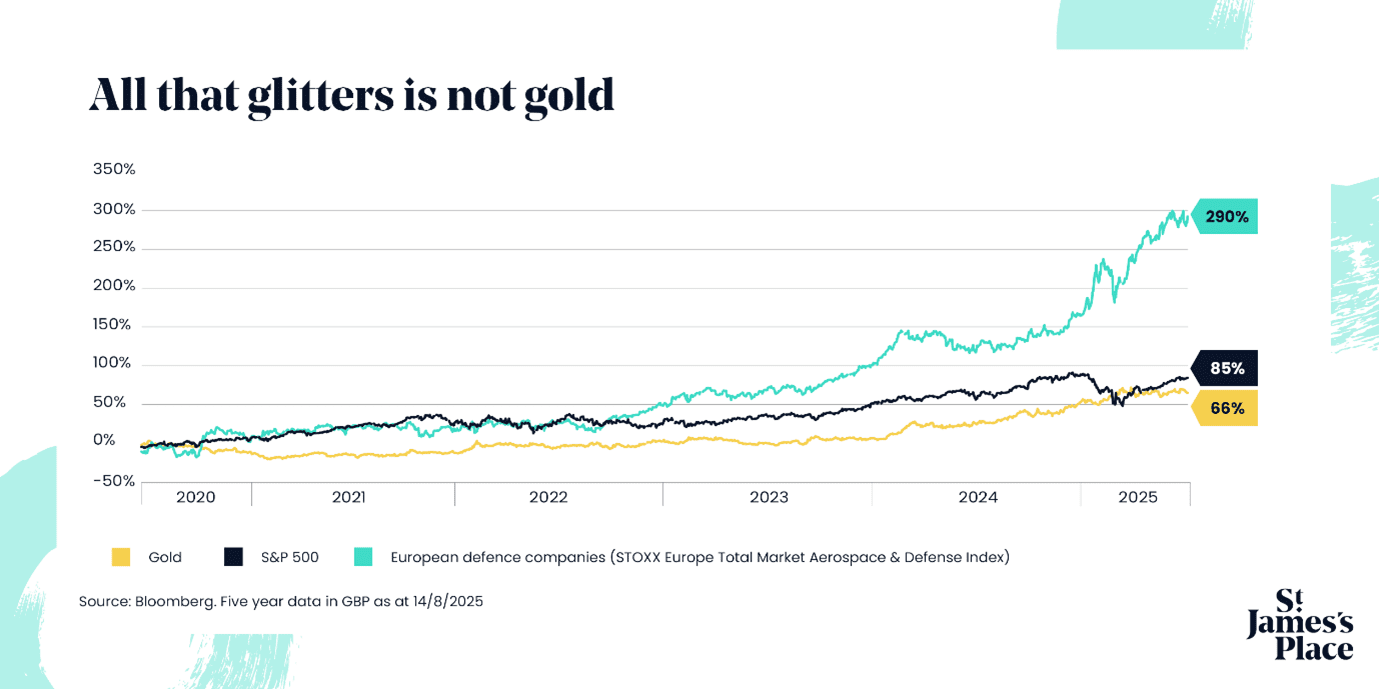
When volatility rolls around, gold remains a safe haven for investors. Currently, the precious metal is less than 5% off its all-time high. This highlights the issues of ongoing inflation, geopolitics and central bank buying. The clear winner on a relative basis is Europe’s defence sector in the aftermath of Russia’s invasion of Ukraine – its growth is noticeable on the chart below. Gold has lagged in comparison and is struggling against the US S&P 500.
The information contained is correct as at the date of the article. The information contained does not constitute investment advice and is not intended to state, indicate or imply that current or past results are indicative of future results or expectations. Where the opinions of third parties are offered, these may not necessarily reflect those of St. James’s Place.
Source: London Stock Exchange Group plc and its group undertakings (collectively, the “LSE Group”). ©LSE Group 2025. FTSE Russell is a trading name of certain of the LSE Group companies.
“FTSE Russell®” is a trademark of the relevant LSE Group companies and is used by any other LSE Group company under license. All rights in the FTSE Russell indexes or data vest in the relevant LSE Group company which owns the index or the data. Neither LSE Group nor its licensors accept any liability for any errors or omissions in the indexes or data and no party may rely on any indexes or data contained in this communication. No further distribution of data from the LSE Group is permitted without the relevant LSE Group company’s express written consent. The LSE Group does not promote, sponsor or endorse the content of this communication.
© S&P Dow Jones LLC 2025; all rights reserved.
Source: MSCI. MSCI makes no express or implied warranties or representations and shall have no liability whatsoever with respect to any MSCI data contained herein. The MSCI data may not be further redistributed or used as a basis for other indices or any securities or financial products. This report is not approved, endorsed, reviewed or produced by MSCI. None of the MSCI data is intended to constitute investment advice or a recommendation to make (or refrain from making) any kind of investment decision and may not be relied on as such.
SJP Approved 18/08/2025
WeeklyWatch – Peak season for US earnings

12th August 2025
Stock Take
US markets reach summit heights
Over the last few weeks, US second-quarter earnings have been in the spotlight, as the greatest number of companies reported in the two weeks leading up to mid-August. But with trade wars escalating, causing further volatility and uncertainty, and indications of deteriorating economic data – what are the main takeaways?
Earnings season is a key barometer of how US-listed companies – large and small – are performing, with details of their operational and financial environment, and assessment of their performance on ‘Main Street’ and in overseas markets. It’s also when companies provide guidance on prospects.
So far, approximately 80% of companies in the S&P 500 index have reported increased sales and earnings in Q2 when compared to the same period in 2024 (this is according to Factset’s financial data).
These positive earnings surprises were dominated by the strong performance of the ‘Magnificent 7’ companies, including in the communication, information technology and consumer discretionary sectors. Together, the Magnificent 7 account for over a third of the S&P 500’s total value – this is a near three-fold increase over the course of the last decade. Even though tech results were the dominant force, the financial sector has performed well and delivered strong earnings which have been boosted by the higher-for-longer interest rate environment in addition to the market volatility spurring on trading income.
A strong tech season
Sharp divergence remains in Q2 returns between the Magnificent 7 mega-cap technology companies and the remainder of the index – showcased in this week’s ‘In the Picture’. Tech-associated companies account for more than half of the US stock market’s value. The defensive sector has fallen to less than 20%.
Tech companies have outperformed due to the high demand for investing in cloud computing and AI infrastructure, as well as a resurgence in digital advertising. During the latest earnings season, these companies have been putting forward positive, upbeat outlooks. Several have opted to raise their full-year 2025 sales forecasts, which has alleviated concerns that demand for AI services is slowing down – despite the possibility that economic growth will falter. Additionally, for some, they’re projecting improvements in profit margins and indicating continuous productivity gains.
Broader market struggles to keep pace
Unlike the strong-performing tech stocks, the broader market (‘the S&P 493’) faced more of a struggle throughout Q2…
- They faced much slower consumer demand, especially for non-essential items like holidays, dining out, cars, furniture and appliances.
- With lower demand, there were higher levels of unsold goods. This could lead to discounting and more cuts in production.
- The US dollar has been weaker than other currencies since the start of 2025, leading to the increased price of raw materials.
- The volatility caused by tariffs has caused the business environment to deteriorate.
Weakened oil prices and energy sector
The weakest earnings generated during Q2 was by the energy sector. A 21% decline in oil prices in the 12 months leading up to June 2025 was the main cause of this. The materials sector, engaged in extracting and processing raw materials like iron and copper ore, was also a poor performer. As a result, more analysts are predicting that global economic growth will slow down in 2026.
Scaling the ‘wall of worry’
According to the London Stock Exchange, Q2 earnings for S&P 500 companies have grown by nearly 8% every year. Since volatility caused by the April announcement of the ‘Liberation Day’ tariffs, the index has since recovered all lost ground and is now close to its all-time high.
The Head of Discretionary Fund Management Research at St. James’s Place, Peter McLoughlin, says that investors are showing willingness to climb ‘the wall of worry’ as more positive momentum keeps building for the AI revolution and is looking to maintain a strong course. He says:
“Earnings have once again exceeded expectations – this is the third consecutive quarter of double-digit EPS growth, and current guidance suggests a high degree of resilience despite tariff concerns.”
However, he urged some caution. US government debt continues to grow at a rapid rate and currently stands at $37 trillion. McLoughlin also alludes to a deteriorating macro picture including rising unemployment and the weaker dollar value. Additionally, inflation pressures continue to mount and the trade war continues to disrupt businesses and create further margin pressures – due to the fact that not all of the extra tariff costs are currently being passed on. This was underlined further by analysts with key issues outlined by company managements being tariffs, uncertainty, inflation and recession.
Markets over the week
There was a stark recovery by the US markets from the previous week’s sell-off, as all key US indices concluded the week higher. Nasdaq led the way by closing at a record high which was boosted by Apple’s double returns. Most investors weren’t as bothered by the latest tariff announcements that took place, partly because the US administration is being more flexible on exceptions for key domestic sectors.
For Europe, major markets also ended the weak with a boost. Positive sentiment towards talks to end the war in Ukraine played a big part in this. However, despite the optimism, the FTSE 100 didn’t make much progress, even with the 0.25% interest rate cut. It’s response was likely a result of the weaker jobs market, even with the Bank of England predicting that inflation will likely rise to 4% in September: a two-year high.
Wealth Check
Investing – it’s all about doing (almost) nothing
Most investors are encouraged to go by the wise action of ‘blocking out the noise’. Situations come and go and may cause volatility as they’re seen through. Over the long-term, ignoring short-term impact and keeping your eye on your ultimate financial goals is the key to achieving what you set out to do.
However, 2025 has proven to be a challenging year (to say the least!), which has made it difficult to hold steady.
Live and unfolding
Once, international trade negotiations were found predominantly in financial outlets. Currently, it’s tariff discussions that are flooding the front pages of the newspapers and social media feeds.
As a result of the spike in inflation and rise of interest rates post-Covid, central banks have become part of the national conversation in a way that’s never been seen before. For example, when was the last time you saw a disagreement between a US president and the head of the Federal Reserve regarding interest rate changes go viral?
Another addition to the pressure is the news cycle that’s on 24 hours a day. With tech advancements, you can watch a news story break, develop and also see immediate investment reaction. Therefore, it requires a lot of effort to resist what can often feel like a bombardment of information, good or bad.
Filtering through assorted information
One of the challenging aspects to this is understanding what’s a useful insight and what’s background noise.
A key consideration for investors is to look at their investment time horizon. If it’s a long-term horizon, i.e. 10 years or more, then the majority of events won’t significantly impact your plans longer term. It’s important to remember that over the long run, companies can grow their earnings ahead of inflation, and reinvest those earnings to grow their businesses and pay dividends to their shareholders. As time goes on, the compound impact of that is what dominates returns.
The Investment Research Director at St. James’s Place, Joe Wiggins, said:
“If we look back through history, there’s been a multitude of huge events that have affected markets in the short-term. At the time, they would have seemed extremely consequential for financial markets. But as you zoom out to a longer time frame, these events usually end up looking like a blip on the horizon. So, providing you have a long-term time horizon, most things are not that consequential for meeting your objectives. The real problem is reacting to these events and making poor short-term decisions that then have a negative, long-term impact.”
The value of an investment with St. James’s Place will be directly linked to the performance of the funds selected and may fall as well as rise. You may get back less than the amount invested.
In the Picture
The chart below shows how the earnings gap between the ‘Magnificent 7’ tech companies and the broader market has grown as Q2 earnings season has unfolded.
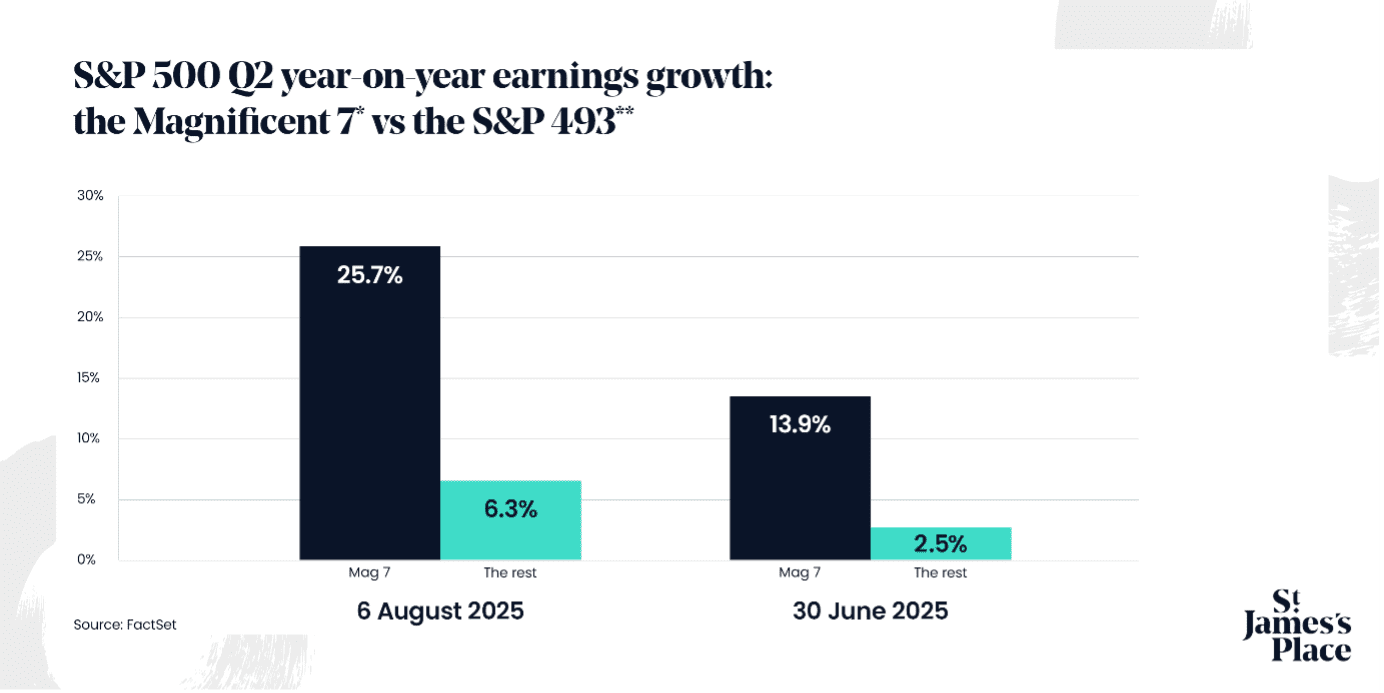
*The Magnificent Seven is the name given to a group of seven mega-cap technology companies. These are: Apple, Amazon, Alphabet, Meta Platforms, Microsoft, Nvidia and Tesla.
** The S&P 493 refers to the S&P 500 without the Magnificent 7.
Past performance is not indicative of future performance.
The information contained is correct as at the date of the article. The information contained does not constitute investment advice and is not intended to state, indicate or imply that current or past results are indicative of future results or expectations. Where the opinions of third parties are offered, these may not necessarily reflect those of St. James’s Place.
Source: London Stock Exchange Group plc and its group undertakings (collectively, the “LSE Group”). ©LSE Group 2025. FTSE Russell is a trading name of certain of the LSE Group companies.
“FTSE Russell®” is a trademark of the relevant LSE Group companies and is used by any other LSE Group company under license. All rights in the FTSE Russell indexes or data vest in the relevant LSE Group company which owns the index or the data. Neither LSE Group nor its licensors accept any liability for any errors or omissions in the indexes or data and no party may rely on any indexes or data contained in this communication. No further distribution of data from the LSE Group is permitted without the relevant LSE Group company’s express written consent. The LSE Group does not promote, sponsor or endorse the content of this communication.
© S&P Dow Jones LLC 2025; all rights reserved.
Source: MSCI. MSCI makes no express or implied warranties or representations and shall have no liability whatsoever with respect to any MSCI data contained herein. The MSCI data may not be further redistributed or used as a basis for other indices or any securities or financial products. This report is not approved, endorsed, reviewed or produced by MSCI. None of the MSCI data is intended to constitute investment advice or a recommendation to make (or refrain from making) any kind of investment decision and may not be relied on as such.
SJP Approved 11/08/2025
WeeklyWatch – Tariffs are a go!

5th August 2025
Stock Take
It’s tariff time
Markets were pushed lower last week as the 1st August tariff deadline arrived. Several nations managed to beat the deadline and secure a deal with the US. The UK signed one much earlier, with a 10% tariff being imposed on most British exports.
A deal has also been signed between the EU and the US, where they’ll face a 15% tariff; yet this has been met with controversy across the continent and still requires signing off by several EU member states. Japan and South Korea’s agreed deals also mean that they will face a 15% tariff.
But now that the deadline has passed, there are still numerous nations that are facing more punitive measures…
- Canadian goods that aren’t covered by the US-Mexico-Canada Trade Agreement will get a 35% tariff when exporting to the US.
- Swiss imports will face a 39% tariff.
- Even though Mexico received a 90-day extension on their deadline, if no deal is agreed upon, their tariffs could reach 30%.
- Brazil originally faced a 10% tariff, but last Thursday, an extra 40% was added to many industries, including beef and coffee exports.
- China’s negotiations with the US continue – their current deadline comes up later this month.
The Chief Economist at St. James’s Place, Hetal Mehta, says that from an economic perspective, the tariffs are a “lose-lose” situation. She states:
“Ultimately US consumers will face higher prices because of them. On the exporter side, what they sell will be more expensive and therefore less competitive.”
While markets processed the situation, there was a drop in global share prices – not quite as severe as April levels, but significant all the same. The S&P 500 concluded the week at a drop of 2.36%.
Cranking up the inflationary pressure
Even before Trump was sworn in as President, many economists expressed concern towards the implementation of tariffs and the increased inflationary pressure it would put on the US and the knock-on effect that this would have on consumers.
They were shielded from much of the initial impact as a result of companies stockpiling goods before the tariffs came into effect. But these stockpiles could only last for a limited time, and in more recent months, inflationary pressures have started to weigh on the data.
The US Commerce Department’s Bureau of Economic Analysis have said that the personal consumption expenditures (PCE) price index was 2.6% for June – this is the highest number since February. Additionally, it marked a third consecutive month where the number had increased.
The PCE price index is used by the Federal Reserve (the Fed) to help inform decision-making regarding interest rates. And with continued increases in inflation, it was hardly surprising when no changes were made last Thursday.
However, there were some noteworthy moments that came from the meeting. One of these was the two dissents to the vote – they voted in favour of a 0.25% cut. This is a first since 1993 and served as an example of how challenging a position the Fed is in right now.
Comments made by Fed chair Jerome Powell following the release caught the attention of the markets. He stated:
“We have made no decisions about September. We don’t…do that in advance.”
While the Fed remains uncertain about their future stance, markets have begun to price out and plan for an interest rate drop in September when the next decision will take place.
An economic slowdown for the US?
News of the Fed’s decision not to change interest rates stayed in the spotlight for approximately a day before other economic news entered the picture.
On Friday, the most recently released payroll data suggested that the US job market was starting to soften. Only 73,000 nonfarm jobs were recorded and added to July by the Bureau of Labor Statistics. The figures for the number of jobs added in May and June are also significantly reduced, dropping in May from 125,000 to 19,000 and in June from 147,000 to 14,000.
Uneven GDP growth across the year has also contributed to the Fed’s complications in its decision-making.
On an initial look, the figures that were released in the previous week appear positive: a growth of 3% was registered over the second quarter (annualised). But, on closer inspection, there’s a different tale to tell. The growth followed a 0.5% decrease in Q1. Moreover, over the first half of 2025, US economic activity expanded only by 1.2% annualised – the first half of 2024’s increase was 2.3%.
Much of the growth in the last quarter was as a result of a drop in imports into the US. GDP growth is calculated by removing imports from the total to avoid double counting. And in Q1, the large increase of imports as a result of stockpiling consequently brought down the overall rate of GDP growth. When Q2 came round, companies were sitting on a surplus of goods – with tariffs starting to nip at the heels – and import levels decreased significantly, which boosted GDP growth into positive territory.
In her comments regarding the figures, Mehta says:
“If you strip out the trade side of it, what you see is that consumer spending has taken a step down from where it was. This also ties in with the cooling jobs market as well and interest rates staying elevated.”
Considering both the job data and the consumer spending, it suggests that the US economy is slowing down.
Wealth Check
How comfortably do you want to live in retirement?
Whether you’re planning to retire in 5 years or 20, it’s essential to have an idea of how much money you’ll require to live comfortably once your regular earning comes to an end.
The Pensions and Lifetime Savings Association (PLSA) have crunched the numbers and released new figures on how much money individuals and couples require in order to live a comfortable, moderate or minimum standard of living during their retirement.
The most important thing to bear in mind is that figures have increased over the last 12 months and will continue to do so as the cost of living continues to go up. The latest numbers were released in February this year.
- Minimum – A single person requires £13,400 a year in order to achieve the minimum living standard, which will cover most people’s basic needs. You could take a holiday in the UK, eat out around once a month and spend £450 on clothes and footwear per year. However, you can’t expect to run a car. Even with the 2025/2026 full State Pension – £11,973 per year – there’s still a shortfall.
- Moderate – This lifestyle requires £31,700 and is a more financially secure and enjoyable option. With this lifestyle, you could afford a two-week European holiday, eat out a couple of times a month and own and run a small car.
- Comfortable – £43,900 is required for this level of retirement lifestyle. You can enjoy further luxuries and higher ticket items, including regular beauty treatments, theatre trips and at least two weeks of holiday in Europe plus a couple of weekend mini breaks each year.
For couples, the price tag of these three lifestyles is £21,600, £43,900 and £60,000 per annum.1
Pension realities
There will be many who’ll be shocked to find out that their savings will provide little income and will worry that they left it too late to start saving.
If you qualify for the full annual State Pension, the PLSA says you’ll need to amass a pension pot of between £540,000 and £800,000 (for a single person) in order to achieve a comfortable retirement.2 If you want to turn your pension into an annuity, this will pay you a guaranteed annual income for life during your retirement.
By combining the full State Pension and a workplace pension, many will be able to look forward to the PLSA’s minimum level of retirement. But even with a modest contribution, it’s unlikely to cross over the line of minimum and moderate levels of living in retirement. Beginning to plan proactively at an early stage to set yourself up for your later years can literally pay dividends.
The value of an investment with St. James’s Place will be directly linked to the performance of the funds selected and may fall as well as rise. You may get back less than the amount invested.
Source:
1, 2 Retirement Living Standards, Pensions and Lifetime Savings Association, 2025. All figures quoted were developed by the Centre for Research in Social Policy at Loughborough University on behalf of the PLSA.
In the Picture
The tariffs may be lower than previously threatened in the earlier part of 2025, but following the August announcements, they’re still significantly above levels seen over the last few decades.
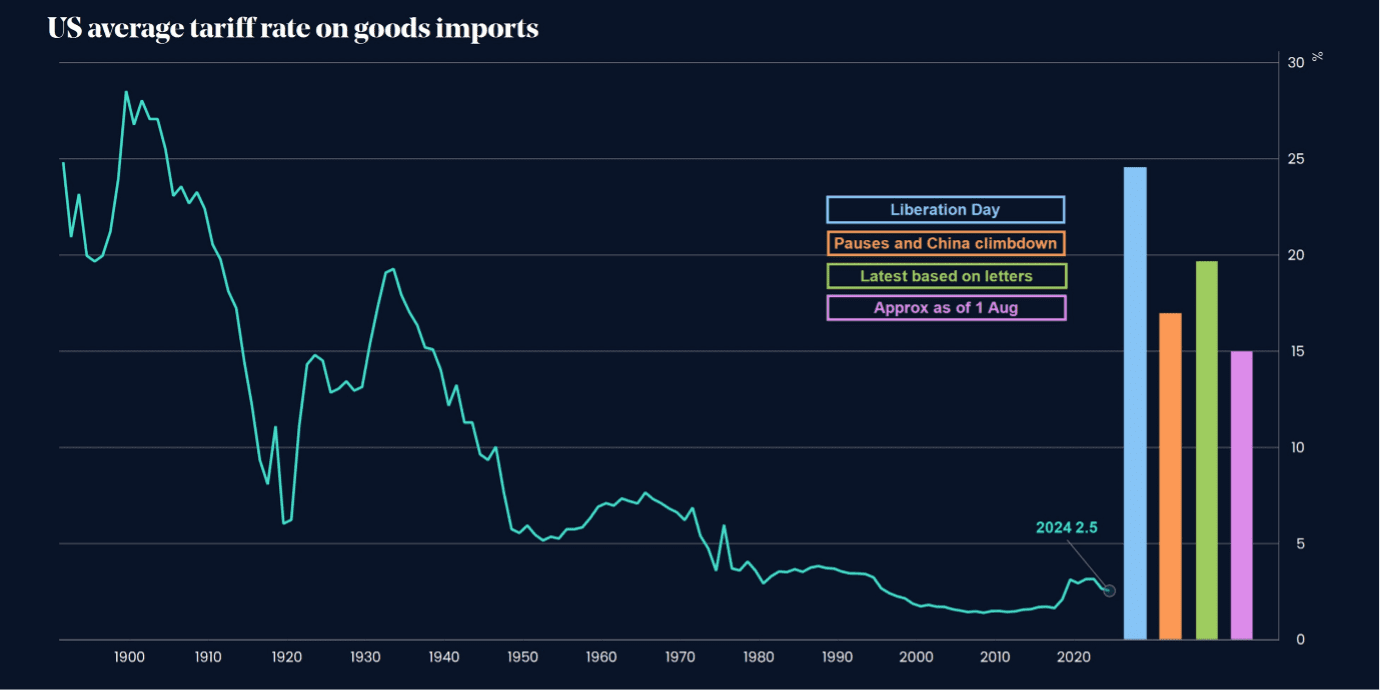
The information contained is correct as at the date of the article. The information contained does not constitute investment advice and is not intended to state, indicate or imply that current or past results are indicative of future results or expectations. Where the opinions of third parties are offered, these may not necessarily reflect those of St. James’s Place.
Source: London Stock Exchange Group plc and its group undertakings (collectively, the “LSE Group”). ©LSE Group 2025. FTSE Russell is a trading name of certain of the LSE Group companies.
“FTSE Russell®” is a trademark of the relevant LSE Group companies and is used by any other LSE Group company under license. All rights in the FTSE Russell indexes or data vest in the relevant LSE Group company which owns the index or the data. Neither LSE Group nor its licensors accept any liability for any errors or omissions in the indexes or data and no party may rely on any indexes or data contained in this communication. No further distribution of data from the LSE Group is permitted without the relevant LSE Group company’s express written consent. The LSE Group does not promote, sponsor or endorse the content of this communication.
© S&P Dow Jones LLC 2025; all rights reserved.
Source: MSCI. MSCI makes no express or implied warranties or representations and shall have no liability whatsoever with respect to any MSCI data contained herein. The MSCI data may not be further redistributed or used as a basis for other indices or any securities or financial products. This report is not approved, endorsed, reviewed or produced by MSCI. None of the MSCI data is intended to constitute investment advice or a recommendation to make (or refrain from making) any kind of investment decision and may not be relied on as such.
SJP Approved 04/08/2025
Business Matters – Issue 43
We hope you like the new look and format of Business Matters – please spare 1 minute to let us know what you think. Take survey >
The smart way to step away: 7 things every SME owner needs to do before exiting a business

If you’re a business owner thinking of hanging up your boots, you might be considering selling up and realising the value you’ve worked so hard to build. Perhaps you’re dreaming of sunkissed beaches or even an exciting new venture.
Whatever life after an exit holds for you, your strategy is one of the most important parts of leaving your business. But navigating the sale process can be fraught with challenges, and preparation is essential.
In our latest issue of Business Matters, Wellesley advisers Ian Howard and Samantha Kaye join forces with guest contributor Nusrat Qureishi, Head of Corporate & Commercial Law at stevensdrake solicitors, to discuss how you can ensure a smooth transition.
Exit Strategies may include the referral to a service that is separate and distinct to those offered by St. James’s Place.

Exiting on your terms
First things first! A business sale is just one way out. Understanding the variety of exit strategies available to you is essential for a smooth transition.
- Trade sale – Sell your shares or assets to another owner/company in your industry.
- Partial exit – Don’t want to give it all away just yet? Step back a bit, but still stay involved.
- Management buy-out – Let your current managers buy and run the business.
- Employee ownership trust – Sell to your team through a tax-friendly set-up.
- Don’t sell at all – Appoint a Managing Director or CEO to run the day-to-day, while you retain ownership and enjoy the dividends.
- Liquidation – If a sale doesn’t work out, a Members’ Voluntary Liquidation (MVL) might be your route.

Preparation is key
Whichever exit route you go down, preparing a company for the transition is crucial to maximising value and minimising risks that could jeopardise a successful exit.
While getting the sale over the line might seem like the most pressing concern, it’s essential to plan ahead. It can take years to prepare a business for sale but those owners that prepare well will not only optimise value but also achieve better deal structures. We recommend starting at least five years before your ideal exit date.
To help you create a timeline, we’ve put together seven ways to prepare.

- Lock in your personal and business goals
There are three basic considerations to ensure your financial future when planning an exit:
- Personal finance plans – Consider the ‘pot of money’ needed to strengthen your financial future and fund retirement.
- A business plan – Spell out how the value of the business will be built.
- How that value will be turned into cash – i.e. how and to whom the business will be sold.
Clarifying your objectives helps you define what you want from the sale (e.g. financial gain, company legacy), enabling you to structure the deal to align with those goals.
Ian says:
“By determining how much money you need for your retirement lifestyle, this will help set a target ‘exit value’ for your business – taking into account the current tax regime and prevailing financial conditions as a base case scenario. Then you can build a timeline with those key milestones of what needs to happen when, and go from there.”
Nusrat agrees:
“Having a clear idea about what your non-negotiables are means that you can quickly filter out buyers/timescales not aligned with what you’re looking for.”

- Streamline the due diligence process
Sales often stall due to missing information or unaddressed concerns. Organising your documents, contracts and financial records in advance helps prevent any delays.
Getting everything in order early doesn’t just build buyer trust, but can save you money in professional fees too. Indeed, bad housekeeping is one of the most common legal pitfalls seen during the due diligence stage, says Nusrat.
She continues:
“As solicitors ‘coming in cold’ to a deal, probably 99 times out of 100 we find an issue regarding the documents pertaining to the company. And it’s an immediate flag for us – immediate extra cost and time. Not to mention that it can scare off potential buyers.
“Statutory registers are a prime example. They’re a requirement under the Companies Act, but I often find that smaller companies don’t have them – or they’re collecting dust somewhere! The owners are so busy running the company, and don’t have the admin resources that huge corporates do. But whether it’s a sale for £50,000 or £5 million, you still have to broadly follow the same processes. The same rules are applicable.”
Nusrat also highlights missing shareholder minutes, supplier contracts, supporting documents for employees, share transfer evidence, intellectual property details or even mismatched details with Companies House as common issues.

- Attract qualified buyers
When a business has well-documented financial and operational records, it demonstrates discipline and transparency. Buyers crave this certainty, and a prepared business makes it easier to attract high-quality parties willing to pay a premium for a business primed for success.
Nusrat continues:
“Having well-prepared accounts and robust legal documentation is so much more attractive and lower risk for a potential buyer. It shows everybody in the company knows what’s going on. There are integrated systems and documented contracts – not just where something’s been done on a handshake!”
There are other things your business should be able to demonstrate if you want to achieve a good sale price. Things like having a good spread of loyal customers or long-term client relationships, a strong financial profile, evidence of good growth and future potential are factors that are likely to appeal to a potential buyer.

- Optimise tax strategies
Structuring an exit strategically can minimise tax consequences, benefiting you financially. Making full use of reliefs such as Business Asset Disposal Relief (BADR) and Business Relief can reduce the tax owed on sale. But planning shouldn’t end there, consider the income you’ll need post sale to maintain your lifestyle, and factor in current and future taxes like Income Tax, Capital Gains Tax, and Inheritance Tax. With recent Budget changes including rises in minimum wage, National Insurance, and Capital Gains Tax, many owners are reassessing their plans.
Samantha explains:
“Now more than ever, business owners need to take a proactive approach to their exit strategy. Making use of the available tax reliefs and thinking ahead to how your post-sale income will support your lifestyle, while factoring in both current and future tax liabilities, is essential. With the right advice, you can exit your business in a way that protects and enhances your financial well-being.”
Against a complicated backdrop, engaging with a financial adviser is a vital step. Understanding the full tax implications of your business exit can help you secure the best possible outcome for your future – and your family’s.
The levels and bases of taxation, and reliefs from taxation, can change at any time. The value of any tax relief depends on individual circumstances.

- Maximise business valuation
Potential buyers closely examine financials. Addressing any inefficiencies and resolving outstanding debts and clarifying asset ownership makes the business more attractive, as buyers want to invest in a company without unexpected financial burdens.
Another legal strategy business owners can implement early to maximise business value ahead of an exit is securing intellectual property, like patents, trademarks, copyrights or proprietary tech. These unique assets are tough to replicate and give buyers confidence in long-term market advantage and strong return potential.

- Ensure continuity for your team and operations
Creating guides on operations, processes, customer relationships and employee roles makes the transition smoother for the new owners and reduces disruptions. What’s more, if you own an SME and are looking to sell with a clean break, think about how closely your name, reputation and role are woven into your business.
Nusrat gives an example:
“You could be so heavily involved and don’t like to delegate. It’s a risk for buyers, as they can’t always see the processes or structures that they could seamlessly inherit because it’s so tightly wound with you and your personal branding.”
What’s more, a solid succession plan ensures that essential staff are motivated to stay through the sale, preserving the company’s value and knowledge base.
If a sale isn’t viable, you might need to look at liquidation. Scaling back or closing a business is challenging, but careful planning and consideration of the legal requirements can protect you and your employees. Ensure you understand employees’ rights in insolvency, such as around redundancy, and the Protection of Employment (TUPE) rules if selling a going concern.
Ian adds:
“Closing a business is never an easy decision, but it doesn’t have to mean chaos or uncertainty. With the right planning, you can meet your legal obligations and support your employees. Understanding your responsibilities ensures that you exit with clarity and integrity, even in difficult circumstances.”

- Take a cross-disciplinary approach
Preparing a company for sale is an investment in its future value. Using trusted advisors – financial, legal and accountancy – can not only help ensure the deal concludes successfully but it also enables you to command a higher price. It will also secure a smooth transition for you and your employees, while protecting both your interests and the business itself.
Nusrat concludes:
“Engaging a cross-disciplinary team is absolutely essential! People are often nervous about spending money because they can’t see a material value, but it’s an investment that can cut down the costs down the road. By engaging with a solicitor early, it helps address compliance issues, reducing legal risks in the transaction. Your advisers will look at the detail to the nth degree. Nothing will be left unturned.”
Samantha summarises:
“I always say that adding a good financial adviser, solicitor and accountant to your power team can bring a level of tailored specialist support you simply can’t get from anyone else in your support network. This really comes into its own during business exit planning. It’s a collaborative, long-term relationship – as financial advisers, we’re there to support you in making your own choices.”

What’s your exit strategy?
Selling your business is one of the biggest decisions you’ll ever have to make, and it’s important to plan your exit strategy carefully to gain control of your financial future. With experts at your side, you can benefit from personalised advice and support that can help you prepare for a successful exit.
Whatever life after an exit holds for you, you can look forward to the future, with Wellesley.
If anything here has struck a chord, get in touch with us today!
Contributors

Nusrat Qureishi, Associate Director, Head of Corporate and Commercial Law Department at stevensdrake solicitors
Nusrat heads up the Corporate and Commercial team at stevensdrake. She has more than 20 years’ experience, with particular expertise in the sale and purchase of businesses and companies, as well as the establishment of partnerships and other joint ventures.

Ian Howard, Chartered Financial Planner at Wellesley
Ian has been with Wellesley since 2006 and in the industry since 1990. People often ask Ian what he does; he says, simply: “I help people.” With such a myriad of choices out there, Ian always asks clients what it is they do or don’t want to do, and takes it from there.

Samantha Kaye, Chartered Financial Planner at Wellesley
Samantha joined Wellesley in 2019 having spent 20 years working in a pensions, legal and technical environment, providing detailed assistance to a variety of financial advice firms. Her passion lies in providing people with bespoke advice tailored to their individual requirements.
WeeklyWatch – Trade deals reached – more nations sign up!

29th July 2025
Stock Take
Indices vs tariffs
A new week – and more new record highs have been reached around the globe for multiple indices, as national leaders have worked hard to shelter themselves from the looming threat of the US tariffs.
Japan beats the deadline
The deadline continues to count down to 1st August when the tariffs are due to be introduced, and negotiations surrounding them have been making the headlines once again. Japan signed a trade deal on Wednesday, which includes a 15% tariff on imports from Japan – a significant improvement from the original 25% tariff that imports from Asian nations were facing. As well as a reduction in the tariff, the deal also included a $550 billion investment package from Japan into the US.
This helped boost the Nikkei, with many Japanese shares seeing a rise following the announcement. Car manufacturers Toyota and Honda were some of the biggest beneficiaries of the news, as their shares rose by around 10%.
The index was up by 4.1% by the end of the week, but it was too little too late when it came to Japan’s 20th July Upper House election. The event resulted in Prime Minister Shigeru Ishiba and his ruling coalition losing control of the Upper House and populist opposition parties making important gains. Despite the setback, Ishiba has remained resolute that he’ll remain in power as he looks ahead to overseeing the agreed Japan–US trade deal play out.
The EU also strikes a deal
As the weekend unfolded, the EU also reached a trade agreement with the US, securing a 15% tariff – half the threatened 30% if a deal wasn’t reached. Additionally, the deal will reportedly involve Europe spending hundreds of billions on US energy and arms, plus an investment of $600 billion into the US.
Even though European stocks closed before the trade deal was announced, they still managed to finish the week with a slight increase, although some automakers slumped.
Global sign-ups
Indonesia and the Philippines have also secured trade deals with the US – and at a lower rate after the deal comes into force. Overall, international markets were encouraged by the progress being made on a wider scale.
Small caps on the rise
Following the recovery from Liberation Day, news has been centred mostly on large companies, many of which are now trading at historic highs. This was illustrated by Nvidia’s recent success as it became the first company in history to achieve a market cap of $4 trillion.
However, some of the biggest winners of the year to date have been small cap companies (smaller companies) outside of the US. As a group, these companies have managed to outperform even the US large caps in the year to date.
The Equity Strategist at St. James’s Place, Carlota Estragues Lopez, said:
“International small caps have benefited from positive macroeconomic sentiment from interest rate cuts in several developed market economies, the prospect of fiscal stimulus in Germany and business reforms in Japan. Smaller companies tend to be more sensitive to interest rates and domestic economic conditions.”
An exception to this is within the US itself, where smaller companies experienced overflows when the initial tariff announcements were made and the fear of recession scared the markets. Moreover, the Federal Reserve’s hesitancy to cut interest rates in comparison to Europe has also had an impact.
With the US small caps not in favour at the moment and the large caps mostly recovered, there’s an extremely wide valuation gap between the two groups in comparison to past results. However, this could present an intriguing investment opportunity…
How is the UK faring?
It’s still good news for the FTSE 100! The index remained above the 9,000 mark as companies continued to benefit from their strong results.
The Office for National Statistics revealed on Friday that the June heatwave boosted UK retail figures by 0.9% in June – encouraging news following the 2.8% drop in May. And with a tax rise announcement in the Autumn Budget looking increasingly likely, Chancellor Rachel Reeves will breathe a small sigh of relief to see more promising activity in the UK consumer base. But it’s worth remembering that June’s 2025 figures are still down compared to pre-pandemic levels.
Are the good times here to stay?
Uncertainty still remains around Trump’s international trade policies but despite this, equities have made great progress and broken into record territory in recent weeks.
Nations that have signed deals with the US are still facing pretty hefty tariffs, giving rise to the question: why did markets drop significantly after the Liberation Day announcement, but are now seemingly able to take tariffs somewhat in their stride?
Estragues Lopez suggests:
“The back and forth has impacted policy credibility as anticipated tariffs were scaled back. The initial panic has been replaced by renewed investor optimism on hopes of trade deals being made. In addition, earnings have remained robust and even beating expectations in some sectors such as Communication Services, Technology and Financials.”
Wealth Check
Beating the 60% tax trap
The average UK salary currently stands at £37,500.1 So earning £100,000 should feel more comfortable, but it’s often not the case. Even though wages have been rising gradually, personal tax thresholds have been frozen since April 2021. Consequently, more people are reaching the higher tax band and falling into the 60% tax trap.
But wait, you might be thinking, a 60% tax band doesn’t exist. While it isn’t an official band, if your income lies between £100,000 and £125,140, the complexities of the UK tax system come into play…
What is the 60% tax trap?
Income tax is charged at 0%, 20%, 40% or 45%, depending on your income amount. Scotland rates differ slightly.
You’re entitled to a £12,750 personal allowance as a basic rate taxpayer – this is the amount of income you can receive each year without paying Income Tax. When your income is £100,000 or more, the personal allowance is reduced or tapers off.
The allowance tapers down at a rate of £1 for every £2 of income above £100,000 currently. For example, for every £100 of income between £100,000 and £125,140, the Income Tax deduction is £40 and another £20 is lost by the tapering of the personal allowance. Additionally, employee National Insurance (NI) is paid at 2% on the income – in total, this comes to a 60% tax rate, plus NI – a real double jeopardy…
When your income stands at £125,140 or more, you become an additional rate taxpayer and the allowance is lost – 45% tax is paid as a result.
Beat the tax, use your pension
Bringing your taxable income below the threshold can be achieved through putting more money into your pension before the tax year-end. Simple, quick and a win-win – you’ll reduce your tax bill and also increase your retirement fund.
For example, if you receive a £1,000 pay rise or bonus that takes your taxable income to £101,000, if you put that £1,000 straight into your pension, you’ll avoid the 60% tax zone, plus you’ll receive the benefit of a 40% top-up on your contribution as a result of pension tax relief for higher rate taxpayers.
The annual pension allowance does put a limit on these tax benefits. £60,000 is the current standard annual allowance but can be lower for higher earners. However, it’s possible to ‘carry forward’ any unused allowance from the three previous tax years. Tax relief on personal contributions is limited to a maximum of 100% of earnings in the tax year that you make the contributions.
If you find yourself just over one of the tax bands, contributing more to your pension can reduce your tax in several ways. As whatever you add to your pension reduces your taxable income and receives tax relief, we highly recommend putting in as much money as you can afford.
Are you facing a 60% tax bill, or want to find out more? Get in touch with our financial advisors today.
The value of an investment with St. James’s Place will be directly linked to the performance of the funds selected and may fall as well as rise. You may get back less than the amount invested.
The levels and bases of taxation, and reliefs from taxation, can change at any time and are generally dependent on individual circumstances.
Any tax relief over the basic rate is claimed via your annual tax return.
Source
1Statistica, average annual earnings for full time employees 2024.
In the Picture
Breaking 9,000 – the latest big accomplishment of the FTSE 100. The dot.com bubble, 2008 financial crisis and 2020 pandemic – shares have certainly taken a battering over the years. But the time gap between 8,000 and 9,000 was under 30 months… So, what’s next in store for the FTSE 100?
Past performance is not indicative of future performance.
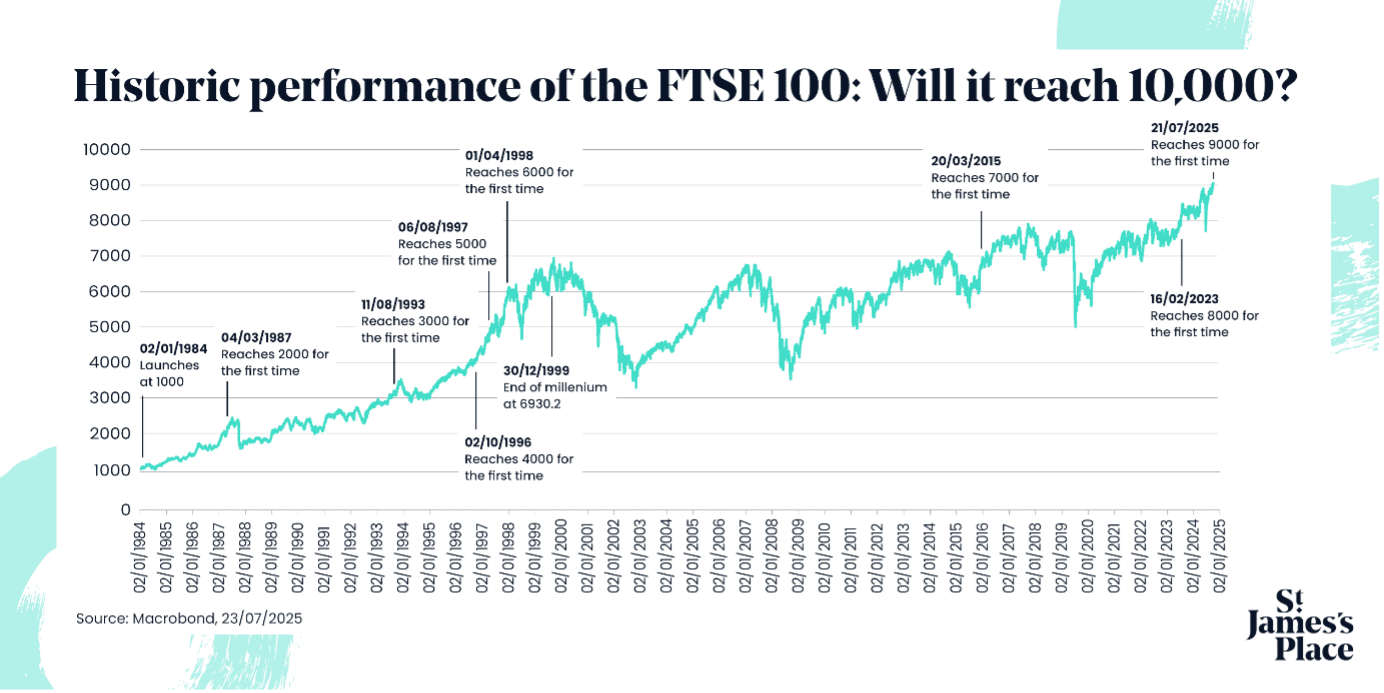
The information contained is correct as at the date of the article. The information contained does not constitute investment advice and is not intended to state, indicate or imply that current or past results are indicative of future results or expectations. Where the opinions of third parties are offered, these may not necessarily reflect those of St. James’s Place.
Source: London Stock Exchange Group plc and its group undertakings (collectively, the “LSE Group”). ©LSE Group 2025. FTSE Russell is a trading name of certain of the LSE Group companies.
“FTSE Russell®” is a trademark of the relevant LSE Group companies and is used by any other LSE Group company under license. All rights in the FTSE Russell indexes or data vest in the relevant LSE Group company which owns the index or the data. Neither LSE Group nor its licensors accept any liability for any errors or omissions in the indexes or data and no party may rely on any indexes or data contained in this communication. No further distribution of data from the LSE Group is permitted without the relevant LSE Group company’s express written consent. The LSE Group does not promote, sponsor or endorse the content of this communication.
© S&P Dow Jones LLC 2025; all rights reserved.
Source: MSCI. MSCI makes no express or implied warranties or representations and shall have no liability whatsoever with respect to any MSCI data contained herein. The MSCI data may not be further redistributed or used as a basis for other indices or any securities or financial products. This report is not approved, endorsed, reviewed or produced by MSCI. None of the MSCI data is intended to constitute investment advice or a recommendation to make (or refrain from making) any kind of investment decision and may not be relied on as such.
SJP Approved 28/07/2025